
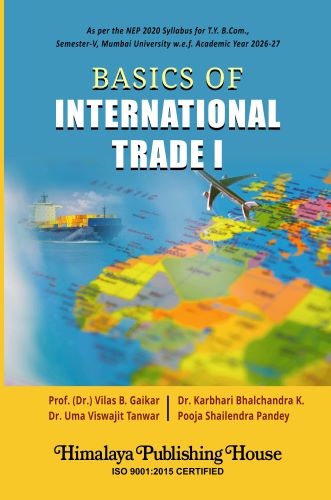





It gives us immense pleasure to present the book “Basics of International Trade I”, specially designed for the students of Third Year Bachelor of Commerce (T.Y.B.Com.), Semester-V, in accordance with the National Education Policy (NEP 2020) and the revised syllabus of the University of Mumbai for the academic year 2026–27.
The rapid expansion of globalisation, technological innovation, digital commerce, and regional economic integration has transformed the nature of international trade. Nations today are increasingly interconnected through trade, investment, finance, and global value chains. An understanding of international trade has therefore become indispensable for commerce students, policymakers, entrepreneurs, and future business professionals. This textbook aims to provide students with a comprehensive understanding of the fundamental concepts, institutions, and trade agreements that shape the contemporary global trading system.
The book has been prepared with a learner-centric approach, presenting concepts in a simple, systematic, and analytical manner. Care has been taken to explain theoretical concepts with suitable examples, illustrations, and current perspectives, enabling students to relate classroom learning with real-world international trade practices.
The book is divided into two well-structured modules.
Module I: Basics of International Trade introduces the concept, importance, scope, and various types of international trade, including export trade, import trade, re-export trade, bilateral trade, multilateral trade, and free trade. It further discusses the gains from international trade, the factors determining such gains, and the concept and various types of terms of trade. These topics provide a strong conceptual foundation for understanding international economic relations and global commerce.
Module II: International Financial Institutions and Trade Agreements focuses on the structure and significance of international financial institutions, particularly the International Monetary Fund (IMF) and the International Bank for Reconstruction and Development (IBRD). The module also explains important regional trade agreements, including the European Union (EU) and the Association of Southeast Asian Nations (ASEAN), highlighting their objectives, benefits, challenges, and contributions to regional economic cooperation and stability. Further, the book introduces students to India’s major trade agreements, namely the India–ASEAN Free Trade Agreement and the India–Japan Comprehensive Economic Partnership Agreement (CEPA), along with a brief overview of India’s trade policy in the context of emerging global economic developments.
Throughout the book, sincere efforts have been made to ensure that the content is academically rigorous while remaining easily understandable for undergraduate students. The language is simple and lucid, and the presentation is aligned with the learning outcomes envisioned under NEP–2020. The book is expected to serve not only as a prescribed textbook but also as a useful reference for competitive examinations and for students aspiring to build careers in international business, trade, finance, logistics, customs administration, and allied disciplines.
Contents –
Module 1: Basics of International Trade
1.1 Introduction
1.2 Meaning of International Trade
1.3 Gains from International Trade
1.4 Concept of Terms of Trade
1.5 Summary
1.6 Practice Questions
Module 2: International Financial Institutions & Trade Agreements
2.1 Introduction
2.2 Meaning & Features of International Financial Institutions (IFIs)
2.3 Regional Trade Agreements
2.4 India’s Major Trade Agreements
2.5 Summary
2.6 Practice Questions
References