



Employee welfare and social security have assumed great significance in the contemporary business and industrial environment. With rapid industrialisation, technological advancement, and changing nature of work, organisations today are expected not only to ensure productivity and profitability but also to safeguard the physical, mental, and social well-being of employees. In this context, the study of Employee Welfare & Social Security becomes essential for commerce and management students, as it provides a comprehensive understanding of labour welfare measures, statutory protections, and human-oriented management practices in India.
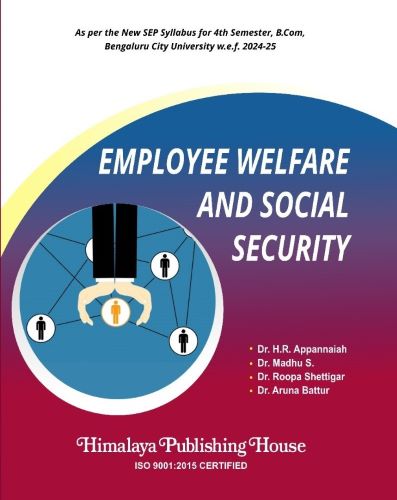
This book, Employee Welfare & Social Security, has been prepared strictly in accordance with the new SEP syllabus prescribed for B.Com, 4th Semester, Bengaluru City University. The primary objective of this book is to present fundamental concepts, legislative provisions, and practical aspects of employee welfare in a simple, systematic, and student-friendly manner. Special care has been taken to use clear language, logical sequencing of topics, and exam-oriented explanations to help students understand and apply the concepts effectively.
Unit 1 introduces the concept of employee welfare and social security, tracing its origin and growth in India. It explains the meaning, importance, merits, and demerits of welfare measures, along with statutory and non-statutory welfare activities. The unit also highlights the development of employee welfare post-independence and discusses welfare measures adopted during the Covid-19 pandemic.
Unit 2 focuses on employee welfare policy in India, covering employer-initiated welfare activities and important labour welfare legislations such as the Minimum Wages Act, ESI Act, Provident Fund Act, Maternity Benefit Act, Payment of Gratuity Act, Unorganised Workers’ Social Security Act, and the Code on Social Security, 2020. Recent amendments to labour laws are also discussed to provide contemporary relevance.
Unit 3 deals with safety and health in organisations, with special emphasis on the Factories Act, 1948, industrial accidents, occupational health hazards, job stress, alcoholism, and drug abuse among workers. Legal provisions relating to safety and health are explained to create awareness about employer and employee responsibilities.
Unit 4 discusses employee counselling as an important welfare measure. It covers the meaning, need, types, conditions, techniques, skills, problems in counselling, role of HR managers, and Employee Assistance Programmes (EAPs), highlighting their importance in promoting mental health and emotional well-being at the workplace.
Unit 5 focuses on Quality of Work Life (QWL), explaining its meaning, evolution, components, issues, relationship with productivity, barriers, and strategies for improvement.
This book is designed to serve as a comprehensive textbook for undergraduate students and also as a useful reference for teachers, practitioners, and aspiring HR professionals.
Contents –
UNIT – 1 CONCEPT OF EMPLOYEE WELFARE & SOCIAL SECURITY
Introduction, Meaning of Employee Welfare and Social Security, Origin of Employee Welfare & Social Security, Merits and Demerits of Employee Welfare and Social Security in the Indian Context. Types of Welfare Activities-Statutory Employee Welfare and Non-Statutory Employee Welfare in India. Growth of Employee Welfare and Social Security in India post-independence. Employee Welfare and Social Security during Covid-19 Pandemic.
UNIT – 2 EMPLOYEE WELFARE POLICY IN INDIA
Employee Welfare Activities Undertaken by the Employer, Legislative Provisions regarding Labour welfare in India – Minimum Wages Act 1948, ESI Act 1948, Employees’ Compensation Act 1923, Provident Fund Act 1952, Maternity Benefit Act 1961, Payment of Gratuity Act 1972, The unorganized Workers’ Social Security Act 2008, Code of Social Security 2020.(Objectives and Features only); Recent amendments to Labour Laws.
UNIT – 3 SAFETY AND HEALTH IN ORGANIZATIONS
Factories Act 1948 – Industrial Health and Safety in the Indian context; Industrial Accidents-causes and prevention; Meaning of safety, Need for safety and measures to ensure safety in Industries, Legal Provisions for safety and health in India.
Employee Health – Employee Health and Occupational Hazards; Job stress – Causes and measures to tackle stress; Alcoholism and Drug abuse among workers – causes and remedies; Legal Provisions for health in India.
UNIT – 4 EMPLOYEE COUNSELLING
Meaning, Need for counselling in Industries. Types of counselling, Conditions for counselling, Techniques and skills for effective counselling, Problems in counselling, Role of H.R. Managers in Counselling; Employee Assistance Programs (EAPs)
UNIT – 5 QUALITY OF WORK LIFE
Quality of Work life (QWL): Meaning, Emergence and Growth of QWL, Components of QWL, Specific issues in QWL, QWL and Productivity, Barriers in QWL, Strategies for improvement of QWL.