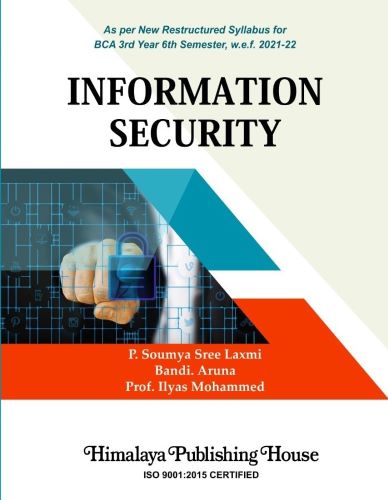

Information has become one of the most valuable assets in today’s digital world. As organizations increasingly rely on technology to store, process, and communicate data, the need to protect this information has become more critical than ever. Information Security, often referred to as InfoSec, focuses on safeguarding information from unauthorized access, misuse, disclosure, disruption, modification, or destruction.
The syllabus begins with the foundational concepts of the discipline—its history, the critical characteristics of information, and the NSTISSC security model. These elements help students appreciate the evolution of security as a discipline and understand how information functions as an organizational asset. Students are gradually introduced to the components of an information system, the need for securing each component, and the role of structured processes such as the SDLC and the Security SDLC.
The second unit extends into the legal, ethical, and professional dimensions of information security. In an interconnected world, understanding global laws, ethical responsibilities, and professional conduct is essential. This section also provides a thorough introduction to risk management, enabling learners to identify, assess, and control risks using both qualitative and quantitative approaches.
The third unit focuses on the planning and governance aspects of security. Topics such as security policies, standards, practices, security blueprints, and continuity strategies equip students with the ability to design effective security frameworks. The unit also introduces technologies such as firewalls and VPNs, emphasizing secure remote connectivity—an increasingly relevant topic in today’s distributed work environments.
The fourth unit explores security technologies and tools, including intrusion detection and prevention systems, scanning and analysis tools, and access control mechanisms. Students are also guided through the fundamentals of cryptography, covering cipher methods, algorithms, secure communication protocols, and common attacks on cryptosystems.
The final unit presents the practical implementation of information security. It concludes with insights into security maintenance and digital forensics, reflecting the ongoing and evolving nature of information security practice.
This book aims to present all topics in a clear and approachable manner, allowing students to grasp complex concepts with easy.
Contents –
UNIT 1 Introduction
UNIT 2 Legal, Ethical and Professional Issues
UNIT 3 Planning for Security
UNIT 4 Security Technology
UNIT 5 Implementing Information Security