
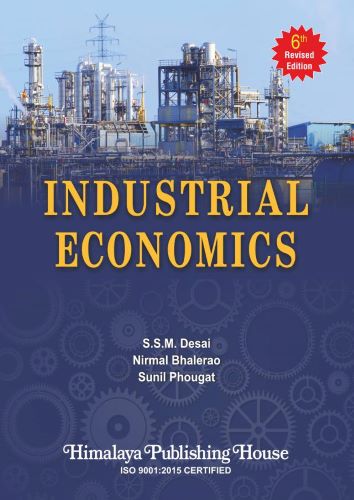

The book Industrial Economics is a comprehensive academic and professional study of the structure, behaviour and performance of industries within an economy. It offers an in-depth understanding of how industrial growth contributes to economic development and how various economic forces influence industrial organisation, production and policy.
From an academic perspective, the book serves as a valuable resource for students and researchers of economics, commerce and management. It systematically integrates theoretical frameworks with real world industrial practices, enabling readers to understand complex concepts such as market structures, industrial efficiency, competition and policy formulation. The book emphasises analytical thinking and critical evaluation, enabling readers to comprehend both micro and macro aspects of industrial behaviour.
From a professional viewpoint, the book provides a practical understanding of industrial dynamics relevant to policymakers, entrepreneurs and business professionals. It examines issues related to industrial finance, productivity, technology, labour relations, and ploicy reforms offering insights useful for strategic planning and decision-making. The book also discusses contemporary challenges such as globalisation, liberalisation and sustainability, making it relevant to the current industrial scenario.
By combining theory, policy and empirical analysis, Industrial Economics bridges the gap between academic learning and professional application. It encourages readers to analyse the changing patterns of industrial development, understand the role of government and private enterprise and explore strategies for sustainable and inclusive industrial growth.
Overall, the book stands as an essential guide for understanding the evolving nature of industries and their critical role in shaping the economic future of nations, particularly in the context of developing economies like India.
Contents –
CHAPTER 1: WHAT IS INDUSTRIALISATION?
1.1 Meaning of Industrialisation
1.2 Why Industrialisation in India?
1.3 Factors Hampering Rapid Industrial Development of India
CHAPTER 2: THEORIES OF SIZE AND LOCATION OF INDUSTRIAL ESTABLISHMENTS
2.1 Introduction
2.2 Concept of ‘Optimum Firm’
2.3 Factors Determining ‘Optimum Size’ of a Firm
2.4 Reconciliation of Optima
2.5 Location of Industries
2.5 (a) Industrial Location Analysis
2.6 Alfred Weber’s Theory of Industrial Location
2.7 Sargant Florence’s Theory of Industrial Location
2.8 Factors Influencing Industrial Location
2.9 Strategies for Industrialisation
2.10 Diversification, Vertical Integration and Merger
CHAPTER 3 INDIAN INDUSTRIES FROM PRE-BRITISH PERIOD UP TO INDEPENDENCE
3.1 Indian Industries During Pre-British Period
3.2 Decline of Indian Handicrafts
3.3 Emergence of Modern Industries in India
3.4 The World War I (1914-18) and the Inter-War Period (1919-39)
3.5 World War II (1939-45) and Indian Industries
3.6 The Post-World War II Crisis (1945-47)
3.7 Effects of Partition of India on Indian Industries
3.8 Post-Partition Period (1947-1951) and Recovery
CHAPTER 4: INDUSTRIAL POLICY
4.1 Industrial Policy of East India Company
4.2 Industrial Policy After 1857
4.3 First World War (1914-18) and the Industrial Policy
4.4 Montague-Chelmsford Reforms (1919)
4.5 The Policy of Discriminating Protection
4.6 Industrial Policy After Independence
4.7 Industrial Policy Resolution of 1948
4.8 Industrial Policy Resolution of 1956
4.9 Industrial Policy Resolutions of 1948 and 1956 — A Comparison
4.10 Industrial Policy Statement of 1977
4.11 Industrial Policy Statement of 1980
4.12 Industrial Policy of 1991
CHAPTER 5: INDUSTRIAL PROGRESS DURING INDIA’S FIVE-YEAR PLANS
5.1 Introduction
5.2 Industrial Progress during the First Five-Year Plan (1951-56)
5.3 Industrial Progress in the Second Five-Year Plan (1956-61)
5.4 Industrial Progress during Third Five-Year Plan (1961-66)
5.5 Three Annual Plans (1966-67, 1967-68 and 1968-69)
5.6 Industrial Progress during the Fourth Five-Year Plan (1969-74)
5.7 Industrial Progress during the Fifth Five-Year Plan (1974-79)
5.8 Industrial Policy Changes in the Sixth Five-Year Plan (1980-85)
5.9 Industrial Progress During the Sixth Five-Year Plan (1980-85)
5.10 Industrial Progress in the Seventh Five-Year Plan (1985-90)
5.11 Industrial Strategies for the Seventh Five-Year Plan
5.12 Industrial Progress in the Eighth Five-Year Plan (1992-1997)
5.13 Industrial Progress in the Ninth Five-Year Plan (1997-2002)
5.14 Industrial Progress during Tenth Five-Year Plan (2002-2007)
5.15 Industrial Progress during Eleventh Five-Year Plan (2007-2012)
5.16 Industrial Progress during Twelfth Five-Year Plan (2012-2017)
CHAPTER 6: PUBLIC SECTOR IN INDIA
6.1 Introduction
6.2 Objectives of the Public Sector in India
6.3 Growth of Central Government Public Sector Undertakings
6.4 Organisation of Public Sector Undertakings in India
6.5 Government’s and Parliamentary Control over Public Sector Enterprises (PEs)
6.6 Pricing Policies of Public Enterprises in India
6.7 Role played by the Public Sector in India
6.8 Performance of Central Government Public Sector Units (PSUs)
6.9 Performance of State Government Public Sector Undertakings
6.10 Industrial Relations in Public Sector Undertakings in India
6.11 Trade Unionism in Public Sector Undertakings in India
6.12 Shortcomings of Public Sector Enterprises in India
6.13 Measure to Improve Efficiency of Public Sector Undertakings
6.14 Public Sector — New Approach of July 1991 Industrial Policy
6.15 Some Management Problems of Public Enterprises
CHAPTER 7: PRIVATE SECTOR INDUSTRIES IN INDIA
7.1 Introduction
7.2 Growth of Private Sector Industries
7.3 Private Sector and Role of the State
7.4 Contribution of Private Sector Industries
7.5 Defects of Private Sector Industries
7.6 Future Prospects for Private Corporate Industries
7.7 Liberal Economic (Industrial) Policy after 1980
7.8 Self-Regulation by Private Sector Industries
7.9 Cooperative Industrial Sector
7.10 Joint Industrial Ventures Abroad
7.11 Private Sector Industrial (Business) Forms of Organisation
7.12 Horizontal Combination
7.13 Vertical Integration or Vertical Combination
CHAPTER 8: SOME IMPORTANT INDUSTRIES IN INDIA
8.1 Cotton Textile Industry
8.2 Jute Industry
8.3 Iron and Steel Industry
8.4 Sugar Industry
8.5 Cement Industry
8.6 Paper Industry
8.7 Coal Industry
8.8 Engineering Industry
8.9 Shipbuilding Industry
8.10 Leather and Leather Goods Industry
8.11 Petroleum Industry
8.12 Petrochemical Industry
8.13 Fertiliser Industry
8.14 Synthetic Rubber Industry
8.15 Electronics Industry
8.16 Chemical Industry
8.17 Drug and Pharmaceutical Industry
8.18 Atomic Energy
8.19 Metallurgical and Mineral Industries
8.20 Aluminium Industry
8.21 Consumer Goods Industries
8.22 Readymade Garment Industry
8.23 Plastic Industry
CHAPTER 9: MONOPOLIES AND INDUSTRIAL CONCENTRATION IN INDIA
9.1 Introduction
9.2 The Indian Companies Act, 1956
9.3 Mahalanobis Committee
9.4 Monopolies Inquiry Commission
9.5 Extension of Economic Concentration
9.6 Consequences of Industrial Concentration in Private Sector
9.7 Remedial Measures
9.8 Growth of Large Industrial Houses
9.9 Change in Government’s Policy in Respect of Monopolies and Big Industrial Houses
9.10 Industrial Policy of July 1991 and Monopolies and MRTP Act
CHAPTER 10: SMALL-SCALE INDUSTRIES IN INDIA
10.1 Introduction
10.2 Definition of Small-Scale and Cottage Enterprise
10.3 Role of Small-Scale Industries in Indian Economy
10.4 The Case for Small-Scale Enterprises
10.5 Policy Regarding Development of Small-Scale Industries
10.6 Five-Year Plans and Small-Scale Industries
10.7 Small-Scale Industries Sector and Financial Provision in Five-Year Plans
10.8 Review of the Policies and Programmes for Development of Small-Scale Industries Sector in India
10.9 Financial Assistance to Small-Scale Industries Sector
10.10 New Strategy for More Rapid Growth of Small-Scale Industries
10.11 Industrial Policy of July 1991 and Small-Scale Industries
CHAPTER 11: LOCATIONAL PATTERN OF INDUSTRIES IN INDIA
11.1 Cotton Textile Industry
11.2 Jute Industry
11.3 Iron and Steel Industry
11.4 Sugar Industry
11.5 Cement Industry
11.6 Government’s Policy in Regard to Locational Pattern of Industries
CHAPTER 12: BALANCED REGIONAL INDUSTRIAL DEVELOPMENT
CHAPTER 13: INDUSTRIAL DEVELOPMENT OF BACKWARD AREAS
13.1 Introduction
13.2 Challenges and Opportunities
13.3 Suggested Measures
13.4 Recent Developments
CHAPTER 14: INDUSTRIAL PRODUCTIVITY IN INDIA
14.1 Introduction
14.2 Importance of Productivity Analysis
14.3 Some Misconceptions about Labour Productivity
14.4 Distinction between ‘Productivity’ and ‘Production’
14.5 Tools of Improving Labour Productivity
14.6 Factors Influencing Industrial Productivity
14.7 Productivity Trends in India
14.8 Quality Control
CHAPTER 15: INDUSTRIAL FINANCE
15.1 Introduction
15.2 Industrial Finance Corporation of India (IFC)
15.3 Industrial Credit and Investment Corporation of India (ICICI)
15.4 Industrial Development Bank of India (IDBI)
15.5 Industrial Reconstruction Bank of India (IRBI)
15.6 State Financial Corporations (SFCs)
15.7 National Industrial Development Corporation (NIDC)
15.8 National Small Industries Corporation (NSIC)
15.9 State Industrial Development Corporations (SIDCs) or State Industrial Investment Corporations (SIICs)
15.10 Unit Trust of India (UTI)
15.11 Life Insurance Corporation (LIC)
15.12 General Insurance Corporation
15.13 Critical Assessment of the Role Played by Public Sector Financial Institutions in the Sphere of Industrial Finance
15.14 Internal Sources of Finance for Large-Scale Industries
CHAPTER 16: ROLE OF FOREIGN CAPITAL
16.1 Introduction
16.2 Role of Foreign Capital in Developing Countries
16.3 Role of Foreign Capital in India Before Independence
16.4 Types of Foreign Capital
16.5 Multinational Corporations and India’s Foreign Collaboration Agreements
16.6 Growth and Performance of Multinational Corporations in India (1973-74 to 1978-79)
16.7 Foreign Investment in Recent Years
16.8 Dangers of Private Foreign Capital
16.9 Government’s Policy in Regard to Foreign Capital
16.10 Limits on the Role of Foreign Capital and Foreign Collaboration Agreements
CHAPTER 17: LABOUR LEGISLATION
17.1 Introduction
17.2 Laws Relating to Weaker Sections (i.e., Children and Women) of the Community
17.3 Labour Legislation Regarding Specific Industries
17.4 Laws Relating to Specific Matters
17.5 Social Security and Labour Welfare
17.6 Trade Union Movement in India
17.7 Brief History of Trade Union Movement in India
17.8 Weaknesses of Trade Union Movement in India
17.9 Suggested Measures for Strengthening Trade Union Movement in India
17.10 Associations of Employers
CHAPTER 18: INDUSTRIAL RELATIONS
18.1 Introduction
18.2 Labour Policy in India Prior to Independence
18.3 Labour Policy in Post-Independence Period
18.4 Labour Relations and Social Security
18.5 Industrial Disputes Act, 1947
18.6 The Problem of Bonus
18.7 Social Security for Labour in India
18.8 Critical Assessment of Social Security Measures in India
18.9 Workers’ Participation in Management
CHAPTER 19: INDIAN INDUSTRIES AND THE ENERGY PROBLEM
19.1 Introduction
19.2 Nature of Energy Problem in India
19.3 Sources of Energy for Indian Industries
19.4 Consumption Trends in Commercial Energy
19.5 Energy Crisis and Measures to Solve Energy Problem
19.6 Conservation of Energy
19.7 Research and Development
CHAPTER 20: WAGE POLICY AND WAGE FIXATION
20.1 Introduction
20.2 Concepts of ‘Living Wage’, ‘Minimum Wage’ and ‘Fair Wage’
20.3 Factors that Influence Wage Structure in a Country
20.4 Wage Boards and their Functioning
20.5 National Wage Policy
CHAPTER 21: INDUSTRIAL SICKNESS 1
21.1 Introduction
21.2 Definition of Industrial Sickness
21.3 Extent of Industrial Sickness in India
21.4 Causes of Industrial Sickness
21.5 Government’s Policy in Regard to Industrial Sickness
CHAPTER 22: SCIENTIFIC MANAGEMENT AND RATIONALISATION
22.1 Introduction
22.2 Feature or Elements of Scientific Management
22.3 Difference between Traditional Management and Scientific Management
21.4 Rationalisation
22.5 Important Aspects or Elements of Rationalisation
22.6 Relationship between Scientific Management and Rationalisation
22.7 Benefits of Rationalisation
22.8 Attitudes of Employers, Workers and Government towards Rationalisation
22.9 Rationalisation of Industries in India
CHAPTER 23: REVIEW OF INDUSTRIAL GROWTH SINCE INDEPENDENCE
23.1 Introduction
23.2 Review of Industrial Growth Under Planning — Structural Transformation
23.3 Deficiencies or Shortcomings of India’s Industrialisation
CHAPTER 24: FUTURE STRATEGY FOR INDUSTRIAL GROWTH IN INDIA
CHAPTER 25: THE POLICY OF ECONOMIC LIBERALISATION AND THE ROLE OF FOREIGN INVESTMENTS IN THE INDUSTRIAL DEVELOPMENT OF INDIA SINCE 1991
BIBLIOGRAPHY