
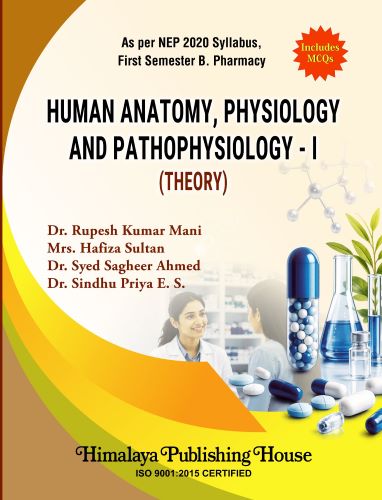



This textbook has been specially designed for First Year B.Pharmacy students studying Human Anatomy, Physiology and Pathophysiology–I (BP104T) in accordance with the Pharmacy Council of India (PCI) curriculum. It presents fundamental concepts of human anatomy and physiology in a clear, systematic, and student-friendly manner, with emphasis on their relevance to pharmaceutical sciences.
The book is organized into five comprehensive units, covering essential topics including the scope of anatomy and physiology, cell biology, integumentary system, skeletal and muscular systems, body fluids and blood, lymphatic and immune systems, peripheral nervous system, special senses, and cardiovascular system.
Each chapter is structured to facilitate progressive learning and includes concise explanations, clinically relevant concepts, appropriate illustrations, and review questions to reinforce understanding and support examination preparation.
A key feature of this textbook is its collection of original, custom-designed medical illustrations and anatomical diagrams, developed to provide accurate visual representation of structures and physiological processes at the undergraduate pharmacy level. These illustrations are intended to enhance conceptual clarity and make complex anatomical and physiological concepts easier to understand and retain.
Overall, the textbook serves as a comprehensive and accessible learning resource for B.Pharmacy students, helping them build a strong foundation in human anatomy and physiology that is essential for understanding pharmacology, pathology, pharmacotherapy, and other pharmaceutical sciences.
Contents –
UNIT I: Foundations — Scope, Cell Physiology & Cell Injury
Chapter 1: INTRODUCTION TO THE HUMAN BODY — SCOPE AND BASIC CONCEPTS
1.1 Cellular and Tissue Level of Organization
1.1.1 Introduction to Cells — The Fundamental Living Building Blocks
1.1.2 Three Main Parts of a Cell
1.1.3 Introduction to Tissues
1.1.4 The Four Basic Types of Tissues
1.2 Definition and Scope of Anatomy, Physiology and Pathophysiology
1.2.1 Anatomy
1.2.2 Physiology
1.2.3 Pathophysiology
1.3 Levels of Structural Organization and Body Systems, Basic Life Processes
1.3.1 Six Levels of Structural Organization
1.3.2 The Eleven Systems of the Human Body
1.3.3 Basic Life Processes
1.4 Homeostasis and Basic Anatomical Terminologies
1.4.1 Homeostasis
1.4.2 Anatomical Position
1.4.3 Directional Terms
1.4.4 Planes and Sections
1.4.5 Body Cavities
1.4.6 Abdominopelvic Regions and Quadrants
Chapter 2: CELL BIOLOGY, TRANSPORT AND TISSUES
2.1 Structure and Functions of the Cell, Transport Across the Cell Membrane, Cell Division and Cell Junctions
2.1.1 Detailed Structure of the Cell and Its Organelles
2.1.2 Transport Across the Plasma Membrane
2.1.3 Cell Division
2.1.4 Cell Junctions
2.2 General Principles of Cell Communication and Forms of Intracellular Signalling
2.2.1 General Principles
2.2.2 Forms of Intercellular Signalling
2.3 Classification of Tissues — Structure, Location and Functions
2.3.1 Epithelial Tissue
2.3.2 Connective Tissue
2.3.3 Muscular Tissue
2.3.4 Nervous Tissue
Chapter 3: CELL INJURY, ADAPTATION AND CELL DEATH
3.1 Components and Types of Feedback Systems
3.2 Causes of Cellular Injury
3.3 Pathogenesis of Cell Injury
3.4 Morphology of Cell Injury — Adaptive Changes
3.5 Cell Swelling, Intracellular Accumulations and Cell Death
3.5.1 Reversible Cell Injury
3.5.2 Irreversible Cell Injury — Cell Death
3.6 Definitions of Commonly Used Relevant Medical Terminologies
Glossary of Important Terms (Unit I)
Unit Summary
Multiple Choice Questions (For Practice)
Sample Questions
Long Answer Questions (10 marks each)
Short Answer Questions (5 marks each)
Very Short Answer / Objective Questions (2 marks each)
Commonly Confused Terms
UNIT II: Support & Movement — Skin, Bones & Muscles
Chapter 1: INTEGUMENTARY SYSTEM AND WOUND HEALING
1.1 Structure and Functions of the Skin
1.1.1 Histology of the Epidermis Cellular Composition of the Epidermis Layers (Strata) of the Epidermis
1.1.2 Histology and Structure of the Dermis
1.2 Accessory Structures of the Skin & Pigmentation
1.2.1 Hair, Glands, and Nails
1.2.2 Physiology of Skin Pigmentation
1.3 Functions of the Integumentary System
1.4 Pathophysiology of Skin Disorders
1.4.1 Psoriasis Clinical & Histological Features of Psoriasis Pharmacological Management of Psoriasis
1.4.2 Dermatitis and Eczema
Classification and Pathophysiology of Dermatitis
1.4.3 Pathophysiology of Leprosy (Hansen’s Disease)
WHO / NLEP Multi-Drug Therapy (MDT) Regimens in India
1.5 Basic Principles of Wound Healing
1.5.1 Phases of Cutaneous Wound Healing
1.5.2 Primary vs Secondary Intention Healing & Impairment Factors
Systemic and Local Factors Impairing Wound Healing
1.5.3 Molecular Biochemistry of Keratinization and
Cornified Envelope Formation
1.5.4 Detailed Pathophysiology of Leprosy Reactions &
Peripheral Nerve Involvement
Chapter 2: SKELETAL SYSTEM, MUSCULAR PHYSIOLOGY AND JOINTS
2.1 Divisions of the Skeletal System
2.2 Bone Tissue Histology, Classification and Ossification
2.2.1 Bone Classification by Shape
2.2.2 Microscopic Histology of Bone Tissue Bone Cells
Compact vs Spongy Bone Structure
2.2.3 Bone Formation (Ossification)
2.3 Salient Features of Axial Skeleton
2.3.1 The Skull (22 Bones)
2.3.2 Vertebral Column (26 Bones)
2.3.3 Thoracic Cage (25 Bones)
2.4 Salient Features of Appendicular Skeleton
2.5 Organization of Skeletal Muscle & Neuromuscular Junction (NMJ)
2.5.1 Neuromuscular Junction (NMJ) Structure & Transmission
2.6 Physiology of Skeletal Muscle Contraction
2.6.1 Excitation-Contraction Coupling & Sliding Filament Theory
2.7 Structural and Functional Classification of Joints
2.7.1 Structural Classification
Anatomy of Synovial Joints
2.7.2 Functional Classification & Types of Synovial Joints
2.7.3 Anatomical Details of the Skull Foramina and Vertebral Regions
2.7.4 Skeletal Muscle Fiber Types and Neuromuscular Disorders
2.7.5 Comprehensive Osteological Monograph of the Human Skeleton (206 Bones)
Chapter 3: DISEASES OF BONES AND JOINTS
3.1 Rheumatoid Arthritis (RA)
3.1.1 Clinical Manifestations & Extra-Articular Features
3.1.2 Pharmacological Management of RA
3.2 Osteoporosis
3.2.1 Pathophysiology of Bone Remodeling Imbalance
3.2.2 Pharmacotherapy of Osteoporosis
3.3 Gout and Hyperuricemia
3.3.1 Uric Acid Metabolism & Pathophysiology of Gout
3.3.2 Stages of Gout & Pharmacological Management
3.3.3 Advanced Immunotherapy and DMARD Pharmacology in RA
Glossary of Important Terms (Unit II)
Unit Summary
Multiple Choice Questions (For Practice)
Sample Questions
Long Answer Questions (10 marks each)
Short Answer Questions (5 marks each)
Very Short Answer / Objective Questions (2 marks each)
Commonly Confused Terms
UNIT III: Body Fluids, Blood & Immunity
Chapter 1: BODY FLUIDS, BLOOD AND LYMPHATIC SYSTEM
1.1 Body Fluid Compartments and Homeostatic Balance
1.1.1 Fluid Compartment Distribution & 60-40-20 Rule
1.2 Composition and Functions of Blood
1.2.1 Composition of Blood Plasma
1.2.2 Formed Elements of Blood
1.3 Hemopoiesis (Hematopoiesis)
1.4 Erythrocytes & Hemoglobin Synthesis
1.4.1 Erythrocyte Morphology & Lifespan
1.4.2 Hemoglobin Structure & Synthesis
1.4.3 Erythrocyte Degradation & Bilirubin Metabolism
1.5 Hemostasis and Mechanism of Blood Coagulation
1.5.1 Vascular Spasm and Platelet Plug Formation
1.5.2 Blood Coagulation Cascade (Secondary Hemostasis)
1.5.3 Fibrinolysis & Anticoagulant Mechanisms
1.6 Blood Grouping, Rh Factor & Transfusion
1.6.1 ABO Blood Group System
1.6.2 Rh Blood Group System & Erythroblastosis Fetalis
1.7 Lymphatic System Architecture and Functions
1.7.1 Lymphoid Organs & Tissues
1.7.2 Lymphatic Vessels & Lymph Circulation
Chapter 2: BASIC MECHANISM OF INFLAMMATION AND REPAIR
2.1 Introduction and Classification of Inflammation
2.1.1 Acute vs Chronic Inflammation
2.2 Acute Inflammation Pathophysiology
2.2.1 Vascular Events & Hemodynamics
2.2.2 Cellular Events: Leukocyte Extravasation
2.2.3 Phagocytosis & Microbial Killing
2.3 Chemical Mediators of Inflammation
2.4 Chronic and Granulomatous Inflammation
2.4.1 Etiology & Cellular Infiltrate of Chronic Inflammation
2.4.2 Granulomatous Inflammation
2.5 Tissue Repair and Regeneration
2.5.1 Proliferative Capacity of Human Tissues
2.5.1 Acute-Phase Response and Systemic Manifestations of Inflammation
Chapter 3: HAEMATOLOGICAL DISEASES
3.1 Overview and Classification of Anemia
3.1.1 Red Blood Cell Indices & Diagnostic Evaluation
3.1.2 Morphological and Etiological Classification
3.2 Iron Deficiency Anemia (IDA)
3.2.1 Iron Physiology and Metabolism
3.2.2 Pathophysiology & Clinical Features of IDA
3.3 Megaloblastic Anemia
3.3.1 Biochemical Roles of Vitamin B12 and Folic Acid
3.4 Sickle Cell Anemia (SCA)
3.4.1 Molecular Genetics and Pathophysiology of Sickling
3.5 Thalassemia
3.5.1 Alpha vs Beta Thalassemia Pathophysiology
3.6 Hereditary & Acquired Hemolytic Anemias
3.6.1 G6PD Deficiency
3.7 Hemophilia and Coagulation Disorders
3.7.1 Hemophilia A, B, and von Willebrand Disease
3.7.2 Iron Overload Syndromes and Iron Chelation Therapy
3.7.3 Disseminated Intravascular Coagulation (DIC)
Glossary of Important Terms (Unit III)
Unit Summary
Multiple Choice Questions (For Practice)
Sample Questions
Long Answer Questions (10 marks each)
Short Answer Questions (5 marks each)
Very Short Answer / Objective Questions (2 marks each)
Commonly Confused Terms
UNIT IV: Peripheral Nervous System & Special Senses
Chapter 1: CLASSIFICATION OF THE PERIPHERAL NERVOUS SYSTEM
1.1 Introduction to the Peripheral Nervous System
1.1.1 Neurons: The Structural Units of the Nervous System
1.1.2 Structural Classification of Neurons
1.1.3 Functional Classification of Neurons
1.1.4 Neuroglia of the Peripheral Nervous System
1.2 Connective Tissue Organization of Peripheral Nerves
1.2.1 Endoneurium
1.2.2 Perineurium
1.2.3 Epineurium
1.3 Myelination and Saltatory Conduction
1.3.1 Process of Myelination by Schwann Cells
1.3.2 Nodes of Ranvier and Saltatory Conduction
1.3.3 Erlanger-Gasser Classification of Nerve Fibers
1.4 Nerve Injury, Degeneration, and Regeneration
1.4.1 Seddon Classification of Nerve Injuries
1.4.2 Wallerian Degeneration
1.4.3 Axonal Regeneration
Chapter 2: AUTONOMIC NERVOUS SYSTEM: SYMPATHETIC AND PARASYMPATHETIC DIVISIONS
2.1 Overview of the Autonomic Nervous System
2.2 Sympathetic Division (Thoracolumbar Outflow)
2.3 Parasympathetic Division (Craniosacral Outflow)
2.4 Autonomic Neurotransmitters and Receptors
2.5 Dual Innervation and Autonomic Antagonism
Chapter 3: ORIGIN AND FUNCTIONS OF SPINAL NERVES
3.1 Formation of Spinal Nerves
Summary Table of All Spinal Nerves
3.2 Nerve Plexuses, Cervical Plexus, Brachial Plexus, Lumbar Plexus
Sacral Plexus
3.3 Dermatomes and Clinical Testing
3.4 Common Spinal Nerve Injuries
Chapter 4: ORIGIN AND FUNCTIONS OF CRANIAL NERVES
4.1 Overview of the 12 Cranial Nerves
4.2 Individual Cranial Nerve Monographs (CN I through CN XII)
Cranial Nerve I: Olfactory Nerve
Cranial Nerve II: Optic Nerve
Cranial Nerve III: Oculomotor Nerve
Cranial Nerve IV: Trochlear Nerve
Cranial Nerve V: Trigeminal Nerve
Cranial Nerve VI: Abducens Nerve
Cranial Nerve VII: Facial Nerve
Cranial Nerve VIII: Vestibulocochlear Nerve
Cranial Nerve IX: Glossopharyngeal Nerve
Cranial Nerve X: Vagus Nerve
Cranial Nerve XI: Accessory Nerve
Cranial Nerve XII: Hypoglossal Nerve
4.3 Summary Table of All 12 Cranial Nerves
Chapter 5: STRUCTURE AND FUNCTIONS OF THE EYE
5.1 Accessory Structures of the Eye
5.2 Microscopic Anatomy and Tunics of the Eyeball
5.2.1 Fibrous Tunic: Sclera and Cornea
5.2.2 Vascular Tunic (Uvea): Choroid, Ciliary Body, and Iris
5.2.3 Nervous Tunic: Retina Histology and Photoreceptor Layers
5.3 Phototransduction: How the Retina Detects Light (Simplified)
5.4 Aqueous Humor Dynamics
5.4.1 Production and Circulation
5.4.2 Drainage Pathways
5.5 Visual Pathways to the Brain
Chapter 6: STRUCTURE AND FUNCTIONS OF THE EAR AND AUDITORY PHYSIOLOGY
6.1 Gross Anatomy and Divisions of the Ear
6.1.1 External Ear
6.1.2 Middle Ear (Tympanic Cavity)
6.1.3 Inner Ear (Labyrinth) and Organ of Corti
6.2 How Cochlear Hair Cells Convert Sound into Nerve Signals (Simplified)
6.3 The Vestibular System and Equilibrium
6.3.1 Static Equilibrium: The Maculae
6.3.2 Dynamic Equilibrium: The Crista Ampullaris
6.4 The Auditory Neural Pathway
6.5 Clinical Correlates of Hearing Loss
6.5.1 Conductive Hearing Loss
6.5.2 Sensorineural Hearing Loss
Chapter 7: OLFACTION AND GUSTATION
7.1 Anatomy and Physiology of Olfaction (Nose)
7.2 Anatomy and Physiology of Gustation (Tongue)
7.3 Molecular Mechanisms of Odorant Transduction
7.4 Molecular Mechanisms of Gustatory Transduction
7.4.1 Transduction of Salty and Sour Tastes
7.4.2 Transduction of Sweet, Bitter, and Umami Tastes
7.5 The Olfactory and Gustatory Neural Pathways
7.6 Evolutionary Significance & Age-Related Changes
Chapter 8: PATHOPHYSIOLOGY OF SPECIAL SENSE DISORDERS
8.1 Pathophysiology of Glaucoma
8.2 Pathophysiology of Cataracts
8.3 Pathophysiology of Refractive Errors: Myopia
8.4 Pathophysiology of Otitis Externa and Otitis Media
8.5 Pathophysiology of Vertigo
8.6 Pathophysiology of Anosmia
8.7 Pathophysiology of Macular Degeneration
8.8 Pathophysiology of Diabetic Retinopathy
8.9 Pathophysiology of Meniere’s Disease and Tinnitus
Glossary of Important Terms (Unit IV)
Unit Summary
Multiple Choice Questions (For Practice)
Sample Questions
Long Answer Questions (10 marks each)
Short Answer Questions (5 marks each)
Very Short Answer / Objective Questions (2 marks each)
Commonly Confused Terms
UNIT V: The Cardiovascular System
Chapter 1: ANATOMY OF THE HEART
1.1 Location, Size and the Pericardium
1.2 The Heart Wall and Cardiac Muscle
1.3 Chambers, Great Vessels and Blood Flow through the Heart
1.4 Heart Valves
1.5 Coronary Circulation
1.6 External Features and Surface Markings
Chapter 2: BLOOD CIRCULATION AND BLOOD VESSELS
2.1 Pulmonary and Systemic Circulation
2.2 Structure and Functions of Arteries, Veins and Capillaries
2.3 Blood Pressure and Velocity in the Blood Vessels
2.4 Types of Capillaries
2.5 Capillary Exchange
Chapter 3: THE CONDUCTION SYSTEM, HEARTBEAT AND ITS REGULATION
3.1 Elements of the Conduction System
3.2 The Cardiac Action Potential and the Heartbeat
3.3 Regulation of the Heart by the Autonomic Nervous System
3.4 The Pacemaker Potential vs. Contractile Action Potential
3.5 Ectopic Pacemakers and the Hierarchy of Automaticity
3.6 Reflex Regulation: Baroreceptors and Chemoreceptors
Chapter 4: THE CARDIAC CYCLE AND CARDIAC OUTPUT
4.1 The Cardiac Cycle and Heart Sounds
4.2 Cardiac Output
4.3 Regulation of Heart Rate and Stroke Volume
4.4 The Wiggers Diagram: Integrating the Cardiac Cycle
4.5 Determinants of Stroke Volume: Preload, Afterload and Contractility
4.5.1 Preload and the Frank-Starling Law
4.5.2 Contractility (Inotropy)
4.5.3 Afterload
Chapter 5: BLOOD PRESSURE, PULSE AND THE ELECTROCARDIOGRAM
5.1 Regulation of Blood Pressure
5.2 Measuring Blood Pressure
5.3 The Arterial Pulse
5.4 The Electrocardiogram (ECG)
5.5 Advanced Electrocardiogram Analysis
5.6 Basic Arrhythmia Recognition
5.7 Long-Term Blood Pressure Regulation: The RAAS
5.8 Pathophysiology of Shock
Chapter 6: PATHOPHYSIOLOGY OF CARDIOVASCULAR DISORDERS
6.1 Hypertension
6.2 Cardiac Arrhythmias
6.3 Congestive Heart Failure
6.4 Ischaemic Heart Disease and Atherosclerosis
6.5 Angina Pectoris and Myocardial Infarction
6.6 Coronary Artery Disease: Risk Factors and Prevention
Glossary of Important Terms (Unit V)
Unit Summary
Multiple Choice Questions (For Practice)
Sample Questions
Long Answer Questions (10 marks each)
Short Answer Questions (5 marks each)
Very Short Answer / Objective Questions (2 marks each)
Commonly Confused Terms
Learning Outcomes
Advanced Topics & Further Reading (Beyond First-Year Scope)
