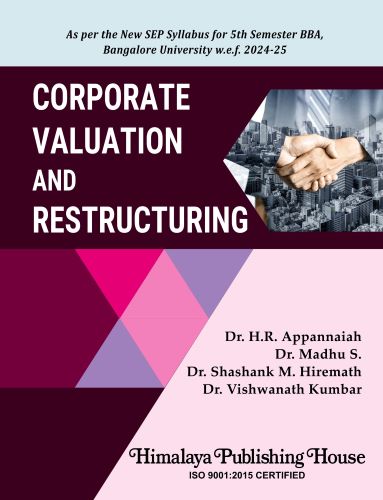



In the contemporary corporate landscape, characterised by intense competition, globalisation, technological disruption, and evolving regulatory frameworks, organisations are continually striving to enhance shareholder value and achieve sustainable growth. Corporate valuation and restructuring have therefore become indispensable tools for strategic decision-making, enabling businesses to assess their true economic worth, facilitate investment decisions, execute mergers and acquisitions, restructure operations, and respond effectively to changing market conditions. A sound understanding of valuation principles and restructuring strategies is essential for commerce graduates aspiring to build successful careers in finance, investment banking, corporate advisory, accounting, and business management.
Recognising the growing relevance of this domain, Bangalore University has introduced Corporate Valuation and Restructuring under the State Education Policy (SEP) for V Semester B.Com. students. This textbook has been meticulously prepared in accordance with the prescribed syllabus with the objective of providing students with a comprehensive understanding of corporate valuation methodologies, restructuring strategies, legal and regulatory frameworks, and contemporary business practices. The subject matter has been presented in a logical, systematic, and learner-friendly manner to ensure conceptual clarity while promoting analytical and practical learning.
The book is organised into five comprehensive modules covering the fundamental concepts of corporate valuation, valuation objectives, value drivers, and valuation standards. It provides detailed discussions on widely accepted valuation approaches, including asset-based, earnings-based, marketbased, and discounted cash flow (DCF) methods, along with Free Cash Flow to Firm (FCFF), Free Cash Flow to Equity (FCFE), Weighted Average Cost of Capital (WACC), and terminal value estimation. The book further explores the concepts and forms of corporate restructuring, including financial, operational, and strategic restructuring, business turnaround strategies, divestments, spin-offs, and split-offs. It also examines valuation in mergers and acquisitions, synergy valuation, exchange ratio determination, valuation of distressed companies, the Insolvency and Bankruptcy Code (IBC), and the role of registered valuers. The concluding module discusses the legal, regulatory, accounting, taxation, governance, and ethical dimensions of corporate valuation and restructuring, together with recent developments and cross-border restructuring challenges.
Special emphasis has been placed on integrating theoretical concepts with practical illustrations, numerical examples, contemporary case studies, and application-oriented discussions to bridge the gap between classroom learning and professional practice. The book aims not only to facilitate academic excellence but also to develop the analytical, financial, and strategic decision-making skills required in today’s dynamic corporate environment.
Contents –
MODULE – 1 INTRODUCTION TO CORPORATE VALUATION
Meaning and importance of corporate valuation – Objectives of valuation – Value versus price – Types of value: book value, market value, intrinsic value, fair value – Need for valuation in business decisions – Valuation process and key valuation drivers – Factors affecting corporate value – Overview of valuation standards and principles.
MODULE – 2 VALUATION APPROACHES AND METHODS
Asset-based valuation: Net Asset Value (NAV) method – Earnings-based valuation – Market-based valuation: comparable company approach and comparable transaction approach – Discounted Cash Flow (DCF) valuation – Free Cash Flow to Firm (FCFF) and Free Cash Flow to Equity (FCFE) – Cost of capital – Weighted Average Cost of Capital (WACC) – Terminal value estimation- NAV valuation – DCF valuation – WACC calculation.
MODULE – 3 CORPORATE RESTRUCTURING – CONCEPTS AND TYPES
Meaning and need for corporate restructuring – Forms of corporate restructuring – Financial restructuring – Operational restructuring – Strategic restructuring – Business expansion, contraction, and turnaround strategies – Divestment and disinvestment – Spin-offs and split-offs – Case studies on corporate restructuring.
MODULE – 4 VALUATION IN MERGERS, ACQUISITIONS, AND INSOLVENCY
Mergers and acquisitions: meaning, types, and motives – Valuation in mergers and acquisitions – Synergy valuation – Exchange ratio determination – Share swap valuation – Valuation of distressed companies – Introduction to Insolvency and Bankruptcy Code (IBC) – Fair value and liquidation value – Role of registered valuers – Due diligence process- Exchange ratio calculations – Synergy valuation illustrations.
MODULE – 5 LEGAL, REGULATORY, AND ETHICAL ASPECTS OF VALUATION AND RESTRUCTURING
Legal framework governing mergers and restructuring – Relevant provisions of the Companies Act – SEBI regulations related to mergers and acquisitions – Accounting standards applicable to business combinations – Tax implications of restructuring – Corporate governance issues – Ethical issues in valuation – Recent trends in corporate valuation and restructuring – Cross-border restructuring challenges.