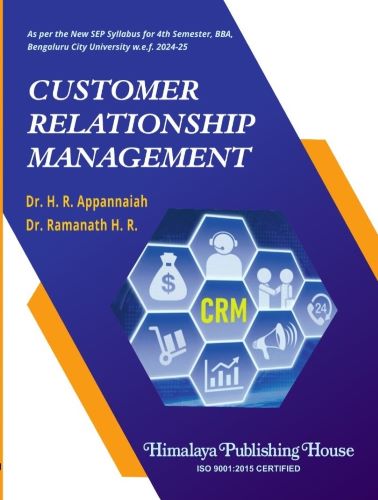

Customer Relationship Management is the study of managing customer interactions. It focuses on building long-term relationships that create value. CRM helps firms understand customer needs better. It also improves service quality and business performance. A strong CRM system supports loyalty. It strengthens competitiveness in all business environments.
Today, CRM practices are changing rapidly. Technology reshapes how firms communicate with customers. Digital platforms support personalized and timely service. Companies now focus on data-driven decisions and customer retention. Concepts like one-to-one marketing and value modeling guide modern practice. These changes demand strong CRM skills and strategic thinking.
This book explains CRM concepts with clarity. It introduces the evolution of customer relationships and CRM growth. It discusses CRM processes, frameworks, and benefits. It covers customer acquisition, loyalty, and relationship optimization. Service profiling and Service Level Agreements are also explained.
Marketing-related CRM concepts form a major section. Topics like cross-selling, up-selling, and customer retention are included. Behaviour prediction and value modeling support deeper understanding. CRM in customer service is discussed through call centres, scripting, and satisfaction measurement.
Sales Force Automation and related systems are covered next. The book includes sales processes, lead management, and field force tools. It highlights CRM links to e-business, ERP, SCM, SRM, and PRM. Analytical CRM is also explained with data management and legal concerns. Data warehousing, mining, and analysis tools show modern applications.
CRM implementation forms the final unit. Success factors, business planning, and tool selection are covered. The book explains conflict handling, strategy resets, and internal adoption. Key ideas on development teams, delivery, and measurement support practical learning.
This book is designed for students and practitioners. It supports academic study and real-world application. Graded questions help reinforce understanding and track progress.
Contents –
UNIT – 1 EVOLUTION OF CUSTOMER RELATIONSHIP & CRM CONCEPTS
Evolution of Customer Relationship: Introduction – CRM-Definition, Emergence of CRM Practice, Factors responsible for CRM growth, CRM process, framework of CRM, Benefits of CRM, Types of CRM.
CRM Concepts: Acquiring Customers, Customer Loyalty and Optimizing Customer Relationships; CRM Definition; Success Factors — The three levels of Service/ Sales Profiling; Service Level Agreements (SLAs), Creating and Managing effective SLAs.
UNIT – 2 CRM IN MARKETING
One-to-one Relationship Marketing; Cross Selling & Up Selling; Customer Retention; Behavior Prediction – Customer Profitability & Value Modeling; Channel Optimization; Event-based marketing; CRM and Customer Service – The Call Centre, Call Scripting, Customer Satisfaction Measurement.
UNIT – 3 SALES FOR AUTOMATION
Sales Process, Activity; Contact- Lead and Knowledge Management; Field Force Automation; CRM links in E-Business; E-Commerce and Customer Relationships on the Internet; Enterprise Resource Planning (ERP); Supply Chain Management (SCM); Supplier Relationship Management (SRM); Partner Relationship Management (PRM)
UNIT – 4 ANALYTICAL CRM
Managing and Sharing Customer Data; Customer Information Databases – Ethics and Legalities of Data use; Data Warehousing and Data Mining concepts; Data Analysis – Market Basket Analysis (MBA), Click stream Analysis, Personalization and Collaborative Filtering
UNIT – 5 CRM IMPLEMENTATION
Defining Success Factors; Preparing a Business Plan Requirements, Justification and Processes; Choosing CRM Tools – Defining Functionalities – Homegrown versus Out-Sourced Approaches; Managing Customer Relationships – Conflict, Complacency; Resetting the CRM Strategy; Selling CRM Internally; CRM Development Team, Scoping and Prioritizing, Development and Delivery, Measurement