




Economic reforms that were introduced in the year 1991 started creating enormous opportunities to entrepreneurs. Liberalisation reforms created new challenges such as providing finance to small and micro enterprises, increasing competitive strengths in startups, upgrading technology, enhancing productivity, improving quality in production and management, etc. Thereafter, several measures to address these challenges. However, the growth of entrepreneurship was at a snail pace.
The inculcation of entrepreneurship in youth of India gained momentum after 2014. NDA government at centre, under Sri Narendra Modi’s stewardship, introduced several attractive schemes to motivate youth and women to take to entrepreneurship. These initiatives provided a platform to startups to emerge in a big way. As of this date (2022) fifty plus schemes are on to encourage startups and unicorns.
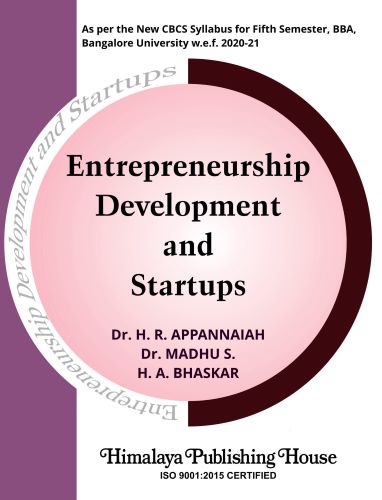
Entrepreneurship is an activity, which needs creativity and enthusiasm to run the business. Entrepreneurs should have self-confidence at its height to face unforeseen challenges that crop up as business moves forward. To motivate young minds at the learning stage, universities of Karnataka and other States have introduced “Entrepreneurship Development” as a subject of study at degree level. In this context, “Entrepreneurship Development and Startups” book is written in a simple style with required content. It is student-centric. This work covers topics on Introduction to entrepreneurship, MSMEs, startups, financial and nonfinancial assistance to entrepreneurs and Artificial Intelligence. Graded questions and skill exercises are given at the end of each chapter. This book covers the B.Com syllabus of fifth semester of Bangalore university, and can be studied by the B.com students of other universities of Karnataka.
Contents –
1. Entrepreneur
2. Types and Characteristics of Entrepreneur
3. Entrepreneurship Development
4. Micro, Small and Medium enterprises (MSME Sector)
5. Challenges (Problems) of MSMEs
6. New Business Venture (Selection Process)
7. Startups and their Financial Issues
8. Incubation Support to Startups
9. Business Plan
10. Feasibility Report
11. Startup India Scheme
12. Institutional Assistance for Entrepreneurship – I (Financial Institutions)
13. Institutional Assistance for Entrepreneurship – II (Non-Financial Assistance)
14. Specialised Institutions Supporting Entrepreneurs
15. Artificial Intelligence