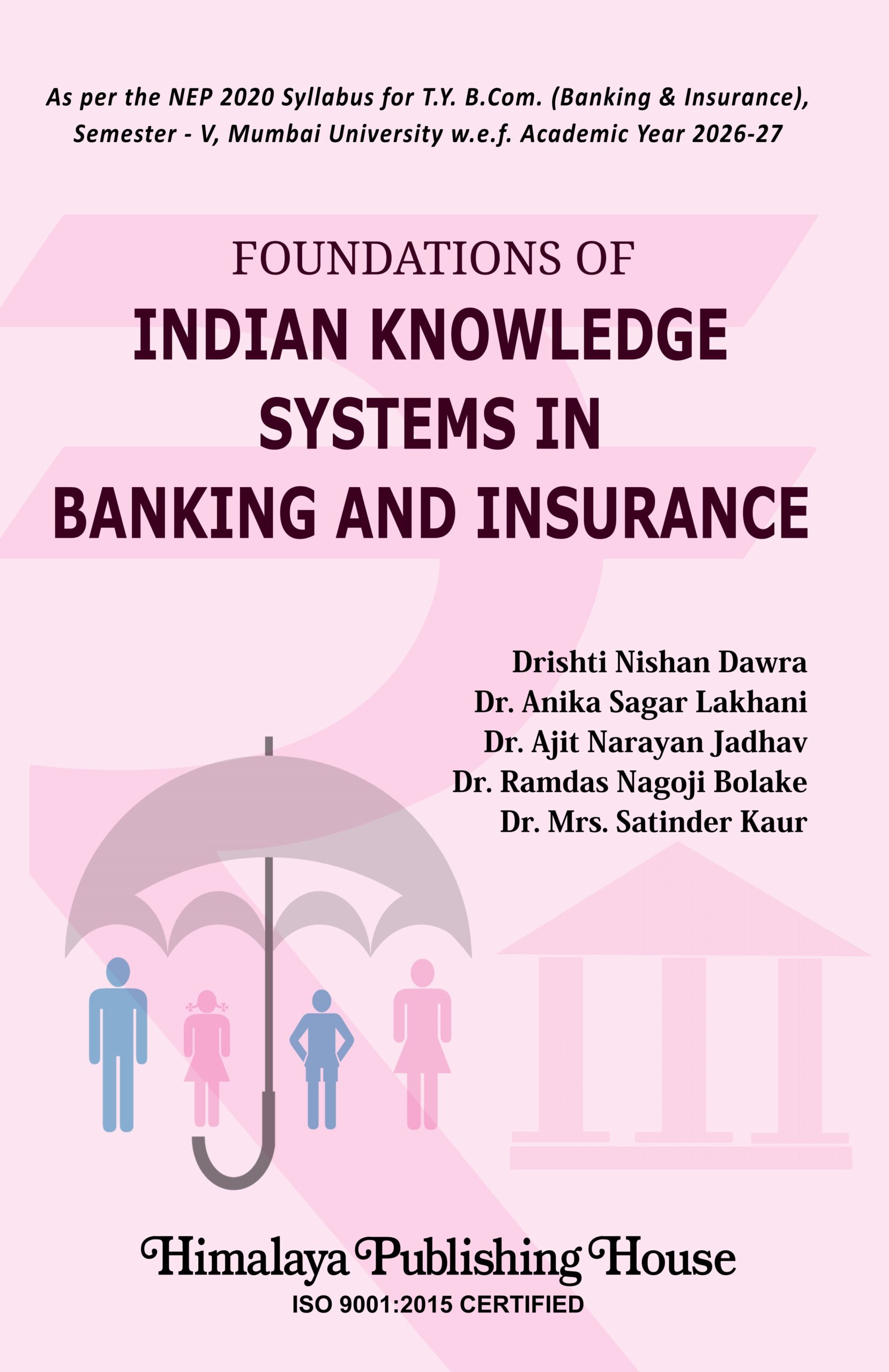


Indian Knowledge Systems (IKS) offer timeless insights into financial governance, ethical business practices, banking, and risk management. Long before the emergence of modern financial institutions, India had well-developed systems of banking, lending, wealth management, and community-based risk sharing that supported economic growth and social welfare. This book, Foundations of Indian Knowledge Systems in Banking and Insurance, introduces students to the indigenous foundations of banking and insurance and highlights their relevance in the modern financial sector. It covers traditional banking practices, the Hundi system, financial administration, community-based risk management, wealth preservation, and ethical principles that continue to influence present-day banking and insurance.
The book has been prepared in accordance with the latest syllabus of the University of Mumbai under the National Education Policy (NEP) 2020, applicable from the academic year 2026–27. It is hoped that this book will help students understand India’s rich financial heritage while encouraging ethical, responsible, and sustainable practices in the banking and insurance industry.
Contents –
Module 1: Indian Knowledge Systems in Banking
Unit 1 Indigenous Banking Concepts and Practices (Advanced)
1.1 Evolution of Indigenous Banking: Study of Early Indian Financial Intermediaries such as Sethis, Mahajans, and Shroffs and their Role in Economic Transactions.
1.2 Hundi System: Types and Operations – Darshani, Muddati, and Shahjog Hundis as Early Instruments of Credit, Remittance, and Bills of Exchange instruments.
1.3 Indigenous Credit and Lending Ethics: Dharma-based Credit Principles, Fairness in Charging Interest, Prohibition of Exploitative Lending, and Guidelines from the Manusmriti and Arthashastra.
1.4 Transition to Modern Banking: Influence of Traditional Banking Practices on Modern Negotiable Instruments, Credit Assessment, Trust-based Finance and Banking Operations.
Unit 2 Financial Governance, Accountability and Economic Administration in IKS
2.1 Arthashastra’s Financial Administration: Insights on Treasury Management, Auditing, Revenue Collection, Expenditure Control, and Fraud Prevention.
2.2 Ethics of Wealth Management: Dharma-inspired Guidelines on Honesty, Transparency, Trusteeship,
and Corporate Governance.
2.3 Regulatory Concepts in Ancient India: Oversight Structures, Penalties, Regulatory Mechanisms, and Financial
Discipline Practiced in Ancient Kingdoms.
2.4 Relevance to Modern Banking Regulation: Application to today’s RBI Compliance Frameworks, Governance
Standards, Accountability Norms, and Anti-corruption Policies.
Module 2: Indian Knowledge Systems in Insurance
Unit 3 Indigenous Insurance, Risk Management and Social Security Systems
3.1 Community-Based Risk Sharing: Village Collectives, Trade Guilds (Shrenis), and Community Funds used
to Support Members during Loss or Adversity.
3.2 Maritime and Trade-Related Risk Mitigation: Protection for Traders, Caravans, and Seafaring Missions;
Early Forms of Insurance against Theft, Loss, and Natural Calamities.
3.3 Natural Disaster Preparedness in Ancient India: Traditional Approaches to Managing Droughts, Floods, and
Famines through Community Reserves, Grain Banks, and Relief Mechanisms.
3.4 Parallels with Modern Insurance Products: Mapping Traditional Practices to today’s Health, Crop, Marine, and Social Insurance Schemes.
Unit 4 Wealth Protection, Security Systems and Ethical Insurance Practices
4.1 Traditional Wealth Preservation Methods: Gold, Land, Cattle, and Temple Treasuries as Long-term
Security and Collateral.
4.2 Moral and Ethical Dimensions of Insurance: Principles of Fairness, Risk-Sharing, and Duty toward the
Community based on Dharmik Values.
4.3 Family and Community-Based Social Security: Lineage Support Systems, Joint Families, Mutual Aids, and their Significance in Modern Micro Insurance.
4.4 Applicability to Modern Insurance Industry: How Ancient Principles can inspire Ethical Claims Settlement,
Customer Trust, Responsible Underwriting, and Community Focused Insurance Models.
Model Question Paper