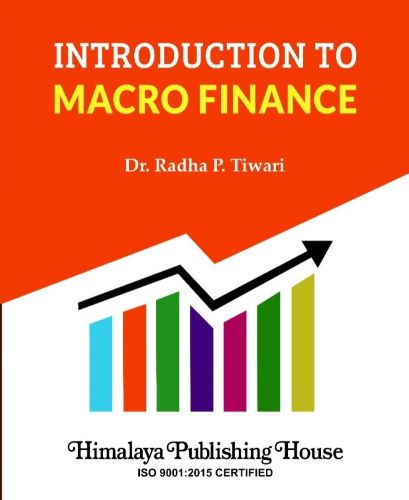




Introduction to Macro Finance has been written to help undergraduate students clearly see how macroeconomic forces and financial markets are linked in practice. Very often, “macroeconomics” and “finance” are taught as separate subjects, but real-world decisions on interest rates, investment, government borrowing, risk and returns are always shaped by macroeconomic conditions. This book brings these themes together in a simple, structured and student-friendly manner.
The book is organised into five units. The opening unit introduces basic macroeconomic ideas and the core linkages between output, inflation, employment, interest rates and financial markets. The next unit explains key macro indicators — GDP, inflation, unemployment and business cycles — with a focus on how they are measured and why they matter to households, firms, investors and policy makers. The third unit discusses financial markets and institutions, monetary policy tools, and the notions of market efficiency and anomalies. The fourth unit turns to fiscal policy and government debt, covering budgeting, taxation, public revenue and the channels through which government debt affects interest rates, private investment and growth. The final unit looks at contemporary issues such as globalisation and financial integration, climate change and sustainable finance, nominal versus real interest rates, the modern role of central banks and the lessons from financial crises.
Contents –
1. INTRODUCTION TO MACROECONOMICS AND FINANCE
1.0 Aim and Rationale of the Chapter
1.1 Meaning and Scope of Macroeconomics
1.1.1 Macroeconomic Indicators
1.1.2 Macroeconomic Aggregates
1.1.3 Objectives of Macroeconomic Policy
1.1.4 Instruments of Macroeconomic Management
1.2 Evolution of Macroeconomic Thought
1.2.1 Classical and Pre-Keynesian Views
1.2.2 Keynes and the Break with Classical Thinking
1.2.3 Post-War Keynesian Framework
1.2.4 Challenges: Monetarism and New Classical Economics
1.2.5 Crises that Joined Macro and Finance
1.3 Introduction to Finance
1.3.1 Major Branches of Finance
1.3.2 Finance in a Developing Economy
1.4 Interactions Between Financial Markets and the Macroeconomy
1.4.1 Role of Finance in the Economy
1.4.2 Policy → Markets: How Economic Policies Affect Financial Markets
1.4.3 Markets → Economy: How Financial Markets Shape Economic Activity?
1.4.4 The Circular Relationship: Finance and Macroeconomy in Motion
1.5 Real-World Example: India’s Policy — Market Interaction
1.5.1 Historical Examples
1.6 Key Personalities to Remember
1.7 Key Terms
1.8 Summary
1.9 Practice Questions
2. MACROECONOMIC INDICATORS
2.0 Aim and Rationale of Chapter
2.1 Meaning and Importance of GDP in Macroeconomics
2.1.1 Definition of National Income
2.1.2 Importance of National Income Accounting
2.1.3 Historical Background — Global and Indian Context
2.1.4 Institutions and Data for National Income in India
2.1.4.1 Main Functions
2.1.4.2 Data Sources
2.1.5 Relationship Between National Income and GDP
2.1.5.1 GDP vs. National Income: Two Different Viewpoints
2.1.5.2 Why do we have many GDP/National Income terms?
2.1.6 The Core Concepts of National Income
2.1.7 Methods of Measuring National Income
2.1.7.1 Product/Output/Value Added Method
2.1.7.2 Income Method
2.1.7.3 Expenditure Method
2.1.8 Final Conversion to National Income
2.2 Inflation: Causes, Measurement, and Effects
2.2.1 Historical Background
2.2.2 Classifications of Inflation
2.2.3 Causes of Inflation
2.2.4 Measurement of Inflation
2.2.5 Effects of Inflation
2.2.6 Policy Responses and Control Measures
2.3 Unemployment Rate and Its Significance
2.3.1 Types of Unemployment
2.3.2 Major Causes of Unemployment
2.3.3 How Unemployment is Measured?
2.3.4 The Great Indian Employment Challenge: From Farm to Formal
2.4 Business Cycles and Economic Fluctuations
2.4.1 Historical Perspective on Business Cycles
2.4.2 Phases of Business Cycle
2.4.3 Examples of Major Business Cycles
2.5 Practice Questions
3. FINANCIAL MARKETS AND INSTITUTIONS
3.0 Aim and Rationale of Chapter
3.1 Introduction to Financial Markets
3.1.1 Classification of Financial Market
3.2 Role of financial institutions
3.3 Monetary Policy Tools and Objectives
3.3.1 Flexible Inflation Targeting in India (RBI — Government Framework)
3.3.2 Objectives of Monetary Policy
3.3.3 Monetary Policy Tools
3.3.3.1 Quantitative vs. Qualitative Tools
3.4 Financial Market Efficiency and Anomalies
3.4.1 Financial Market Efficiency
3.4.2 Financial Market Anomalies
3.4.3 Limits to Arbitrage — Why Anomalies Persist
3.5 Practice Questions
4. FISCAL POLICY AND GOVERNMENT DEBT
4.0 Aim and Rationale of Chapter
4.1 Meaning of Fiscal Policy
4.1.1 Definitions of Fiscal Policy
4.1.2 Origin and Historical Evolution of Fiscal Policy
4.1.3 Types of Fiscal Policy
4.1.4 Pillars of Fiscal Policy
4.1.5 Interrelationship: The Cycle of Public Finance
4.2 Role of Fiscal Policy in Stabilising the Economy
4.2.1 Economic Instability and the Need for Stabilisation
4.2.2 Fiscal Policy as a Tool of Stabilisation
4.2.3 Limitations and Challenges of Fiscal Stabilisation
4.2.4 Stabilisation Role in Developing Economies (with Reference to India)
4.3 Government Budgeting and Taxation
4.3.1 Historical Evolution of Government Budgeting
4.3.2 Types of Government Budgets
4.3.3 Characteristics of a Good Budget
4.3.3.1 Real-Life Illustrations of Government Budgeting
4.3.3.2 Indian Contributors to Public Finance and Government Budgeting
4.3.4 The Budget Cycle: Formulation, Presentation, Implementation and Audit (with special reference to India)
4.3.5 The Economic Survey: Role in Budgeting and Macro Finance
4.3.6 Economic Survey vs. Union Budget
4.4 Public Revenue
4.4.1 Main Sources of Public Revenue
4.4.2 Types of Taxes
4.4.3 Tax vs. Cess
4.5 Effects of Government Debt on Interest Rates and Economic Growth
4.5.1 Basic Concepts: Debt, Deficit and Debt Sustainability
4.5.2 Effects of Government Debt on Interest Rates
4.5.3 Role of Monetary Policy in Government Debt
4.5.4 Effects of Government Debt on Economic Growth
4.6 Non-linearities and Threshold Effects
4.6.1 Composition and Use of Debt: Why It Matters
4.6.2 Policy Implications and Strategies
4.7 Practice Questions
5. CURRENT AND CONTEMPORARY ISSUES IN MACRO-FINANCE
5.0 Aim and Rational of the Chapter
5.1 Globalisation and Financial Integration (with Localisation and Re-globalisation)
5.1.1 Benefits of Globalisation and Financial Integration
5.1.2 Risks and Challenges of Global Financial Integration
5.1.3 Localisation and Re-globalisation: New Phases of Integration
5.1.4 Macro-Finance Trade-offs and India’s Approach
5.2 Climate Change and Sustainable Finance
5.2.1 Climate Change as a Macro-Financial Issue
5.2.2 Sustainable Finance: Concept and Rationale
5.3 Role of Financial Institutions, Regulators, and Central Banks
5.3.1 Central Banks and Financial Regulators
5.3.2 Disclosure Standards and Green Taxonomies
5.4 Nominal vs. Real Interest Rates
5.4.1 Role of Real Interest Rates in Macroeconomic Analysis
5.5 Financial Crises and Economic Policy
5.5.1 Types of Financial Crises
5.5.2 Key Features
5.5.3 Main Causes
5.5.4 Historical Examples
5.6 Practice Questions
CASE STUDIES
BIBLIOGRAPHY