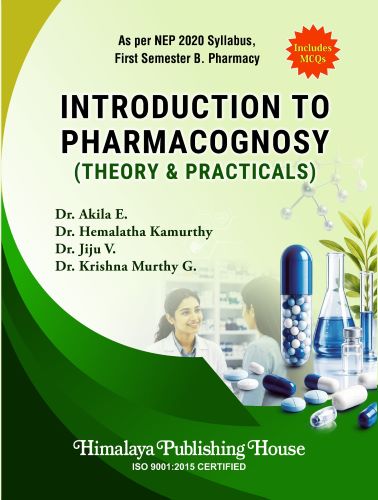

Pharmacognosy is a fundamental branch of pharmaceutical sciences concerned with medicinal substances obtained from natural sources and provides the scientific basis for their identification, evaluation, quality control, and therapeutic applications. With the growing interest in natural products and traditional systems of medicine, the subject has expanded to incorporate modern approaches to authentication, standardization, quality control, conservation, and scientific evaluation of medicinal plants.
“Introduction to Pharmacognosy” has been designed primarily for I Semester students of the Bachelor of Pharmacy (B.Pharm) programme, presenting the subject in a clear, systematic, and student-friendly manner.
The book introduces the fundamentals, history, development, scope, sources and classification of crude drugs, along with the role of pharmacopoeias. It further covers the cultivation, collection, processing and storage of drugs of natural origin, including Good Agricultural and Collection Practices, factors affecting cultivation and collection, plant growth hormones, mutation, hybridization, polyploidy, conservation, cryopreservation, and eco-pharmacognosy.
The book also addresses qual ity control of natural drugs, including adulteration, evaluation, physicochemical parameters, and modern authentication techniques such as DNA barcoding. An overview of plant metabolites and traditional systems of medicine—Ayurveda, Siddha, Unani, Homeopathy, and Traditional Chinese Medicine—is provided, along with important phytotherapeutic agents, their biological sources, major constituents, and therapeutic uses.
The practical section complements the theoretical concepts through experiments involving morphological and organoleptic evaluation, powder microscopy, moisture content, swelling and foaming indices, stomatal and vein characteristics, ash and extractive values, foreign organic matter, and microscopic measurement of calcium oxalate crystals, fibres, and starch grains.
To support effective revision and examination preparation, unit-wise important questions are included at the end of the respective units. The contents are organized to facilitate classroom teaching, self-study, practical learning, revision, and university examination preparation.
Contents –
UNIT 1 FUNDAMENTALS OF PHARMACOGNOSY
1.1 Definition
1.2 The History of Pharmacognosy
1.3 The Present Status of Pharmacognosy
1.3.1 Revolution in Analytical Standardization
1.3.2 Genomic and Transcyptomic Authentication
1.3.3 Transition to Green Biotechnology
1.3.4 Stringent Contaminant Screening
1.3.5 Clinical Evidence and Regulatory Integration
1.4 The Scope of Pharmacognosy
1.5 Development of Pharmacognosy
1.6 Sources of Drugs
1.7 Historical Milestones in Drug Discovery
1.8 Introduction to Traditional and Herbal Pharmacopoeias
1.8.1 Indian Pharmacopoeia (IP)
1.8.2 British Herbal Pharmacopoeia (BHP)
1.8.3 United States Pharmacopoeia (USP) – Herbal Medicines and Dietary Supplements
1.8.4 Ayurvedic Pharmacopoeia of India (API)
1.8.5 Unani Pharmacopoeia of India (UPI)
1.8.6 American Herbal Pharmacopoeia (AHP)
1.9 Official and Non-Official: Codified and Non-Codified Drugs
1.10 Classification of Crude Drugs
UNIT 2 CULTIVATION, COLLECTION, PROCESSING AND STORAGE OF DRUGS OF NATURAL ORIGIN
2.1 Cultivation of Medicinal Plants
2.1.1 Cultivation Techniques
2.2 Good Agricul tural and Col lect ion Pract ices (GACP/GCP) for Medicinal Plants
2.2.1 Good Agricultural Practices (GAP)
2.2.2 Good Collection Practices (GCP)
2.3 Factors Influencing Cultivation
2.3.1 Intrinsic Factors (Internal Factors)
2.3.2 External Factors (Extrinsic Factors)
2.4 Factors Affecting Collection of Medicinal Plants
2.5 Factors Affecting Storage of Medicinal Plants
2.6 Plant Growth Hormones and their Applications in Cultivation of Medicinal Plants
2.7 Mutation, Hybridization and Polyploidy in the Production of Secondary Metabolites
2.7.1 Polyploidy
2.7.2 Mutation
2.7.3 Hybridization
2.8 EX-SITU and IN-SITU Conservation and Strategies for value addition of Medicinal Plants
2.8.1 In-Situ Conservation of Medicinal Plants
2.8.2 Ex-Situ Conservation of Medicinal Plants
2.8.3 Cryopreservation
2.9 Role of Eco-pharmacognosy in Sustainable Conservation of Endangered Medicinal Plants Endangered Medicinal Plants
Unit 3 QUALITY CONTROL OF DRUGS OF NATURAL ORIGIN
3.1 Adulteration
3.1.1 Forms of Adulteration
3.1.2 Intentional Adulteration
3.1.3 Incidental Contamination
3.1.4 Deliberate Adulteration
3.1.5 Intentional Contamination Techniques
3.2 Evaluation of Crude Drugs
3.2.1 Morphological Evaluation of Crude Pharmaceuticals
3.2.2 Microscopic Evaluation of Crude Drugs
3.2.3 Physical Evaluation of Crude Drugs
3.2.4 Chemical Evaluation of Crude Drugs
3.2.5 Biological Evaluation of Crude Drugs
3.3 Physiochemical Parameters
3.3.1 Extractive Value
3.3.2 Moisture Content
3.3.3 Foreign Organic Matter
3.3.4 Ash Value
3.3.5 The Bitterness Value
3.3.6 Foaming Index
3.3.7 Hemolytic Assay
3.3.8 Swelling Index
3.3.9 Viscosity
3.3.10 Optical Rotation
3.3.11 Refractive Index
3.3.13 Saponification Value
3.4 DNA Barcoding
UNIT 4 INTRODUCTION TO METABOLITES OF PLANT ORIGIN
4.1 Introduction to Metabolites of Plant Origin
4.1.1 Introduction
4.1.2 Definition of Plant Metabolites
4.1.3 General Properties of Plant Metabolites
4.1.4 Classification of Plant Metabolites
4.2 Traditional Systems of Medicine Basic Principles of Treatment of Diseases in Different Systems of Medicine including AYUSH and TCM.
4.3 Traditional System of Medicine
4.3.1 Introduction
4.3.2 Ayurveda System of Medicine
4.3.3 Siddha Systems of Medicine
4.3.4 Unani System of Medicine/Unani Tibb System
4.3.5 Homeopathic System of Medicine
4.3.6 Traditional Chinese Systems of Medicine (TCM)
4.4 Types of dosage forms in AYUSH Medicines
4.5 Role of Pharmacognosy in Allopathy and Traditional Systems of Medicine such as AYUSH and TCM
4.5.1 Role of Pharmacognosy in Allopathy or Modern System of Medicine
4.5.2 Role of Pharmacognosy in in Ayurvedic System of Medicine
4.5.3 Role of Pharmacognosy in Unani System of Medicine
4.5.4 Role of Pharmacognosy in Siddha System of Medicine
4.5.5 Role of Pharmacognosy in Homeopathy
4.5.6 Role of Pharmacognosy in the Traditional Chinese Medicine (TCM)
Unit 5 PHYTO-THERAPEUTIC AGENTS
5.1 Adaptogens and Immunomodulators
5.1.1 Ashwagandha
5.1.1 Tulsi
5.1.2 Amla
5.2 Hepatoprotectives
5.2.1 Milk Thistle
5.2.2 Kutki
5.3 Cardiovascular Drugs
5.3.1 Garlic
5.3.2 Arjuna
5.4 Antidiabetics
5.4.1 Gymnema
5.4.2 Fenugreek
5.5 Anti-inflammatory and Analgesics
5.5.1 Turmeric
5.5.2 Boswellia
5.6 CNS Drugs
5.6.1 Brahmi
5.7 Antimicrobial and Antivirals
5.7.1 Giloy
5.7.2 Neem
5.7.3 Andrographis
5.8 Gastrointestinal Drugs
5.8.1 Psyllium
5.9 Dermatological Agents
5.9.1 Aloe
5.10 Drugs used in Women’s Health
5.10.1 Chasteberry
5.10.2 Shatavari
5.11 Respiratory Drugs
5.11.1 Vasaka
Practicals