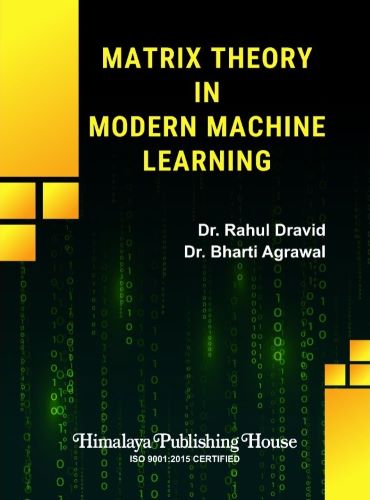




This book is a comprehensive yet student-friendly guide that bridges essential matrix concepts with their real-world applications in machine learning and AI. Covering topics like linear transformations, eigenvalues, SVD, and matrix factorisations, the book helps readers build a strong mathematical foundation for understanding and developing modern algorithms. With clear explanations, practical examples, and exercises, it is ideal for undergraduate and postgraduate students in computer science, data science, and engineering. This book not only supports academic learning but also prepares students for research and industry roles in the rapidly evolving field of machine learning.
Contents –
Chapter 1 Matrices
1.1 Introduction to Matrix
1.2 Definition
1.3 Types of Matrices
1.4 Properties of Transpose of Matrix
1.5 Linear Independent Row and Linear Independent Columns
1.6 Linear Dependent Row and Linear Dependent Columns
1.7 Rank of Matrix
1.8 Solution of a System of Linear Equations by Rank Method
Chapter 2 Eigen Values and Eigen Vectors
2.1 Introduction to Eigen Values and Eigen Vectors
2.2 Definition
2.3 Characteristic Polynomial
2.4 Characteristic Equation
2.5 Properties of Eigen Values
2.6 Spectrum of Eigen Values of Various Matrices
2.7 Properties of Eigen Vectors
2.8 Some Important Facts of the Matrix
Chapter 3 LU Decomposition
3.1 Introduction
3.2 Definition
3.3 LU Decomposition by Row Operation Method
3.4 General Python Code for LU Decomposition
3.5 Python Algorithm Using Row Operations for LU Decomposition
Chapter 4 QR Decomposition
4.1 Introduction
4.2 Definition
4.3 QR Decomposition is Useful Why?
4.4 Gram Schmidt Method for QR Decomposition
4.5 Application of QR decomposition in Machine Learning
Chapter 5 Singular Value Decomposition (SVD), PCA, and Applications
5.1 Introduction to Singular Value Decomposition (SVD)
5.2 Definition
5.3 Intuition behind SVD
5.4 SVD of Matrix A
5.5 Application in Image Compression
5.6 Introduction to Machine Learning (ML)
5.7 ML Types
5.8 Principal Component Analysis (PCA)
5.9 How to Implement PCA?
5.10 Matrix and Machine Learning Concept in Indian
Knowledge System