
Banking is a long-established activity in a financial system of a country. The provision of efficient loan and deposit facilities by banks, is an essential ingredient for the development of people in a society. This is the reason why all banks are managed prudently. Asset-liability mismatch and liquidity risk management are the two core principles of banking. Accepting deposits for shorter period and advancing for long period creates a mismatch. This mismatch gives rise to liquidity risk. Banks, therefore, take measures to ensure liquidity by maintaining cash reserves as prescribed by statutes and take temporary loans from RBI (The Central Bank of our Country).
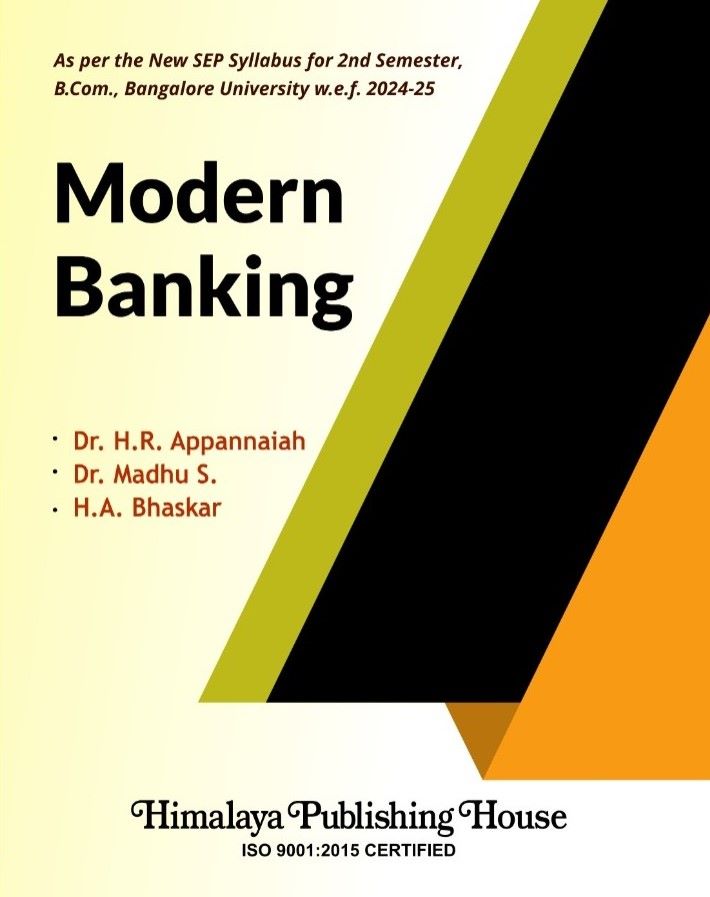
This title “MODERN BANKING” provides an overview of the concept of bank and banking and its operations. The book covers the banking aspects such as meaning, importance and types of banks, function of banks, RBI’s functions and role in controlling commercial banks, different types of bank accounts, Cheque as a negotiable instrument and it’s utility, loans and advances and innovation in banking operations.
Bangalore University is offering B.Com Course and have prescribed “Modern Banking” as an core subject. This title is produced as per the syllabus prescribed under New Education Policy. Basic aspects of banking are analysed in a very simple and understandable language to see that students enjoy and internalise the various aspects of banking operations.
Contents –
Module – 1: Evolution on Banking
1. Evolution of Banking
Module – 2: Types of Banks & Banker – Customer Relationship
2. Types of Banks
3. Banker and Customer Relationship – I (General Relationship)
4. Banker and Customer Relationship – II (Special Relationship)
Module – 3: Negotiable Instruments and Endorsement
5. Negotiable Instruments – I (Promissory Notes and Bill of Exchange)
6. Negotiable Instruments – II (Cheque)
7. Endorsement
Module – 4: Digital Banking Services
8. Digital Banking Services
Module – 5: Ethics in Banking
9. Ethics in Banking