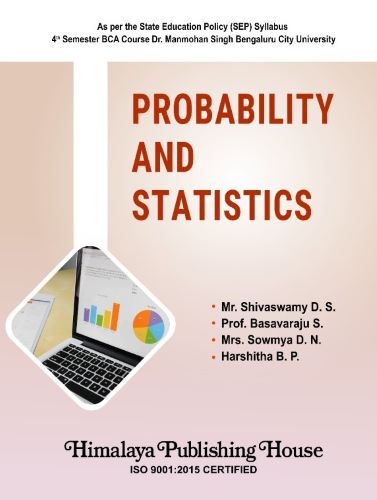


Probability and Statistics constitute a fundamental discipline for understanding uncertainty, analyzing data, and supporting informed decision-making across diverse domains. This course is structured to develop a strong conceptual and analytical foundation in probability theory and random variables, which are essential for students in fields such as engineering, computer science, data analytics, and management.
The course begins with an introduction to the fundamental principles of probability, including random experiments, sample spaces, and events. It emphasizes both the frequentist and axiomatic approaches, enabling students to interpret probability from practical as well as theoretical perspectives. Key concepts such as conditional probability and independence are explored in depth, providing a basis for analyzing relationships between events. Additionally, important theorems, including the addition and multiplication rules and Bayes’ theorem, are presented to facilitate systematic and logical problem-solving.
The subsequent unit focuses on random variables and their associated probability distributions. Students are introduced to both discrete and continuous random variables and learn to represent them using Probability Mass Functions (PMF) and Probability Density Functions (PDF). The study of distribution functions and their properties further enhances understanding of how probabilities are structured and interpreted.
The course also covers essential statistical measures such as mathematical expectation and variance, which are critical for summarizing and analyzing data. Furthermore, the concept of functions of random variables is included to enable the analysis of more complex probabilistic models.
Contents –
UNIT 1: FOUNDATIONS OF PROBABILITY
1.1 Introduction to Probability
1.2 Random Experiments
1.3 Sample Space
1.4 Events and Types of Events
1.4.1 Simple Events
1.4.2 Compound Events
1.4.3 Certain (Sure) Event
1.4.4 Impossible Event
1.4.5 Equally Likely Events
1.4.6 Complementary Events
1.4.7 Mutually Exclusive Events
1.4.8 Exhaustive Events
1.4.9 ‘Or’ Event
1.4.10 ‘And’ Event
1.5 Approaches to Probability
1.5.1 Classical Approach
1.5.2 The Empirical (Experimental) Approach
1.5.3 Axiomatic Approach
1.6 Basic Laws of Probability
1.6.1 Addition Theorem of Probability
1.6.2 Multiplication Theorem of Probability
1.7 Conditional Probability
1.8 Bayes’ Theorem
1.9 Applications of Bayes’ Theorem
1.10 Review Questions
Solved Example Problems
Unit 2 RANDOM VARIABLES AND PROBABILITY DISTRIBUTIONS
2.1 Introduction to Random Variables
2.2 Discrete Random Variables
2.3 Continuous Random Variables
2.4 Probability Distribution
2.5 Probability Mass Function (PMF)
2.5.1 Properties of PMF
2.5.2 Mean and Variance using PMF
2.6 Probability Density Function (PDF)
2.6.1 Properties of PDF
2.6.2 Mean and Variance using PDF
2.7 Mathematical Expectation
2.7.1 Expectation of a Function of Random Variable
2.7.2 Variance and Standard Deviation
2.8 Standard Probability Distributions
2.8.1 Binomial Distribution
2.8.2 Poisson Distribution
2.8.3 Normal Distribution
2.9 Applications and Solved Examples
2.9.1 Applications of Discrete Random Variables
2.9.2 Applications of Continuous Random Variables
2.9.3 Application of Normal Distribution
2.9.4 Business Decision-Making Example
2.9.5 Mixed Concept Problem
2.10 Review Questions