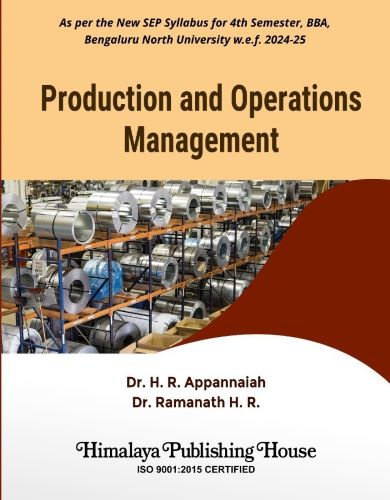
Production and Operations Management (POM) is the study of managing, designing, and controlling production processes. It also involves redesigning business operations for goods or services. POM ensures that resources are used efficiently. It helps meet customer requirements consistently. Managing production and operations is key to the success of any manufacturing or service organization. It includes activities such as plant location, facility layout, production planning, inventory management, and quality assurance. All of these aim to improve productivity while reducing costs.
Recently, POM has changed significantly due to technology and evolving market needs. There is more focus on quality and sustainability. Concepts like Industry 4.0, Lean Manufacturing, Just-in-Time (JIT), and Total Quality Management (TQM) are central today. Organizations must optimize processes and ensure product quality. They must also adopt sustainable practices to stay competitive in a global market.
This book is for students and practitioners seeking a full understanding of POM. It covers key topics such as the meaning, scope, and benefits of production and operations management. It also explains plant location strategies, facility layout, production planning and control, inventory management, and current trends. Each chapter provides clear explanations and examples. Graded questions are included for self-assessment. The content helps students in business management courses and those preparing for real-world operational challenges. Special attention is given to Smart Manufacturing, Supply Chain Digitalization, Sustainable and Green Manufacturing, and Business Process Reengineering. Learners gain knowledge that is relevant to today’s business world.
Contents –
UNIT – 1 INTRODUCTION
Concept of Production, Production Management: Meaning, Scope and Benefits of Production Management, Functions of a Production Manager Operations Management: Concept of Operations, Operations Management, Functions of Operations Management, Differences Between Production and Operations Management Production System: Meaning and Types of Production System.
UNIT – 2 PLANT LOCATION AND LAYOUT
Plant Location: Meaning, Factors affecting plant location, Cost Factor in Plant Location Plant Layout: Meaning, Principles and Types of Plant Layout Organization of Physical Facilities: Building, Sanitation, Lighting, Air Conditioning and Safety.
UNIT – 3 PRODUCTION PLANNING AND CONTROL
Production Planning and Control: Meaning, Characteristics, Objectives, Scope and Stages Production Planning and Control; Factors affecting Production Planning and Control, Production Planning System (Meaning Only).
UNIT – 4 INVENTORY AND QUALITY MANAGEMENT
Inventory: Concept and Classification of Inventory, Costs Associated with Inventories; Inventory Management: Meaning, Objectives and Importance; Factors Influencing Inventory Control Policies; Stock Levels: Minimum Level, Maximum Level, Economic Order Quantity (EOQ) And Re-Order Level (Meaning Only) Inventory Control Techniques: ABC Analysis, Just-in-Time (JIT) Quality Management: Concept of Quality, Objectives and Importance of Quality Management in Production, Concept of Quality Circles, role of quality management in organizational growth Quality Control: Meaning and Objectives of Quality Control, Need for Quality Control.
UNIT – 5 RECENT TRENDS IN PRODUCTON AND OPERATIONS MANAGEMENT
Smart Manufacturing & Industry 4.0, Lean Manufacturing, Just-in-Time (JIT) Production, Total Quality Management (TQM), Supply Chain Digitalization, Sustainable and Green Manufacturing, Agile Manufacturing, Kaizen, Cycle Time Reduction, Business Process Reengineering (Meaning and Importance of these Concepts are to be discussed)