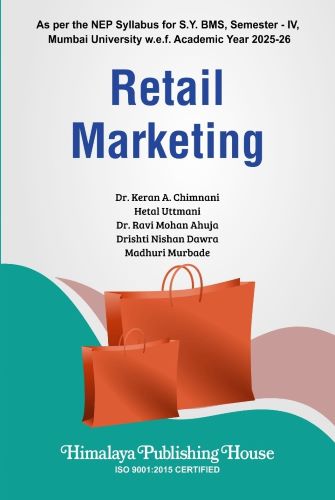


It gives us immense pleasure to present the First Edition of Retail Marketing, which has been carefully developed to align with the Second Year B.Com. (Management Studies) curriculum under the University of Mumbai, as per the guidelines of the National Education Policy (NEP) 2020 and is applicable from the academic year 2025–26.
Retail marketing has evolved from simple product displays and promotional discounts into a dynamic, data-driven discipline centred on creating meaningful customer experiences. Today’s shoppers are informed, digitally connected and selective expecting brands to understand their needs, anticipate their preferences and communicate with authenticity. This shift has transformed retail into a landscape where strategy, creativity and technology must work together seamlessly.
This book is designed to guide readers through that landscape. It explores the principles, tools, and emerging trends that shape successful retail marketing, from understanding consumer behaviour and managing brand identity to leveraging Omni channel strategies, analytics and experiential retail. Whether you are a student entering the field, a professional refining your expertise, or a business leader seeking to deepen your understanding, this work aims to provide both foundational concepts and practical applications.
Contents –
Module I: Introduction to Retail Marketing
1.1. Retail Marketing – Meaning, Definitions – Characteristics and Functions – Social and Economical, Importance of Retailing; Types of Retail stores, Challenges and Opportunities.
1.2. FDI in Retail Marketing – Meaning, Need for FDI in Indian Retail scenario, Concept of Green Retailing, Concept of Airport Retailing, Impact of Globalisation on Retail marketing
1.3. Retail Consumer: Meaning, Retail Consumer Behaviour, Factors influencing the Retail Consumer, Retail Customer Buying Behaviour, Customer Decision-making Process
1.4. CRM in Retail Marketing – Meaning, Objectives, Customer retention approaches, Special Customer services, Personalisation, Community
Module II: Decision on Retail Location, Layout and Merchandising
2.1. Retail Location Strategy – Importance of Location decision – Types of Location decision and its determining factors – Retail Location theories – Location assessment procedures
2.2. Store Design and Layout – Comprehensive Store Planning – Exterior Design and Layout – Interior Store Design and Layout – Interior Design Elements
2.3. Merchandising and Assortment Planning, – Concept, Types, Evolution, Factors Influencing Principles of Merchandising.
2.4. Merchandise Category – Meaning, Importance, Components, Role of Category captain, Merchandise Procurement – Meaning, Process, Sources of Merchandise.
Module III: Rural Retailing and Retail Branding
3.1. Rural Retailing: Meaning Characteristics, Importance, Scope, Trends, Challenges, Difference between Rural and Urban Retailing
3.2. 4 Ps of Rural Retailing: Product Strategy of Rural Retail, Price Strategy of Rural Retail, Place Strategy of Rural Retail, Promotion Strategy of Rural Retail
3.3. Retail Branding – Concept of Retail Branding and its Importance, Scope of Retail Branding, Challenges and Opportunities of Retail Branding
3.4. Brand Equity – Strategic Brand Management, Retail Branding: Process, Retail Brand vs. Corporate Brand.
Module IV: E-Retailing and Visual Merchandising
4.1. Foundation of E-Retailing: Meaning, Features, Need of E-Retailing, Traditional Marketing to E-Marketing, Challenges of E-Retailing
4.2. E-Retailing Business Models, E-Retailing Marketing Mix: Supply Chain Management System in E-Retailing, Promotional Strategies of E-Retail Business
4.3. Concept of Online Pricing; Factors affecting; Different Methods/Strategies of Online Pricing; Price Discrimination in E-Retailing; Dynamic Pricing for E-Retailing
4.4. VisualMerchandising – Meaning, Significance, Tools used for Visual Merchandising, Concept of Planogram, Meaning and Methods of display, Errors in creating display.
Model Question Paper