




India’s economic landscape is deeply rooted in its villages, with nearly two-thirds of the population residing in rural areas. Over the years, rural markets have transformed from subsistence-driven, agriculture-centric economies into dynamic, aspiration-led consumption and production hubs. Rising incomes, improved infrastructure, digital penetration, financial inclusion, and proactive government initiatives have collectively reshaped rural India into one of the most promising frontiers for business growth. In this context, Rural Marketing has emerged as a vital discipline for students of commerce and management, enabling them to understand, analyse, and strategically engage with rural consumers and markets.
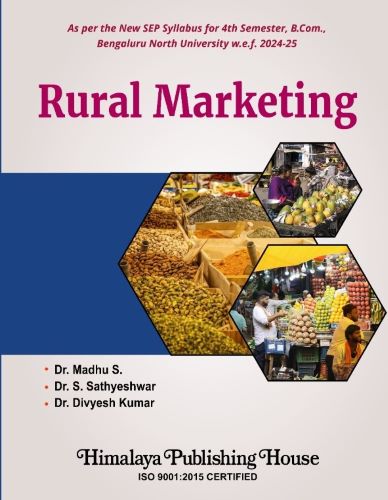
This book, Rural Marketing, is carefully designed in accordance with the B.Com, 4th Semester, SEP syllabus of Bengaluru North University. It aims to provide students with a comprehensive, structured, and contemporary understanding of rural markets in India. The content blends conceptual clarity with practical relevance, enabling learners to appreciate the unique nature of rural markets while equipping them with the tools required to design effective marketing strategies.
Module 1: Introduction to Rural Marketing lays the foundation by explaining the meaning, nature, scope, and evolution of rural marketing in India. It highlights the distinctive features of rural markets, compares rural and urban markets, examines the rural business environment, and discusses the challenges and opportunities faced by marketers. Special emphasis is given to government initiatives for rural development and their critical role in shaping rural marketing practices.
Module 2: Rural Consumer Behaviour focuses on understanding the rural consumer, whose buying behaviour is shaped by cultural traditions, social structures, economic conditions, and community influence. The module explores the characteristics of rural consumers, factors influencing their purchase decisions, the rural household buying process, and the significant role played by opinion leaders and reference groups in influencing consumption patterns.
Module 3: Rural Marketing Mix addresses the adaptation of the traditional marketing mix to rural realities. It covers product planning and design suitable for rural needs, pricing strategies sensitive to rural income patterns, distribution channels and logistics challenges, the role of retailers, and the effectiveness of various promotional tools and media. The module also highlights the importance of packaging and branding in enhancing acceptance and trust among rural consumers.
Module 4: Rural Marketing Strategies provides strategic insights into market segmentation, targeting, and positioning in the rural context. It examines rural distribution strategies, supply chain management, promotion and communication approaches, and the vital role of the sales force and personal selling. The module also emphasizes institutional support systems, including NGOs, Self-Help Groups (SHGs), and cooperatives, which play a crucial role in strengthening rural markets.
Module 5: Emerging Trends and Innovations in Rural Marketing captures the ongoing transformation of rural India. It discusses the impact of digital technology and e-rural marketing, the role of microfinance and rural credit systems, green marketing and sustainable practices, Preface circular economy models, rural innovation, emerging business models, and rural entrepreneurship. The module concludes with a forward-looking perspective on the future of rural marketing in India.
This book adopts a student-friendly approach, using simple language, logical flow, real-world examples, and contemporary perspectives to enhance learning and application. It is intended not only to help students excel in examinations but also to prepare them to understand and engage with rural markets as future managers, entrepreneurs, policymakers, and marketing professionals.
Contents –
MODULE 1 INTRODUCTION TO RURAL MARKETING
Rural Marketing: Meaning, Nature and Scope – Features of Rural Markets – Evolution and Development of Rural Marketing in India – Classification of Rural Markets – Rural v/s Urban Markets – Rural Business Environment – Challenges and opportunities in Rural Marketing – Government Initiatives for Rural Development and its role in Rural Marketing.
MODULE 2 RURAL CONSUMER BEHAVIOUR
Rural Consumer Behaviour: Characteristics Of Rural Consumers – Factors Influencing Rural Consumer Behaviour – Cultural, Social & Economic Aspects Of Rural Buyers – Buying Decision Process In Rural Households – Role Of Opinion Leaders And Reference Groups.
MODULE 3 RURAL MARKETING MIX
Rural Marketing Mix: Product planning and design for rural markets, pricing strategies for rural consumers, rural distribution channels and logistics, role of retailers in distribution, promotional tools and media in rural areas, packaging and branding for rural markets.
MODULE 4 RURAL MARKETING STRATEGIES
Market Segmentation: Targeting and Positioning in rural context – Distribution Strategies and Rural Supply Chain Management – Promotion and Communication strategies for Rural Consumers – Role of Sales Force & Personal Selling in Rural Areas – Institutional Support in Rural Marketing including NGOs, SHGs, and Cooperatives.
MODULE 5 EMERGING TRENDS AND INNOVATIONS IN RURAL MARKETING
Impact of Digital Technology on Rural Marketing – e-rural Marketing – Role of Microfinance and Rural Credit Systems – Green marketing and Sustainable practices in Rural Areas – Circular Economy & Rural Innovation – Emerging Business Models and Rural Entrepreneurship – Future Outlook of Rural Marketing in India.