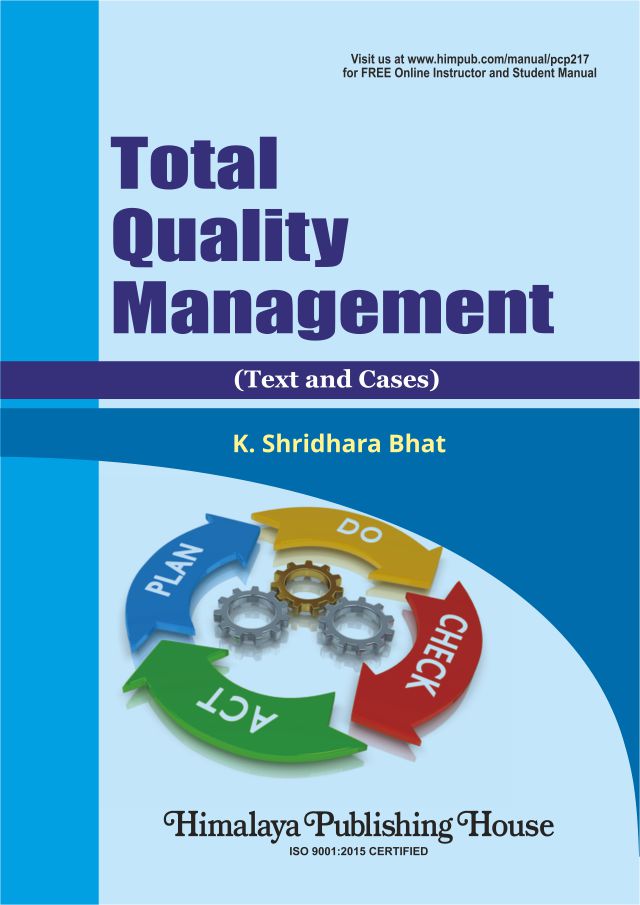

The subject of TQM is vast. There are many issues and interfaces to be considered; and there are many principles and practices to be understood. Also there are many tools, techniques an organisation can use to assist the introduction and development of the TQM concept. An attempt has been made in this book to cover the main aspects and functions of TQM, from the “quality system” concepts, through management issues and technical issues in quality management, to the management of total quality which includes the tools and techniques of total quality management.
This book is organized into 21 chapters, the first three chapters concerned with the concepts and principles of TQM, the next seven chapters (Chapter 4 to 10) concerned with management issues in quality, chapter 11 to chapter 14 concerned with technical issues in quality and the remaining 7 chapters (chapter 15 to chapter 21) concerned with management of total quality. The Learning Objectives, Box Illustrations, Exhibits, Tables, Summary, Key Words Used, Objective Questions, Discussion Questions, Assignments and Chapter Cases are value additions to the text in each chapter.
Contents –
1 : Introduction to Quality Management
1.0 Introduction
1.1 What is Quality
1.2 Definitions of Quality
1.3 The Concept of Quality
1.4 Importance of Quality
1.5 Benefits of Quality
1.6 Dimensions of Quality
1.7 Types of Quality
1.8 Five Views of Quality
1.9 Levels of Quality
1.10 Determinants of Quality
1.11 Quality in Production Systems
1.12 Some Aspects of Quality
1.13 The Evolution of Quality Management
1.14 Principles of Quality Management
1.15 The Concept of Total Quality
1.16 Principles of Total Quality
1.17 Total Quality and Organisational Culture
1.18 The Evolution of Total Quality Control
1.19 Principles of Total Quality Control
1.20 Quality in Practice
1.21 Summary
1.22 Key Words Used
1.23 Objective Questions
1.24 Review Questions
1.25 Discussion Questions
1.26 Assignments
1.27 Chapter Case
2 : Total Quality in Organisations
2.0 Introduction
2.1 Quality in Manufacturing and Service Systems
2.2 Quality Management
2.3 Traditional vs Modern Quality Management
2.4 Quality Planning, Control and Improvement
2.5 Quality and Financial Performance
2.6 What is Total Quality Management? (TQM)
2.7 Principles of Total Quality Management (TQM)
2.8 The Scope of Total Quality Management
2.9 Overview of The Major Elements of a Total Quality Infrastructure
2.10 Total Quality Management Vs Traditional Management Practices
2.11 Benefits of TQM
2.12 Major Axioms of TQM
2.13 Elements of Total Quality Management Concept
2.14 Quality in Practice
2.15 Summary
2.16 Key Words Used
2.17 Objective Questions
2.18 Review Questions
2.19 Discussion Questions
2.20 Assignments
2.21 Chapter Case
3 : Quality Management Philosophies
3.0 Introduction
3.1 The Deming Philosophy
3.2 The Juran Philosophy
3.3 The Crosby Philosophy
3.4 Genichi Taguchi and TQM
3.5 Kaoru Ishikawa and TQM
3.6 Masaaki Imai and TQM
3.7 A.V. Feigenbaum and TQM
3.8 Shigeo Shingo and TQM
3.9 Dr. Walter Shewhart and TQM
3.10 Overview and Criticism of Quality Philosophies
3.11 Quality in Practice
3.12 Summary
3.13 Key Words Used
3.14 Objective Questions
3.15 Review Questions
3.16 Discussion Questions
3.17 Assignments
3.18 Chapter Case
4 : Frameworks for Organisational Quality
4.0 Introduction
4.1 Models of Achieving TQM
4.2 Emerging Quality Standards
4.3 International Quality Award Programs
4.4 The TQMEX (Total Quality Management for Excellence) Model
4.5 TQM Kitemarks
4.6 ISO 9000 : 2000 Standards
4.7 Six Sigma Concept
4.8 Quality Awards Programs in India
4.9 The Business Excellence Model
4.10 CII–Exim Bank Award For Excellence
4.11 Rajiv Gandhi National Quality Award (RGNQA)
4.12 Golden Peacock National Quality Award (GPNQA)
4.13 IMC Ramakrishna Bajaj National Quality Award
4.14 Quality in Practice
4.15 Summary
4.16 Key Words Used
4.17 Objective Questions
4.18 Review Questions
4.19 Discussion Questions
4.20 Assignments
4.21 Chapter Case
5 : Focusing on Customers
5.0 Introduction
5.1 Who is the Customer?
5.2 Customer Perception of Quality
5.3 The Driver of Customer Satisfaction
5.4 The Importance of Customer Satisfaction
5.5 Model of Customer Satisfaction
5.6 Understanding Customer Needs and Wants
5.7 Delighting the Customers
5.8 Customer Relationship Management
5.9 Establishing a Customer Focus
5.10 Quality in Practice
5.11 Summary
5.12 Key Words Used
5.13 Objective Questions
5.14 Review Questions
5.15 Discussion Questions
5.16 Assignments
5.17 Chapter Case
6 : Leadership and Strategic Planning for TQM
6.0 Introduction
6.1 Requirement of Effective Leadership
6.2 Leadership Theories
6.3 Quality Implications of Leadership Theories
6.4 Strategic Quality Management (SQM)
6.5 Leadership and Strategic Planning
6.6 Management and Planning Tools for Implementing Policy Deployment
6.7 Leadership and Strategic Planning in The Baldrige Criteria
6.8 Deploying a Quality Culture
6.9 Developing Culture for TQM
6.10 Organisational Culture and Ethics
6.11 Establishing a Quality Culture
6.12 Quality in Practice
6.13 Summary
6.14 Key Words Used
6.15 Objective Questions
6.16 Review Questions
6.17 Discussion Questions
6.18 Assignments
6.19 Chapter Cases
7 : Human Resource Practices for TQM
7.0 Introduction
7.1 The Scope of Human Resource Management
7.2 Linking Human Resource Plans and Business Strategy
7.3 Designing High Performance Work Teams
7.4 Team Work and Co-Operation
7.5 Developing Successful Teams
7.6 Health, Safety and Employee Well-Being
7.7 Managing Human Resources in a Total Quality Environment
7.8 Applying Motivational Theories to TQ
7.9 Measuring Employee Satisfaction and HRM Effectiveness
7.10 Human Resource Focus in the Baldrige Criteria, ISO 9000 and Six Sigma
7.11 Quality in Practice
7.12 Summary
7.13 Key Words Used
7.14 Objective Questions
7.15 Review Questions
7.16 Discussion Questions
7.17 Assignments
7.18 Chapter Case
8 : Total Quality and Organisational Behaviour
8.0 Introduction
8.1 Quality Team Work
8.2 Types of Total Quality Teams
8.3 Effective Team Work
8.4 Team Membership and Roles
8.5 Team Processes
8.6 Empowerment and Motivation
8.7 Principles of Empowerment
8.8 Implementing Empowerment
8.9 Motivation
8.10 Quality in Practice
8.11 Summary
8.12 Key Words Used
8.13 Objective Questions
8.14 Review Questions
8.15 Discussion Questions
8.16 Assignments
8.17 Chapter Case
9 : Organising for TQM
9.0 Introduction
9.1 Need for Organising for Quality
9.2 Evolution of Organisation for Quality
9.3 Today’s Requirements for Organising for Quality
9.4 Organising for TQM – The Systems Approach
9.5 Organising for Quality Implementation
9.6 Roles in Organisational Transition to TQM
9.7 Teams For Total Quality Management
9.8 The Concept and Philosophy of Quality Circles
9.9 Self Managing Teams/Self-Managed Teams (SMT)
9.10 Comparison of Organisational Forms
9.11 Future Organisation for TQM
9.12 Providing for Self-Development and Empowerment
9.13 Providing Participation as a Means of Inspiring Action
9.14 Building a Change Oriented Organisation
9.15 Continuous Improvement (Kaizen)
9.16 The Continuous Improvement Strategy
9.17 The Kaizen Approach
9.18 Kaizen Five Step Plan
9.19 The Kaizen Philosophy
9.20 The Universal “Breakthrough Sequence”
9.21 Theory of Constraints
9.21 Quality in Practice
9.23 Summary
9.24 Key Words Used
9.25 Objective Questions
9.26 Review Questions
9.27 Discussion Questions
9.28 Chapter Case
10 : Building and Sustaining Total Quality Organisation
10.0 Introduction
10.1 Corporate Culture and Organisational Change
10.2 Quality Systems
10.3 ISO 9000
10.4 Structure of The ISO 9000 Standards
10.5 The ISO 9000 : 2000 Quality Management System
10.6 Major Elements in ISO 9001 : 2000
10.7 ISO 9000 : 2000 and TQM
10.8 Development of The Quality Management System (QMS)
10.9 Registration of ISO 9001 : 2000
10.10 ISO 9001 : 2000 Certification
10.11 Implementation of ISO 9001 : 2000
10.12 Environmental Management System
10.13 Requirements of ISO 14001 : 1996 Environmental Management System (EMS)
10.14 Other Quality Systems
10.15 Implementing a Total Quality Strategy
10.16 The Role of Employees
10.17 Sustaining The Quality Organisation
10.18 Building a Change-Oriented Organisation
10.19 Building of a Learning Organisation
10.20 Building a Fear-Free Organisation
10.21 Case Illustration
10.22 Quality in Practice
10.23 Summary
10.24 Key Words Used
10.25 Objective Questions
10.26 Review Questions
10.27 Discussion Questions
10.28 Assignments
10.29 Chapter Case
11 : Process Management
11.0 Introudction
11.1 The Scope of Process Management
11.2 Product Design Processes
11.3 Product Design Concepts and Techniques
11.4 Legal and Environmental Issues
11.5 Streamlining the Product Development Process
11.6 Process Improvement
11.7 Process Improvement Methods
11.8 Quality in Practice
11.9 Summary
11.10 Key Words Used
11.11 Objective Questions
11.12 Review Questions
11.13 Discussion Questions
11.14 Assignments
11.15 Chapter Case
12 : Statistical Concepts in Quality Management
12.0 Introduction
12.1 Quality Assurance
12.2 Concepts of Quality Assurance
12.3 Objectives of Quality Assurance
12.4 Quality Assurance System
12.5 Process Control, Inspection and Testing
12.6 Statistical Methods in Quality Assurance
12.7 Random Variables and Probability Distributions
12.8 Process Capability
12.9 Six-Sigma Quality
12.10 Statistical Quality Control
12.11 Statistical Process Control
12.12 Special Control Charts for Variables Data (‘x’ and ‘s’ Charts)
12.13 Control Charts for Attributes
12.14 NP Charts for Number Nonconforming for Constant Sample Size
12.15 Quality in Practice
12.16 Summary
12.17 Key Words Used
12.18 Objective Questions
12.19 Review Questions
12.20 Discussion Questions
12.21 Exercises
12.22 Assignments
12.23 Chapter Cases
13 : Six-Sigma Quality
13.0 Introduction
13.1 Six-Sigma Quality
13.2 Concept of Six-Sigma Quality
13.3 Six-Sigma Process Capability
13.4 Evolution of Six-Sigma Approach
13.5 Six-Sigma Philosophy
13.6 Ten Principles of Six Sigma
13.7 Pre Requisites of Six-Sigma Approach
13.8 Core Elements of Six-Sigma
13.9 Structured Problem-Solving Approaches used in Six-Sigma Projects
13.10 Six-Sigma as a Quality Framework
13.11 Application of Six-Sigma in Service Organisations
13.12 Six-Sigma Management
13.13 How Does Six-Sigma Work?
13.14 Success of Six-Sigma
13.15 Implementing Six-Sigma
13.16 Readying the Organisation
13.17 Planning for Six-Sigma
13.18 Roles and Responsibilities of People Responsible for Six-Sigma Implementation
13.19 Over View of Six-Sigma Tools
13.20 Selecting Six-Sigma Projects
13.21 Sustaining Six-Sigma
13.22 Design for Six-Sigma
13.23 Why do Design for Sigma?
13.24 Quality in Practice
13.25 Summary
13.26 Key Words Used
13.27 Objective Questions
13.28 Review Questions
13.29 Discussion Questions
13.30 Assignments
13.31 Chapter Cases
14 : Tools and Techniques For Total Quality Management
14.0 Introduction
14.1 Tools for Design Processes
14.2 Taguchi Methods
14.3 Quality Function Deployment
14.4 Poka-Yoke (Fail Safing/Fail Proofing)
14.5 Management Model for Quality Improvement
14.6 Tools for Process Improvement
14.7 Analytical Tools for TQM
14.8 Improvement Tools and Techniques
14.9 Control Tools and Techniques
(a) Project Scheduling Techniques
(b) Radar Chart
(c) Milestone Tracker Diagram
(d) Failure Modes and Effects Analysis
(e) Statistical Process Control
(f) Balanced Score Card
14.10 Quality in Practice
14.11 Summary
14.12 Key Words Used
14.13 Objective Questions
14.14 Review Questions
14.15 Discussion Questions
14.16 Assignments
14.17 Chapter Case
15 : Benchmarking
15.0 Introduction
15.1 The Evolution of Benchmarking
15.2 Advantages and Limitations of Benchmarking
15.3 Levels of Benchmarking
15.4 Types of Benchmarking
15.6 The Seven Step Benchmarking Model
15.7 Some Issues Related to Benchmarking Process
15.8 Quality in Practice
15.9 Summary
15.10 Key Words Used
15.11 Objective Questions
15.12 Review Questions
15.13 Discussion Questions
15.14 Assignments
15.15 Chapter Case
16 : Business Process Reengineering
16.0 Introduction
16.1 History and Development of Business Process Re-Engineering
16.2 Principles of Reengineering
16.3 Application of Reengineering
16.4 Process Reengineering in a Manufacturing Organisation
16.5 The Essence of Reengineering
16.6 The Three ‘r’s of Reengineering
16.7 Requirement of Reengineering Process
16.8 Reengineering in The Service Industry
16.9 Quality and Reengineering
16.10 The Reengineering Process
16.11 Process Redesign Tools and Techniques
16.12 Reengineering and Total Quality Management
16.13 Integrating Reengineering and Process Improvement
16.14 Reengineering Versus Benchmarking
16.15 Benefits of Reengineering
16.16 Limitations of Reengineering
16.17 Beyond Business Process Reengineering
16.18 Types of Holonic Networks
16.19 Advantages of Holonic Business System
16.20 Quality in Practice
16.21 Summary
16.22 Key Words Used
16.23 Objective Questions
16.24 Review Questions
16.25 Discussion Questions
16.26 Assignments
16.27 Chapter Case
17 : Managing Service Quality
17.0 Introduction
17.1 The Service Environment
17.2 Total Quality Management in Services
17.3 Models For Service Quality
17.4 Measuring Satisfaction
17.5 Role of Personnel in Service Delivery
17.6 Service Delivery
17.7 Quality Assurances in Services
17.8 Return On Service Quality
17.9 Measuring Service Quality
17.10 Building a Service Quality Information System
17.11 Summary
17.12 Key Words Used
17.13 Objective Questions
17.14 Review Questions
17.15 Discussion Questions
17.16 Assignments
17.17 Chapter Cases
18 : Implementing Total Quality Management
18.0 Introduction
18.1 Rationale for Change
18.2 Requirements for Implementation of TQM
18.3 Implementation Variation Among Organisations
18.4 Evolution of Implementation Approaches
18.5 Implementation Phases to be Considered
18.6 Getting on with Total Quality
18.7 Implementation Strategies
18.8 Quality in Practice
18.9 Summary
18.10 Key Words Used
18.11 Objective Questions
18.12 Review Questions
18.13 Discussion Questions
18.14 Chapter Case
19 : Managing Quality – Modern Improvement Approaches
19.0 Introduction
19.1 Approaches Systematically Defined
19.2 Approach 1: Total Quality Management (TQM)
19.3 Approach 2: Total Productive Maintenance (TQM)
19.4 Approach 3: Business Process Reengineering (BPR)
19.5 Approach 4: Six–Sigma
19.6 Approach 5: Lean Manufacturing
19.7 Analysis of the Five Approaches
19.8 Managerial Implications: Which Improvement Approach is Best?
19.9 Quality in Practice
19.10 Summary
19.11 Objective Questions
19.12 Review Questions
19.13 Discussion Questions
19.14 Chapter Case
20 : Managing Quality – Issues and New Challenges
20.0 Introduction
20.1 The Key Elements of TQM
20.2 Critical Issues in Effective Implementation of TQM
20.3 TQM Issues Which Need to Be Considered in The Future
20.4 New Challenges Faced By Quality Management
20.5 Quality in Practice
20.6 Summary
20.7 Objective Questions
20.8 Review Questions
20.9 Discussion Questions
20.10 Assignments
20.11 Chapter Case
21 : Achieving Business Excellence
21.0 Introduction
21.1 Business Excellence
21.2 Quality Management Awards and Frame-Works
21.3 Quality Certification
21.4 Lead Assessment
21.5 Self-Assessment for Business Excellence
21.6 Business Process Maturity Models
21.7 Overview of CMM
21.8 People Capability Maturity Model
21.9 Quality in Practice
21.10 Summary
21.11 Objective Questions
21.12 Review Questions
21.13 Discussion Questions
21.14 Assignments
21.15 Chapter Case