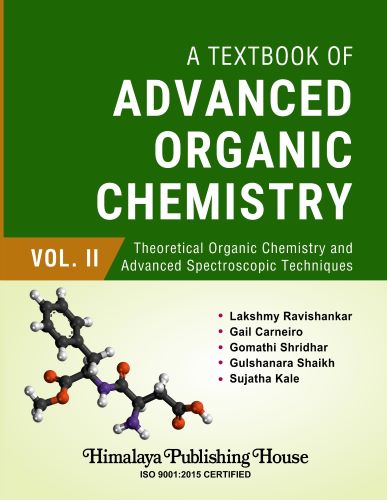





The book offers a comprehensive approach to Theoretical Organic Chemistry and Advanced Spectroscopic Techniques, tailored to the second-year M.Sc. syllabus of Indian Universities in general and Mumbai University in particular and is fully aligned with NEP 2020 guidelines. Written in a lucid style, it simplifies complex topics to help students understand and apply core concepts. Additionally, the wealth of solved and end-of-chapter problems makes it an invaluable resource for teachers and an ideal preparation tool for students preparing for competitive exams like CSIR-NET, SET, and GATE.
Contents –
1. ORGANIC REACTIVE INTERMEDIATES
1.1 Reactive Intermediates
1.2 Carbocations
1.2.1 Methods of Generation of Carbocations
1.2.2 Factors Affecting Stability of Carbocations
1.2.3 Reactions Involving Carbocation Intermediates
1.2.3.1 Addition reactions
1.2.3.2 Carbon-carbon bond formation
1.2.3.3 Rearrangement of carbocations
1.3 Carbenes
1.3.1 Generation of Carbenes
1.3.2 Stability of Carbenes
1.3.3 Reactions of Carbenes
1.3.3.1 Addition reactions
1.3.3.2 Insertion reactions
1.3.3.3 Generation of ylides from carbenoid decomposition
1.3.3.4 Rearrangement reactions
1.4 Nitrenes
1.4.1 Generation of Nitrenes
1.4.2 Stability of Nitrenes
1.4.3 Reactions of Nitrenes
1.4.3.1 Addition to alkenes
1.4.3.2 Insertion reactions
1.4.3.3 Abstraction of hydrogen
1.4.3.4 1,2 -Hydrogen shift
1.4.3.5 Coupling
1.4.3.6 1,3-Dipolar cycloaddition
1.4.3.7 Rearrangements to electron deficient nitrogen
1.5 Arynes
1.5.1 Generation of Arynes
1.5.2 Structure of Benzyne
1.5.3 Reactions of Benzyne
1.5.3.1 Reaction with a nucleophile
1.5.3.2 Dimerization
1.5.3.3 Diels-Alder reaction
1.5.3.4 [2+2] Cycloaddition and ene reaction
1.6 Ketenes
1.6.1 Generation of Ketenes
1.6.2 Structure of Ketenes
1.6.3 Reactions of Ketenes
1.6.3.1 [2+2] Cycloaddition
1.6.3.2 Dimerization
1.6.3.3 Cycloaddition
1.6.3.4 [3+2] Cycloaddition
1.6.3.5 Nucleophilic addition
1.6.3.6 Wittig reaction
1.7 Neighbouring Group Participation
1.7.1 NGP by Lone Pair of Electrons on O, N, S and Halogens
1.7.2 Aryl Participation: The Phenonium Ion
1.7.3 Alkyl and Cyclopropyl Participation in NGP
1.7.4 NGP by σ Bonds in Bicyclic Systems
1.7.3 NGP by π Bonds
1.8 Role of FMOs in Organic Reactivity
1.8.1 Hard and Soft Nucleophiles
1.8.2 Ambident Nucleophiles and Electrophiles
1.9 α-Effect
Problems
2. PERICYCLIC REACTIONS
2.1 Classification of Pericyclic Reactions
2.1.1 Electrocyclic Reactions
2.1.2 Cycloaddition Reactions
2.1.3 Cheletropic Reactions
2.1.4 Sigmatropic Rearrangement
2.1.5 Group Transfer Reactions
2.2. Theories to Explain Pericyclic Reactions and Their Outcome
2.3 Electrocyclic Reactions
2.3.1 Stereochemistry of Electrocyclic Reactions
2.3.2 Woodward – Hoffmann Rules
2.3.3 Torquoselectivity
2.4 Cycloaddition Reactions
2.4.1 Stereochemistry of Cycloaddition
2.4.2 [2+2] Cycloaddition
2.4.3 The Diels-Alder Reaction
2.4.3.1 Conformation of the diene
2.4.3.2 Electronic effects of the diene and dienophile
2.4.3.3 Regioselectivity
2.4.3.4 Stereochemistry of the Diels-Alder reaction
2.4.3.5 Drawing and interpreting the transition state of a Diels Alder reaction
2.4.4 Intramolecular Diels -Alder (IDA) Reaction
2.4.5 Hetero Diels-Alder Reaction
2.4.6 Inverse Electron Demand Diels-Alder Reaction
2.4.7 Retro Diels-Alder Reaction
2.5 1,3-Dipolar Cycloaddition
2.5.1 Regioselectivity and Reactivity of 1,3-Dipoles
2.5.2 Stereochemistry of 1,3-Dipolar Cycloadditions
2.6 Periselectivity
2.7 Cheletropic Reactions
2.8 Sigmatropic Rearrangements
2.8.1 FMO Analysis of [1, j] Sigmatropic Shifts
2.8.2 Sigmatropic Rearrangements of Alkyl Groups
2.9 [3.3] Sigmatropic Rearrangement
2.9.1 FMO Analysis of Cope Rearrangement
2.9.2 PMO Analysis of Cope Rearrangement
2.9.3 Stereochemistry of the Cope Rearrangement
2.9.4 Oxy-Cope and Anionic Oxy-Cope Rearrangement
2.9.5 Aza-Cope Rearrangement
2.9.6 Claisen Rearrangement
2.10 Group Transfer Reactions
2.11 Ene Reaction
Problems
3. PHOTOCHEMISTRY
3.1 Principles of Photochemistry
3.1.1 Excitation
3.1.2 Selection Rules
3.1.3 Jablonski Diagram
3.1.4 Photosensitization
3.1.5 Quenching
3.2 Photochemistry of Carbonyl Compounds
3.2.1 Norrish I Cleavage
3.2.2 Norrish II Cleavage
3.2.3 Patterno Buchi Reaction
3.2.4 Photoreduction
3.2.4.1 Quantum yield
3.2.5 Photochemistry of Enones
3.2.6 Photo Fries Rearrangement
3.2.7 Barton Reaction
3.3 Photochemistry of Olefins
3.3.1 Cis-trans Isomerization
3.3.2 Photodimerization
3.3.3 Di-π-methane Rearrangement
3.4 Photochemistry of Arenes
3.4.1 Valence Isomerization
3.4.2 Cycloaddition
3.5 Photooxygenation Reactions
3.6 Photochemically Induced Radical Reactions
3.7 Chemiluminescence
3.8 Bioluminescence
Problems
4. STEREOCHEMISTRY – I
4.1 Molecular Symmetry
4.1.1 Symmetry Operations and Elements
4.1.1.1 Proper axis of symmetry (Cn axis)
4.1.1.2 Plane of symmetry (σ)
4.1.1.3 Centre of symmetry or inversion centre (i)
4.1.1.4 Improper axis of symmetry or alternating axis of symmetry
4.1.1.5 Identity (E)
4.1.1.6 Chirality and elements of symmetry
4.1.2 Point Groups
4.2 Conformational Analysis of Medium Rings
4.2.1 Conformations of Medium Rings
4.2.1.1 Cyclooctane
4.2.1.2 Cyclononane
4.2.1.3 Cyclodecane
4.2.2 Unusual Properties of Medium Rings
4.2.2.1 Accommodation of a trans double bond/anti-butane unit
4.2.2.2 Conformational mobility
4.2.2.3 Concept of I-strain
4.2.2.4 Spectral properties
4.2.2.5 Transannular reactions
4.3 Stereochemistry of Fused and Bridged Ring Compounds
4.3.1 Fused Bicyclic Ring Compounds
4.3.1.1 Decalin
4.3.1.2 Hydrindane
4.3.1.3 Perhydroanthracenes
4.3.1.4 Steroids
4.3.2 Bridged Bicyclic Ring Compounds
4.3.2.1 Bicyclo[2.2.1]heptane
4.3.2.2 Bredt’s Rule
4.4 Effect of Conformation on Reactivity in Cyclic Systems
4.4.1 Introduction
4.4.2 Choice of Substrate
4.4.3 Nucleophilic Substitution
4.4.3.1 SN1 reaction
4.4.3.2 SN2 reaction
4.4.3.3 SNi reaction
4.4.4 Electrophilic Addition
4.4.5 Elimination
4.4.5.1 E2 reactions
4.4.5.2 Pyrolytic cis elimination
4.4.6 Molecular Rearrangements
4.4.7 Oxidation of Cyclohexanols
4.4.8 Reduction of Cyclohexanones
4.4.8.1 Lithium aluminium hydride
4.4.8.2 Selectrides
4.4.8.3 MPV reduction
Problems
5. STEREOCHEMISTRY – II
5.1 Racemization
5.2 Types of Racemates
5.3 Mechanism of Racemization
5.3.1 Racemization Brought about by Chemical Reactions
5.3.1.1 Racemization proceeding through formation of carbanions
5.3.1.2 Racemization proceeding through formation of carbocations
5.3.1.3 Racemization proceeding through formation of free radicals
5.3.2 Thermal Process of Racemization
5.3.3 Racemization via Stable Symmetrical Intermediates
5.4 Resolution
5.4.1 Mechanical Separation
5.4.2 Preferential Crystallisation
5.4.3 Resolution through the Formation of Diastereomers
5.4.4 Resolution through Formation of Molecular Complexes
5.4.5 Resolution by Chromatography
5.4.6 Resolution through Equilibrium Asymmetric Transformation
5.4.7 Resolution through Kinetic Asymmetric Transformation
5.5 Determination of Enantiomer and Diastereomer Composition
5.5.1 Enzymatic Methods
5.5.2 Chromatography Methods
5.5.3 Methods based on NMR Spectroscopy
5.6 Determination of Configuration
5.7 Correlative Method for Configurational Assignment
5.7.1 Chemical Method
5.7.2 Methods Based on Comparison of Optical Rotation
5.7.3 Correlation by NMR Spectroscopy
5.8 Molecular Dissymmetry and Chiroptical Properties
5.8.1 Circular Birefringence and Circular Dichroism
5.8.2 Optical Rotatory Dispersion (ORD) and CD Curves: Cotton Effect
5.8.2.1 Comparison between ORD and CD spectra
5.8.2.2 Applications of ORD and CD spectra
5.9 Empirical and Semi-Empirical Rules
5.9.1 The Axial Haloketone Rule
5.9.2 The Octant Rule
5.9.2.1 Applications of the octant rule
Problems
6. ASYMMETRIC SYNTHESIS
6.1 Introduction
6.2 Principles of Asymmetric Synthesis
6.3 Methods of Asymmetric Induction
6.3.1 Substrate Controlled Asymmetric Synthesis
6.3.1.1 Chiron approach – the chiral pool in nature
6.3.1.2 Chiral pool synthesis
6.3.1.3 Chiral substrate synthesis
6.3.2 Reagent Controlled Asymmetric Synthesis
6.3.3 Auxiliary Controlled Asymmetric Synthesis
6.3.4 Catalyst Controlled Asymmetric Synthesis
6.4 The First Industrial Catalytic Asymmetric Synthesis
6.5 Asymmetric Reactions
6.5.1 Diastereoselective Nucleophilic Addition to Carbonyl Compounds
6.5.1.1 Cram’s rule
6.5.1.2 Felkin’s model
6.5.1.3 Felkin-Anh model
6.5.1.4 Prelog’s rule
6.5.2 Aldol and Related Reactions
6.5.2.1 Aldol reaction: achiral aldehyde and an achiral enolate – Simple Diastereoselectivity
6.5.2.2 Aldol reaction: chiral aldehyde and achiral enolate – Diastereofacial Selectivity
6.5.2.3 Aldol Reaction: achiral aldehyde and chiral enolate – Diastereofacial Selectivity
6.5.2.4 Aldol Reaction: chiral aldehyde and chiral enolate – Double Stereoselection
6.5.3 Sharpless Asymmetric Oxidation Reactions
6.5.3.1 Sharpless asymmetric epoxidation
6.5.3.2 Sharpless asymmetric hydroxylation
6.5.3.3 Sharpless asymmetric aminohydroxylation
6.5.4 Asymmetric Diels-Alder Reaction
6.5.4.1 Asymmetric Diels-Alder reaction using an auxiliary
6.5.4.2 Asymmetric Diels-Alder reaction using a chiral catalyst
6.5.5 Enantioselective Reduction of Prochiral Carbonyl Compounds
6.5.5.1 Reduction of ketones using chiral reagents
6.5.5.2 Reduction of ketones using chiral boron catalysts
6.5.5.3 Reduction of ketones using transition metal catalysts
6.5.6 Enantioselective reduction of prochiral olefins
6.6 Use of Chiral Auxiliaries in Diastereoselective Reductions
6.6.1 Reduction of Carbonyl Groups
6.6.2 Diastereoselective Hydrogenation of Aromatic Compounds
6.6.3 Diastereoselective Hydrogenation of Chiral Hydrazones
6.7 Use of Chiral BINOLS, BINAPS and Oxazolines in Asymmetric Transformations
6.7.1 BINOLS
6.7.2 BINAPS
6.7.3 Oxazolines
6.8 Asymmetric Amplification and Autocatalysis
Problems
7. PHYSICAL ORGANIC CHEMISTRY
7.1 Structural Effects and Reactivity
7.2 Linear Free Energy Relationship (LFER)
7.2.1 Substituent Effects
7.3 The Hammett Equation
7.3.1 Substituent Constant
7.3.2 Reaction Constant ρ
7.3.3 Applications of the Hammett Equation
7.3.4 Mechanistic Significance of Hammett Plots
7.3.5 Assumptions Underlying the Hammett Equation
7.3.6 Scope and Applications
7.3.7 Limitations
7.3.8 Deviations from Hammett Behaviour
7.4 Yukawa-Tsuno Equation
7.4.1 Advantages Over the Hammett Equation
7.4.2 Assumptions and Limitations
7.4.3 Significance of the Yukawa–Tsuno Equation
7.4.4 Mechanistic Interpretation
7.5 Dual-Parameter Correlations
7.6 The Taft Equation
7.7 Okamoto–Brown Equation
7.8 Swain–Scott Equation
7.9 Edwards and Ritchie Correlations
7.10 Solvent Effects on Reactivity
7.11 Grunwald–Winstein Equation
7.11.1 Physical Interpretation of the Sensitivity Parameter (m)
7.11.2 Mechanistic Significance
7.11.3 Extensions and Modifications
7.11.4 Assumptions and Limitations
7.11.5 Importance in Physical Organic Chemistry
7.12 Dimroth’s ET Parameter
7.13 Solvatochromism Z-Scale
7.14 Spectroscopic Correlations
7.15 Thermodynamic Implications
Problems
8. SUPRAMOLECULAR CHEMISTRY
8.1 Types of Non-Covalent Interactions
8.2 Biological Macromolecules
8.2.1 Proteins
8.2.2 Nucleic Acids
8.2.3 Enzymes
8.3 Synthetic Molecular Receptors
8.3.1 Receptors with Molecular Tweezers
8.3.2 Receptors with Molecular Clefts
8.3.3 Receptors with Multiple Hydrogen Bonding Sites
8.3.3.1 Structural diversity: learning from nature
8.4 Structure and Properties of Some Supramolecules
8.4.1 Crown Ethers
8.4.1.1 Properties of crown ethers
8.4.1.2 Synthesis of crown ethers
8.4.2 Cryptands
8.4.2.1 Properties of cryptands
8.4.2.2 Synthesis of cryptands
8.4.3 Calixarenes
8.4.3.1 Properties of calixarenes
8.4.3.1 Synthesis of calixarenes
8.5 Cyclophanes
8.5.1 Properties of Cyclophanes
8.5.2 Applications of Cyclophanes
8.6 Rotaxanes
8.7 Cyclodextrins
8.8 Molecular Recognition and Catalysis
8.9 Molecular Self-Assembly
8.10 Supramolecular Polymers, Gels and Fibres
Problems
9. ADVANCED SPECTROSCOPIC TECHNIQUES
9.1 Introduction
9.2 Proton Magnetic Resonance (PMR)
9.2.1 Spin-Spin Coupling
9.2.2 Magnetic Equivalence
9.2.3 First Order and Second Order Spectra
9.2.3.1 Pople notation for spin-spin labelling
9.2.4 Long Range Coupling
9.2.5 Temperature Effect on NMR
9.2.6 Heteronuclear Coupling of 1H
9.2.6.1 Coupling with 19F nuclei
9.2.6.2 Coupling with 31P nuclei
9.3 13C NMR
9.3.1 Chemical Shift
9.3.1.1 Calculation of chemical shift in substituted aromatic compounds
9.3.2 Proton Coupled 13C spectra: Spin-Spin Splitting of 13C Signals
9.3.3 Heteronuclear Coupling to Other Nuclei
9.3.3.1 With 19F
9.3.3.2 With 31P
9.4 Simplification of Complex Spectra
9.4.1 Increasing the Magnetic Field
9.4.2 Use of Lanthanide Shift Reagents (LSR)
9.4.3 Nuclear Magnetic Double Resonance
9.4.4 DEPT
9.5 Two-Dimensional Spectroscopy Techniques
9.5.1 COSY (Correlation Spectroscopy)
9.5.2 HETCOR (Heteronuclear Correlation Spectroscopy)
9.5.3 NOE Difference Spectroscopy
9.5.4 NOESY (Nuclear Overhauser Effect Spectroscopy)
Problems