
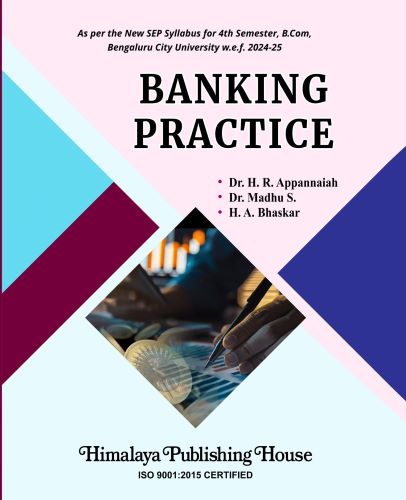



Banking plays a pivotal role in the economic development of a country by facilitating savings, investments, and the smooth flow of financial transactions. With rapid changes in the financial system, banking has evolved from traditional practices to technologically advanced and customer-centric operations. A sound understanding of banking practice is therefore essential for commerce students to appreciate both the operational and regulatory dimensions of the banking industry. The book “Banking Practice” has been carefully designed to meet this academic need.
This book is prepared strictly in accordance with the B.Com, IV Semester, SEP syllabus of Bengaluru City University. It aims to provide students with a clear, systematic, and practical understanding of banking operations, instruments, and emerging trends. The content is presented in simple language with conceptual clarity, enabling students to grasp both theoretical and applied aspects of banking practice.
Unit 1: Principles and Practices of Banking introduces students to the fundamentals of banking operations. It covers types of bank accounts, account opening and operating procedures, termination of accounts, and various categories of bank customers. The unit also explains banker-customer relationships, principles of bank lending, modes of creating charge such as lien, pledge, hypothecation, and mortgage, along with types of mortgage. Further, it provides a comprehensive understanding of debt recovery, including Non-Performing Assets (NPAs), causes of overdue, problems of debt recovery, and recovery procedures followed by banks.
Unit 2: Negotiable Instruments focuses on the legal and practical aspects of negotiable instruments used in business. It explains the meaning, definitions, features, and types of negotiable instruments. Special emphasis is given to promissory notes, bills of exchange, and cheques, along with their procedures, parties, and types. The unit also discusses dishonour of cheques, reasons for dishonour, types of crossing, and endorsement of negotiable instruments with their effects.
Unit 3: Modern Technology and Trends in Banking highlights the impact of technology on the banking sector. It covers modern banking technologies such as ATMs, RTGS, NEFT, SWIFT, EFT, ECS, mobile banking, internet banking, UPI, and IMPS. The unit also introduces students to emerging trends such as digitization, blockchain technology, artificial intelligence and banking robots, peer-to-peer payment services, biometric authentication, and cryptocurrency, providing insights into the future of banking.
This book is intended to serve as a comprehensive learning resource for students, faculty, and aspiring banking professionals. The authors hope that this work will help students build a strong foundation in banking practice and prepare them to meet academic requirements as well as real-world banking challenges.
Contents –
UNIT – 1 PRINCIPLES AND PRACTICES OF BANKING
Types of Bank Accounts, Account Opening Procedure, Account Operating Procedure, Termination of Bank Account. Bank Customers – Meaning of Bank Customer, Types of Bank Customer (i) Individual Customer (Retail) (ii) Institutional Customer and (iii) Business Customer (Companies); Bank and Customer Relations; Principles of Bank Lending; Modes of creating Charge, Lien, Pledge, Hypothecation, Mortgage – Types of Mortgage; Debt. Recovery – Concept of Non – Performing Assets (NPA), Causes of Overdue, Problems of Debt Recovery, Procedure of Debt Recover.
UNIT – 2 NEGOTIABLE INSTRUMENTS
Meaning, Definition and features of Negotiable Instruments, Types of Negotiable Instruments – Promissory Note: Definition, Features, Procedure, Bill of Exchange: Definition, Features, Procedures, Cheques: Definition, Types and Parties; Dishonour of cheques- Reasons for Dishonour of Cheques, Types of crossing of cheques. Endorsement of Negotiable Instruments – Definition and types of Endorsement, Effects of Endorsement.
UNIT – 3 MODERN TECHNOLOGY AND TRENDS IN BANKING
Modern Technology in Banking: ATM, RTGS, NEFT, SWIFT, Electronic Fund Transfer (EFT), Electronic Clearing Services (ECS), Tele Banking, Mobile Banking, Internet Banking, Unified Payment Interface (UPI), Immediate Payment service (IMPS).
New Trends in Banking: Digitization, Enhanced Mobile Banking, Block Chain, Artificial Intelligence Robots, P2P Payment Services, Biometric Authentication, Crypto currency.