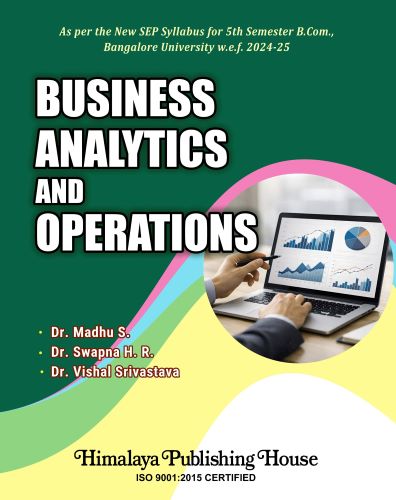


The contemporary business environment is characterised by unprecedented volumes of data, rapid technological advancements, and an increasing demand for evidence-based decision-making. In this dynamic landscape, Business Analytics has emerged as a vital discipline that empowers organisations to transform raw data into meaningful insights, enabling informed decisions, operational excellence, and sustainable competitive advantage. As businesses embrace digital transformation, the ability to collect, analyse, interpret, and utilise data has become an indispensable skill for commerce and management professionals. Consequently, Business Analytics has evolved from being a specialised function to a core competency across all business domains.
Recognising the significance of this emerging discipline, Bangalore University has introduced Business Analytics and Operations under the new State Education Policy (SEP) for V Semester, B.Com., students. This textbook has been meticulously prepared in accordance with the prescribed syllabus, with the objective of providing students with a strong conceptual foundation and practical understanding of business analytics and its applications in organisational decision-making. The contents have been presented in a simple, systematic, and learner-centric manner, making the subject accessible to students while maintaining academic rigour.
The book is organised into five comprehensive modules that progressively build the learner’s understanding of business analytics. It begins with the evolution, concepts, models, and significance of Business Analytics in solving business problems. It then explores various types of data, data collection methods, data quality, and ethical considerations associated with data management. The subsequent module introduces fundamental data analysis tools, MS Excel, basic statistical techniques, and data visualisation for business applications. The book further examines descriptive, diagnostic, predictive, and prescriptive analytics, highlighting their practical applications in marketing, finance, human resource management, and operations. The final module focuses on the role of analytics in operations management, demand forecasting, inventory management, production planning, quality management, and strategic decision-making for achieving organisational excellence.
Special emphasis has been placed on developing analytical thinking and practical problem-solving abilities through relevant illustrations, business examples, and application-oriented discussions. The book aims not only to facilitate academic learning and examination preparation but also to equip students with the analytical competencies required in today’s data-driven business environment.
The book is systematically organized into five comprehensive modules, each designed to build analytical competence progressively.
Module 1: Introduction to Business Analytics
Module 2: Data, Data Types and Data Collection
Module 3: Data Analysis Tools & Basic Statistics
Module 4: Business Analytics Models & Applications
Module 5: Business Analytics in Operations & Decision Making
Contents –
MODULE – 1 INTRODUCTION TO BUSINESS ANALYTICS
Introduction – Meaning and definition of Business Analytics, Evolution of Business Analytics -Difference between traditional decision-making and analytics-based decision-making – Usage of Business Analytics in business functions – Impact of Business Analytics on business performance – Challenges in adopting Business Analytics , Models in Business Analytics -Role of Business Analytics in problem-solving.
MODULE – 2 DATA, DATA TYPES AND DATA COLLECTION
Meaning of Data and Information – Importance of data in business decision-making – Types of data: Qualitative and Quantitative data, Primary and Secondary data, Structured and Unstructured data – Sources of data: Internal sources, External sources – Methods of data collection: Observation, Survey, Interview, Questionnaire, Case study method – Data quality concepts: Accuracy, Completeness, Consistency – Ethical issues in data collection: Privacy, Confidentiality, Data security.
MODULE – 3 DATA ANALYSIS TOOLS AND BASIC STATISTICS
Introduction to data analysis tools – Role of spreadsheets in business analytics – Introduction to MS Excel for data analysis – Data organization and tabulation – Basic statistical concepts: Mean, Median, Mode – Measures of dispersion: Range, Variance, Standard Deviation, Introduction to data visualization: Tables Bar charts, Pie charts, Line graphs, Interpretation of simple statistical results.
MODULE – 4 BUSINESS ANALYTICS MODELS AND APPLICATIONS
Descriptive Analytics: Meaning and applications – Diagnostic Analytics: Meaning and applications -Predictive Analytics: Meaning and applications – Prescriptive Analytics: Meaning and applications Application of analytics in: Marketing analytics, Financial analytics, Human resource analytics, Operations analytics.
MODULE – 5 BUSINESS ANALYTICS IN OPERATIONS AND DECISION MAKING
Role of Business Analytics in operations management – Analytics in demand forecasting – Inventory management using analytics – Production planning and control – Quality management and analytics – Analytics for strategic and operational decision-making – Steps in analytics-based decision-making – Use of analytics for competitive advantage.