
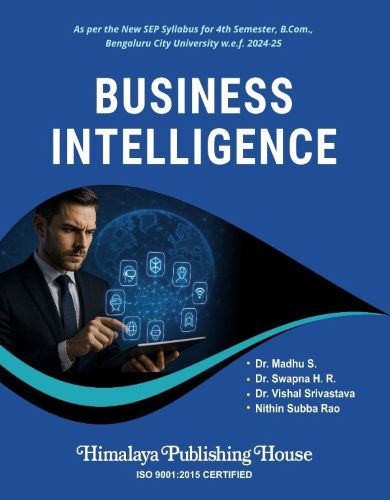

The rapid advancement of Artificial Intelligence (AI) has transformed the global business landscape, redefining how organizations think, operate, and compete. Today, AI is no longer a futuristic concept but an essential component of business intelligence and strategic decision-making. This book, Business Intelligence, is designed to provide learners with a comprehensive and structured understanding of AI’s growing role in commerce, management, and organizational transformation. It aims to bridge foundational knowledge with practical business applications, enabling students, professionals, and researchers to appreciate both the potential and the responsibility that comes with integrating AI into enterprise systems.
Unit 1 lays the groundwork by introducing the meaning, evolution, and fundamental concepts of AI, including data, algorithms, and machine learning. It distinguishes between narrow and general AI while highlighting the benefits and challenges businesses face as they adopt intelligent technologies. This foundational perspective ensures that learners understand AI not just as a technical field, but as a strategic tool with broad managerial implications.
Unit 2 explores the dynamic applications of AI across business domains. From enhancing customer experience through CRM systems and personalized recommendations to strengthening financial decision-making, fraud detection, and human resource functions, this section uncovers how AI is reshaping everyday business operations. It also discusses the proliferation of chatbots and intelligent interfaces that are redefining customer engagement.
Building upon these applications, Unit 3 focuses on AI-driven decision-making. It introduces predictive and descriptive analytics, automation, and optimization while shedding light on AI’s impact on supply chain management, logistics, and retail operations. This unit underscores the importance of data-driven strategies in achieving operational efficiency and competitive advantage.
As AI becomes increasingly embedded in business practices, understanding its ethical and legal ramifications is crucial. Unit 4 examines issues of transparency, privacy, bias, and cyber security. It also provides an overview of emerging regulatory frameworks and emphasizes the significance of ethical conduct in fostering responsible human-machine collaboration.
Finally, Unit 5 looks to the future, discussing emerging trends, opportunities, and risks associated with AI in business. It highlights the role of AI in small and medium enterprises, the convergence of AI with IoT, and the contribution of intelligent technologies to sustainable business models.
This book aspires to equip readers with both theoretical insight and practical clarity. By integrating foundational principles with real-world applications and future-oriented perspectives, it serves as a valuable resource for anyone seeking to understand or harness the power of AI in business.
Contents –
UNIT 1 INTRODUCTION TO BUSINESS INTELLIGENCE
Definition and Meaning of AI, History and Evolution of AI, Basic Concepts: Data, Algorithms, and Machine Learning, Types of AI: Narrow AI vs. General AI, Benefits and Challenges of AI in Business.
UNIT 2 AI IN BUSINESS APPLICATIONS
Role of AI in Commerce and Management; AI in Customer Relationship Management (CRM); AI in Marketing; Chatbots; Personalized Recommendations; AI in Finance; Basic Concepts in Fraud Detection and Risk Management; AI in Human Resources- Resume Screening, Employee Engagement.
UNIT 3 AI AND DECISION-MAKING IN BUSINESS
AI in Business Analytics: Overview of Predictive and Descriptive Analytics; Basics of Automation and Process Optimization; Introduction to AI in Supply Chain and Logistics; AI in Retail – Inventory Management and Demand Forecasting.
UNIT 4 ETHICAL AND LEGAL ASPECTS OF AI IN BUSINESS
Ethical Issues in AI: Bias, Privacy and Transparency; Social and Economic Impact of AI; Overview of AI Regulations and Compliance; Cyber security and Data Protection; Ethical Practices in Man-Machine relationships.
UNIT 5 FUTURE TRENDS IN AI AND BUSINESS
The Future of AI in Business: Opportunities and Risks; AI in Small and Medium Enterprises (SMEs); Introduction to Emerging Technologies; Internet of Things (IoT) and AI; Role of AI in Sustainable Business Practices.
