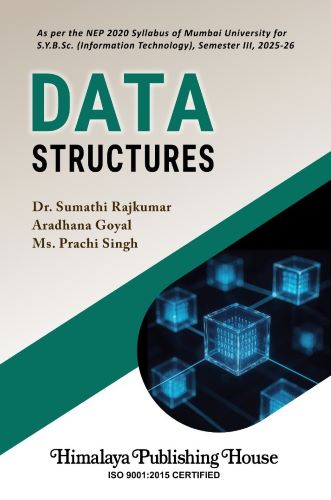


Data Structures is one of the fundamental subjects in Computer Science that provides the knowledge required to organise, store, manage, and process data efficiently. Selecting an appropriate data structure and algorithm plays a vital role in developing efficient software solutions and solving real-world computational problems.
This course introduces students to the basic concepts of data structures, beginning with the understanding of data, information, abstract data types, and algorithm analysis using time complexity and Big O notation. Students will learn the implementation and applications of linear data structures such as arrays, linked lists, stacks, and queues, along with the concept of recursion for solving repetitive computational problems.
The course further explores non-linear data structures, including binary trees and binary search trees, enabling students to understand hierarchical data representation and efficient searching techniques. Students are also introduced to hashing for fast data retrieval and common collision handling methods. In addition, the subject covers fundamental sorting and searching algorithms that form the basis of efficient data processing in software applications.
The practical approach of this course helps students develop logical thinking, analytical skills, and problem solving abilities through the implementation of various data structures and algorithms. By the end of the course, students will be able to analyse algorithm efficiency, select suitable data structures for different applications, and implement basic data structures to solve computational problems effectively. This foundation prepares learners for advanced topics in computer science, software development, database systems, artificial intelligence, and competitive programming.
Contents –
1. Introduction
2. Arrays and Linked Lists
3. Stacks and Queues
4. Recursion
5. Introduction to Trees
6. Hashing
7. Sorting and Searching
Question Bank