




Electronic commerce is considered as any form of business transaction in which the parties interact electronically rather than by physical exchanges of documents or direct meetings amongst officials. It is simply doing business on line. It is the hottest computing topic in India right now and has opened exciting new possibilities for all businesses alike, both big and small.
E-commerce in general is the buying and selling, marketing and servicing and delivery payment of products, services and information over the Internet, intranets, extranets and other networks, between an internet worked enterprise and its prospects, customers, suppliers and business partners. It includes Business to Consumer (B2C), Business to Business (B2B), Consumer to Consumer (C2C), etc., e-commerce. E-commerce has a vast potential.
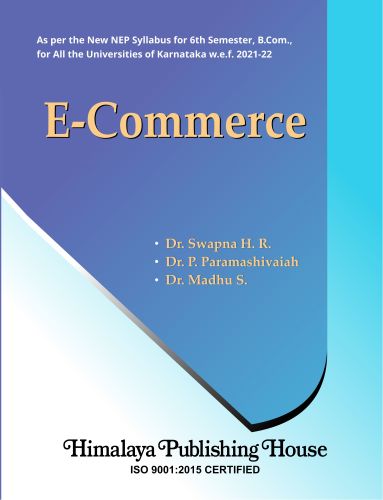
In this backdrop this book “E-Commerce” is written, which is a subject of study for B.Com sixth semester students of various universities of Karnataka.
The books has 5 modules.
Module 1 – E-Commerce and Its Technological Aspects
Module 2 – Consumer Oriented E-Commerce
Module 3 – Electronic Data Interchange
Module 4 – Security in E-Commerce Threats in Computer Systems
Module 5 – Issues in E-Commerce
Contents –
MODULE 1 E-COMMERCE AND ITS TECHNOLOGICAL ASPECTS
Overview of developments in Information Technology and Defining E-Commerce: The scope of E-commerce, Electronic Market, Electronic Data Interchange, Internet Commerce, Benefits and limitations of E-Commerce, Produce a generic framework for E-Commerce, Architectural framework of Electronic Commerce, Web based E-Commerce Architecture.
MODULE 2 CONSUMER ORIENTED E-COMMERCE
E-Retailing, Traditional retailing and e-retailing, Benefits of e-retailing, Key success factors, Models of e-retailing, Features of e-retailing. e-services: Categories of e-services, Web-enabled services, matchmaking services, Information-selling on the web, e-entertainment, Auctions and other specialized services. Business to Business Electronic Commerce.
MODULE 3 ELECTRONIC DATA INTERCHANGE
Benefits of EDI, EDI technology, EDI standards, EDI communications, EDI Implementation, EDI Agreements, EDI Security. Electronic Payment Systems, Need of Electronic Payment System: Study and examine the use of Electronic Payment system and the protocols used, Electronic Fund Transfer and secure electronic transaction protocol for credit card payment. Digital economy: Identify the methods of payments on the net – Electronic Cash, cheque and credit cards on the Internet.
MODULE 4 SECURITY IN E-COMMERCE THREATS IN COMPUTER SYSTEMS
Virus, Cyber Crime Network Security: Encryption, Protecting Web server with a Firewall, Firewall and the Security Policy, Network Firewalls and Application Firewalls, Proxy Server.
MODULE 5 ISSUES IN E-COMMERCE
Understanding Ethical, Social and Political issues in E-Commerce: A model for Organizing the issues, Basic Ethical Concepts, Analyzing Ethical Dilemmas, Candidate Ethical Principles Privacy and Information Rights: Information collected at E-Commerce Websites, The Concept of Privacy, Legal protections Intellectual Property Rights: Types of Intellectual Property Protection, Governance.