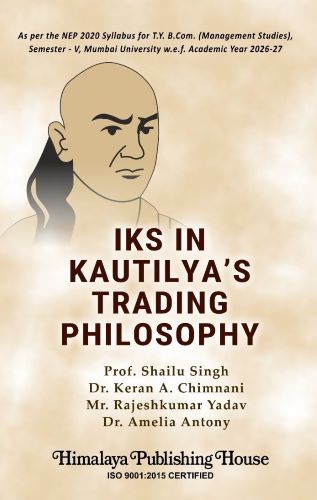





The National Education Policy (NEP) 2020 emphasizes the integration of Indian Knowledge Systems (IKS) into higher education, enabling students to understand the relevance of India’s rich intellectual heritage in contemporary disciplines. In line with the University of Mumbai syllabus for T.Y. B.Com. (Management Studies), Semester V, this book, IKS in Kautilya’s Trading Philosophy, has been specially designed to meet the academic requirements of students.
The book presents Kautilya’s ideas on trade, commerce, market regulation, taxation, business ethics, entrepreneurship, and economic governance in a simple, systematic, and student-friendly manner. Contemporary examples and illustrations have been included to help students relate ancient Indian wisdom to modern business and management practices.
Every effort has been made to present the subject in an easy-to-understand format while covering the prescribed syllabus comprehensively. It is hoped that this book will serve as a useful guide for students, teachers, and all readers interested in understanding the timeless relevance of Kautilya’s trading philosophy.
Contents –
Module 1: Foundations of Kautilyan Economics and Trade
1.1 The Context of Wealth: from Dharma to Dividend
1.2 Artha, Treasury (Kosa) and State Power
1.3 Jagat Seth, Merchant-Bankers and Mercantilism
1.4 Vārtā: Livelihood, Agriculture, Cattle Rearing and Trade
1.5 Role of Economic Activities in State Revenue
1.6 Market Organisation: Paṇyādhyakṣa, Bazaar System and Agency Houses
1.7 Private vs. State Enterprise: Kautilya’s Mixed Economy Model
1.8 State Monopolies and Private Participation in Economy
Module II: Price Determination and Market Regulation
2.1 Pricing Principles
2.2 Prevention of Arbitrary Price Fixation
2.3 Profit Regulation and Internal Transit Duties
2.4 Anti-Fraud Measures
2.5 Monopoly, Gluts and Cartel Control
2.6 Policies to Prevent Merchants from Combining to Raise Prices (Cartel Control)