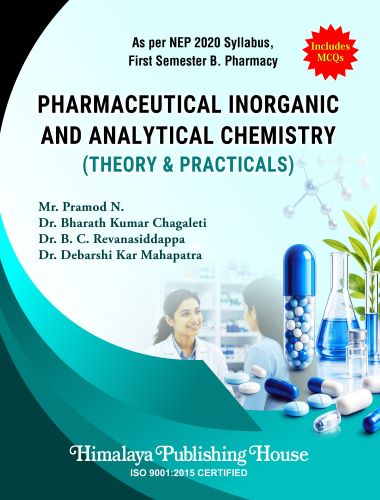
Pharmaceutical chemistry forms one of the fundamental pillars of pharmaceutical education, providing students with the essential chemical knowledge required to understand medicines, their quality, purity, stability, and therapeutic applications. Pharmaceutical Inorganic and Analytical Chemistry is an important foundation course for students of the first semester of the Bachelor of Pharmacy programme, as it introduces them to the principles of inorganic pharmaceutical substances and the analytical approaches used for their identification, purity assessment, and quality control.
This textbook has been carefully developed in accordance with the new Pharmacy Council of India (PCI) B.Pharm curriculum under NEP 2020, particularly the Semester I course BP106T Pharmaceutical Inorganic and Analytical Chemistry. The content has been organized systematically to facilitate conceptual understanding and make the subject accessible to beginners. The book aims to bridge the gap between fundamental chemistry and its practical application in pharmaceutical sciences.
The book begins with the fundamental concepts of Pharmaceutical impurities, sources and types of impurities, pharmacopoeias, and limit tests. Special emphasis is given to the principles of limit tests for chloride, sulphate, iron, arsenic, lead, and heavy metals, along with modified limit tests. These topics provide students with an understanding of the importance of controlling impurities in pharmaceutical substances.
The subsequent chapters introduce acids, bases and buffer systems, including buffer equations, buffer capacity, pharmaceutical buffers, buffered isotonic solutions, tonicity, and methods of adjusting isotonicity. The role of major intra- and extracellular electrolytes in maintaining physiological functions is also discussed, together with electrolyte replacement therapy and oral rehydration solutions.
The book further covers important classes of Pharmaceutical inorganic compounds, including gastrointestinal agents, topical agents, dental products, inhalants, expectorants, antidotes, haematinics, and other therapeutically significant inorganic substances. For important compounds, emphasis has been placed on their chemical formula, preparation, properties, identification, assay principles, storage, and medicinal and pharmaceutical uses, wherever applicable.
An important feature of this textbook is the integration of analytical chemistry with pharmaceutical applications. Fundamental analytical concepts are presented in a simple and logical manner so that students can appreciate the role of analytical techniques in pharmaceutical quality control. Wherever appropriate, principles are supported by chemical equations, reaction schemes, tables, examples, and concise explanations.
The presentation of the subject has been designed not only for university examinations but also to encourage conceptual learning, problem-solving ability, laboratory understanding, and professional competence. Important terms, key points, review questions, and examination-oriented material may assist students in effective revision and preparation.
The ultimate objective of this book is to provide first-semester B.Pharm students with a clear, concise, systematic, and student-friendly resource that develops a strong foundation in pharmaceutical inorganic and analytical chemistry. It is hoped that the book will also serve as a useful reference for teachers, pharmacy professionals, and students preparing for competitive and professional examinations.
Contents –
Unit 1 Introduction to Pharmaceutical Chemistry
Unit 2 Acid-Base Chemistry and Buffer in Systems in Pharmacy
Unit 3 Acid-Base Titrations
Unit 4 Gastrointestinal Agents Acidifiers
Unit 5 Miscellaneous Compounds Expectorants
Practical Manual