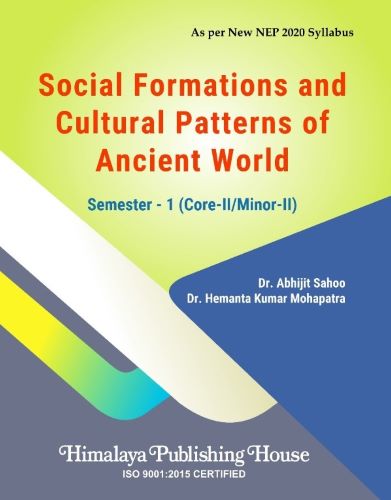



History is the study of past events and achievements of Man. With the advent of the twenty-first century, knowledge of history has become highly essential. And to obtain this knowledge, one has to make a systematic study on various aspects of past events. The book “Social Formations and Cultural Patterns of Ancient World” (Major Core Paper – II and Minor Paper – II) has been written for the history students under the NEP-2020 syllabus adopted by the Universities and Autonomous Colleges of Odisha. For the convenience of the students, different terminologies are clarified, Summary recaps are given, point and sub-points are high-lighted, Model Questions are given and LMR (Last Minutes Revision) is supplied. In the first unit, vivid description has been made on the Evolution of Man Evolution of Man from Hominoid to Homo sapiens. Paleolithic Cultures: Lower, Middle and Upper Paleolithic Culture, Tool typologies and technologies, Migration of Homo Sapiens and Colonization. Mesolithic Cultures, Tool Typology Foraging, Rock Art, Religion. Discussions are also made on the Food Production: Major sites in Fertile Crescent, Food Production, Habitation structure, Pottery, Neolithic Revolution Development of Agriculture, Early Domesticated Plants in Fertile Crescent, China, India. Animal Husbandry: Archaeological Evidence of Animal domestication, Characteristics of Domesticated Animals. Egypt (Natural and Cultural Settings, Major Development in Old Kingdom, Middle Kingdom and New Kingdom, Society, Economy, Religion, Art and Temple Architecture. Mesopotamia : Developments in Sumerian, Babylonian and Assyrian periods; Natural and Cultural Setting, Cultural Developments from Ubaid period to emergence of Uruk as a state, religion, society, economy and cultures of Sumer; Developments in Imperial Ur, Code of Hammurabi and Babylonian expansion, Introduction of Iron and Neo-Assyrian Empire. China (Shang): Pre-Shang Culture, Oracle Bones, Major Developments, Chinese Society are also discussed. Subsequent chapter’s deals with topics like Athens and Sparta: Natural and Cultural setting of Ancient Greece, Development of Polis, Evolution of Oligarchic Spartan State, its Intuitional structure and society. Polity, Economy and Society: Evolution of Athenian Democracy from Solon to Peloponnesian War), Athenian Economy Culture: Literature, Religion, Art and Architecture, Science. In preparing this book, we have taken the help of classical as well as contemporary books on the topics. We have also gone through different websites dealing with the subjects. All the units of this book have been presented in a systematic and comprehensive manner.
Contents –
UNIT – I: EVOLUTION OF MAN
Chapter – 1: Evolution of Man: From Hominoid to Homo Sapiens
Chapter – 2: Palaeolithic Cultures: Lower, Middle and Upper Palaeolithic Culture, Tool Typologies and Technologies, Migration of Homo Sapiens and Colonisation
Chapter – 3: Mesolithic Cultures, Tool Typology, Foraging, Rock Art, Religion
UNIT – II: NEOLITHIC CULTURE
Chapter – 4: Food Production: Major Sites in Fertile Crescent, Food Production, and Habitation Structure, Pottery, Neolithic Revolution. Development of Agriculture: Early Domesticated Plants in Fertile Crescent, China, India Animal Husbandry: Archaeological Evidence of Animal domestication, Characteristics of Domesticated Animals
UNIT – III: BRONZE AGE CIVILISATIONS
Chapter – 5: Egypt: Natural and Cultural Settings, Major Development in Old Kingdom, Middle Kingdom and New Kingdom, Society, Economy, Religion, Art and Temple Architecture
Chapter – 6: Mesopotamia: Developments in Sumerian, Babylonian and Assyrian Periods; Natural and Cultural Setting, Cultural Developments from Ubaid Period to Emergence of Uruk as a State, Religion, Society, Economy and Cultures of Sumer; Developments in Imperial Ur
Chapter – 7: Babylonian Civilisation: Code of Hammurabi and Babylonian Expansion, Introduction of Iron and Neo-Assyrian Empire
Chapter – 8: China (Shang): Pre-Shang Culture, Oracle Bones, Major Developments, Chinese Society
UNIT – IV: ANCIENT GREECE
Chapter – 9: Athens and Sparta: Natural and Cultural Setting of Ancient Greece, Development of Polis, Evolution of Oligarchic Spartan State, Its Institutional Structure and Society
Chapter – 10: Polity, Economy and Society: Evolution of Athenian Democracy from Solon to Peloponnesian War, Athenian Economy
Chapter – 11: Economy and Culture: Literature, Religion, Art and Architecture, Science
Multiple Choice Questions
Question Bank: Core – II
Model Question Papers
Last Minute Revision