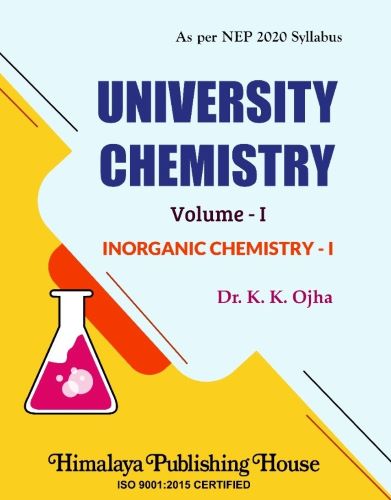



The book entitled “University Chemistry – Vol-I” is a very sincere attempt to arouse the interest of the students in Inorganic Chemistry. This book is written in easily understandable and catchy language so that the students can easily grasp the contents that they read. This book is intended as a theory book for students appearing for B.Sc. (Hons.).
The salient features of this book are –
- It is based on the prescribed NEP-2020 syllabus for the B.Sc. courses of the state universities.
- It provides basics of theory.
- It gives concise and pointwise information of the subject matter.
- It includes solved problems in each chapter and different questions at the end of each chapter.
Contents –
Chapter-1 : ATOMIC STRUCTURE
Rutherford’s nuclear model of atom, Bohr’s theory and the origin of hydrogen spectrum, Sommerfeld’s extension of Bohr’s theory, de-Broglie equation, Heisenberg’s Uncertainty Principle and its significance. Postulates of wave mechanics, Derivation of Schrodinger’s wave equation for hydrogen atom, significance of Ψ and Ψ². Radial and angular wave functions, Radial function plots, radial probability distribution plots, angular distribution curves. Shapes of s-, p-, d- and f- orbitals, Relative energies of orbitals. Slater’s rule and its limitations, Quantum numbers and their significance. Pauli’s Exclusion Principle, Hund’s rule of maximum spin multiplicity and Aufbau principle.
Chapter-2 : PERIODICITY OF ELEMENTS
Introduction to long form periodic table, Cause of periodicity, Division of elements into s-, p-, d- and f- blocks. Atomic radius, ionic radius, covalent radius and Van der Walls radius. Periodic trends in ionic and covalent radii. Ionization energy, electron affinity, electronegativity, and their variations in the periodic table. Applications of electronegativities. Pauling’s/Mulliken’s scale of electronegativity, Sanderson’s electron density ratio.
Chapter-3 : CHEMICAL BONDING – I
Ionic bond : General characteristics, types of ions, size effects, radius ratio rule and its limitations. Packing of ions in crystals. Lattice energy, Born-Haber cycle and its application, Born-Lande equation, Madelung constant, importance of Kapustinskii equation for lattice energy. Solvation energy, Covalent character in ionic compounds, polarizing power and polarizability. Fajan’s rules and consequences of polarization.
Chapter-4 : CHEMICAL BONDING – II
Valence shell electron pair repulsion theory (VSEPR), shapes of the following simple molecules and ions containing lone pairs and bond pairs of electrons : CH4, H2O, NH3, PCl3, PCl5, SF6, ClF3, l3⁻, BrF2+, PCl₆⁻, ICl2⁻, ICl₄⁻, NH4+, PO₄³⁻ and SO₄²⁻. Valence Bond theory (Heitler-London approach). Hybridization, equivalent and non-equivalent hybrid orbitals, ionic character in covalent compounds : Dipole moment. Percentage character from dipole moment and electronegativity difference, Molecular orbital diagrams of homo- & hetero-diatomic molecules (N2, O2, C2, B2, F2, CO, NO) and their ions. Calculation of bond order. Concept of bent rule.
Examination Corner (M.Sc./IIT JAM)