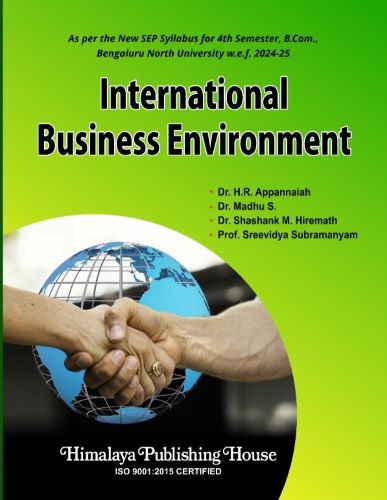


In the contemporary era of globalization, businesses operate in an increasingly interconnected world where economic, political, cultural, legal, technological, and environmental forces transcend national boundaries. Understanding the complexities of the international business environment has therefore become essential for students of commerce and management. The present book, International Business Environment, has been carefully designed in accordance with the new SEP syllabus prescribed for B.Com., Fourth Semester, Bengaluru North University, with the objective of providing students a comprehensive and practical understanding of global business dynamics.
This book aims to present concepts in a clear, systematic, and student-friendly manner while maintaining academic depth. It covers the various dimensions of international business that influence decision-making and organizational strategies in global markets. The content is structured module-wise to facilitate easy learning and examination preparation, with emphasis on conceptual clarity, examples, and current business relevance.
Module 1: Introduction provides the foundation of international business by explaining its meaning and definition, along with the concept, importance, and features of the international business environment. It also discusses micro and macro environmental factors using the PESTLE framework, approaches to international business, stages of internationalization, and modes of entry into foreign markets. Further, the module highlights the ripple effects of globalization, the role of multinational corporations, their advantages and criticisms, and India’s growing presence in global business.
Module 2: Political and Legal Environment examines the influence of political systems and legal frameworks on international business operations. It focuses on political risks, their sources and types, and remedial measures that multinational corporations can adopt to manage such risks. The module also explains different systems of law, international disputes, and dispute settlement mechanisms, along with their implications for international managers.
Module 3: Socio-Cultural Environment emphasizes the role of social and cultural factors in shaping international trade and business relationships. It explains the meaning, features, and elements of culture, including language, religion, education, aesthetics, and attitudes. Important topics such as multiculturalism, cross-cultural communication, Hofstede’s cultural dimensions theory, Indian culture, and the impact of global culture on Indian society are also discussed to provide a holistic understanding of cultural diversity.
Module 4: Economic and Financial Environment focuses on economic policies, macroeconomic factors influencing investment decisions, and foreign investment flows such as Foreign Direct Investment (FDI) and Foreign Portfolio Investment (FPI). It also highlights the advantages and disadvantages of capital inflows and outflows, enabling students to understand financial aspects of international business operations.
Module 5: Natural and Technological Environment discusses the growing importance of sustainability and technological advancement in global business. Topics such as green business practices, environmental management standards (ISO 14000), sustainability strategies, and the role of information technology and satellite communication in international business are covered to reflect modern business realities.
Contents –
MODULE 1 INTRODUCTION
International Business: Meaning & Definition – International Business Environment: Meaning, Definition, Importance & Features – Micro and Macro Environment (PESTLE) – Approaches to International Business – Stages of Internationalization – Modes of Entry – Ripple effects of Globalization – Multinational Corporations – Advantages to Host and Home Countries – Criticisms of MNC’s – India’s presence in global business.
MODULE 2 POLITICAL ENVIRONMENT AND LEGAL ENVIRONMENT
Political Environment: Introduction & Meaning – Features of Political Risk – Sources of Political Risk – Types of Political Risk – Remedial Measures to be undertaken by MNC to tackle Political Risk. Legal environment – Systems of law – International disputes – Dispute Settlement Mechanisms and resolution implications for International Manager.
MODULE 3 SOCIO-CULTURAL ENVIRONMENT
Social Environment: Introduction, Meaning, Need, Importance – Impact of Social Environment on International Trade. Culture: Introduction, Meaning, Features – Elements of Culture: Language, Religion, Education, Aesthetics & Attitudes – Multiculturalism – Managing Multiculturalism – Indian Culture – Impact of Global Culture on Indian Culture – Cross Cultural Communication – Hofstede’s Cultural Dimensions Theory
MODULE 4 ECONOMIC AND FINANCIAL ENVIRONMENT
Economic Environment: Meaning and Importance – Economic Policies – Discretionary Policy and Policy rules – Macro Economic Factors affecting Investment Decisions – Foreign Investments Sources – Foreign Direct Investment (FDI) – Factors influencing FDI – Inbound FDI – Outbound FDI – Foreign Portfolio Investment (FPI)- FPI Vs FDI – Advantages and Disadvantages of Inflow and Outflow of Capital
MODULE 5 NATURAL AND TECHNOLOGICAL ENVIRONMENT
Natural Environment: Meaning & Importance – Evaluation of Interaction between Foreign trade and Environment – Green Business – Sustainability Strategies – Essential Characteristics-Green Business Practices-Ecomarks – EIS – EMP – ISO 14000 Information Technology – Impact of Information Technology on International Business – Role played by Satellite Signals in assisting Government and Private Sectors.