
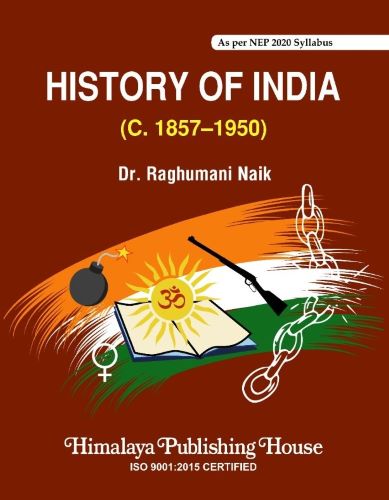

This book, Indian History from 1857 CE to 1950 CE, has been prepared with the objective of providing readers, particularly students and scholars of history, with a clear, balanced, and academic understanding of these ninety-three years. The book contains four units. Unit I contains Cultural Changes, Socio and Religious Movements of India. Unit II deals with Nationalism and its Trends up to 1919, Unit III describes brief history on Mahatma Gandhi and finally Unit IV is Communalism and Partition in India.
The book is intended to serve as a useful resource for students preparing for academic examinations, teachers seeking structured content, and general readers interested in understanding the making of modern India. It is hoped that the chapters that follow will provide knowledge and inspire reflection on the enduring legacy of this formative century in India’s history.
Contents –
Unit – I: Cultural Changes, Socio and Religious Reform Movements
1. The Advent of Printing and Its Implications
1.1 Introduction
1.2 Cultural Changes in 19th Century India
1.3 Nature of Cultural Changes and Socio-religious Movements
1.4 Characteristics of Cultural Changes and Socio-religious Movements
1.5 Growth and Development of Printing Press
1.6 Causes for the Development of the Printing Press
1.7 Evolution of the Printing Press in India
1.8 Development of Press and Journalism in British India
1.9 Evolution of the Press in India
1.10 Early Regulation of the Indian Press (1800s) – Licensing and Censorship
1.11 Printing Press and Post-Independence India
1.12 Milestones and Challenges (1556-1947)
1.13 Conclusion of Printing Press
1.14 Possible Model Questions
2. Brahmo Samaj – The Reformist Movement in India
2.1 Introduction
2.2 Religious Movements in 19th Century
2.3 Importance of Socio-religious Reform Movements
2.4 Raja Ram Mohan Roy (1772-1833)
2.5 Maharishi Devendranath Tagore
2.6 Keshab Chandra Sen and Brahmo Samaj
2.7 Adi Brahmo and Sadharan Brahmo Samaj
2.8 Analysis of Brahmo Samaj
2.9 The Decline of Brahmo Samaj
2.10 Possible Model Questions
3. Arya Samaj – The Revivalist Movement in India
3.1 Introduction
3.2 Swami Dayananda Saraswati (1824-83)
3.3 Origin and Foundation of Arya Samaj
3.4 Philosophy and Core Principles of Arya Samaj
3.5 Possible Model Questions
4. Aligarh Movement – The Reformist Movement of Muslims in India
4.1 Introduction
4.2 An Overview of Sayed Ahmed Khan’s Early Life and Vision
4.3 Aligarh Movement
4.4 Role of Sir Syed Ahmed Khan and His Associates in their Community Development
4.5 The Aligarh Movement and the Development of Muslim Education
4.6 The Foundation of Aligarh Muslim University
4.7 Outcomes of the Aligarh Movement
4.8 Opposition to the Aligarh Movement
4.9 The Aligarh Movement’s Political Impact
4.10 The Impact of the Aligarh Movement on Society and Education
4.11 Possible Model Questions
5. Emancipation of Women
5.1 Introduction
5.2 Meaning
5.3 Position of Women through Vedic Society to Colonial Period
5.4 Factors Contributing to Women’s Emancipation in India
5.5 Emergence of Women’s Movements and Organisations in 20th Century
5.6 Challenges to Women’s Emancipation
5.7 Emancipation and Sanskritisation
5.8 Women’s Emancipation and Anti-caste and Dalit Feminist Movements
5.9 Impact on Emancipation
5.10 Possible Model Questions
6. Sanskritisation
6.1 Introduction
6.2 Possible Model Questions
7. Anti-Caste Movement in India
7.1 Background
7.2 Historical Roots of Anti-caste Movements in India
7.3 Christian Missionary Impact
7.4 Chhatrapati Shahu Maharaj of Kolhapur (1874-1922)
7.5 Narayana Guru (Kerala, 1856-1928)
7.6 Gopal Baba Walangkar – Early Dalit Activist
7.7 Harichand Thakur – Matua Sect in Bengal for Namasudra Uplift
7.8 Formation of the Matua Movement and Religious Reform
7.9 Social Reforms of E.V. Ramaswamy (1879-1973)
7.10 B.R. Ambedkar (1891-1956)
7.11 Historical Timeline of Anti-caste Protests in India
7.12 Possible Model Questions
Unit – II: Nationalism : Trends up to 1919
8. Political Ideology and Organisation, Formation of Indian National Congress
8.1 Introduction
8.2 Background and Causes behind the Formation of INC
8.3 Timeline of Organisations before INC (1830-1885)
8.4 Immediate Pre-Congress Phase (1880s)
8.5 Theories for Establishing the INC
8.6 Nationalist Theory – Indian and Progressive View
8.7 Goals and Objectives of INC
8.8 Features of INC
8.9 Formation of INC (1885)
8.10 Resolutions Passed During the First Session (1885)
8.11 Indian National Congress (1885-1920)
8.12 Possible Model Questions
9. Moderate Phase (1885 – 1905)
9.1 Introduction
9.2 Early Nationalists’ Objectives
9.3 Objectives for the Moderate Phase
9.4 Military Demands of Moderates, 1885
9.5 Constitutional Methods used by Early Nationalists
9.6 Prominent Moderate Leaders
9.7 Demands of Moderates
9.8 Contributions of Moderate Nationalists towards Indian Nationalism
9.9 Protection of Civil Rights
9.10 Achievements of the Moderates
9.11 Limitations for Moderates
9.12 Evaluation of Early Nationalists
9.13 Important Annual Sessions of the Indian National Congress
9.14 Moderates’ Failure
9.15 Impact of the Moderates’ Phase (1885-1905)
9.16 Significance of the Moderates’ Phase
9.17 Possible Model Questions
10. Extremist Period (1905-1919)
10.1 Introduction
10.2 Background
10.3 Factors Driving the Rise of Extremism in India
10.4 Nature of the Extremist Phase (1905-1919)
10.5 Ideology Differences between Moderates and Extremists
10.6 Methods used During the Extremist Period in India
10.7 Impact of Extremist Phase
10.8 Achievements of the Extremists
10.9 Possible Model Questions
11. Swadeshi Movement
11.1 Introduction
11.2 Nature of the Swadeshi Movement
11.3 Characteristics of the Swadeshi Movement
11.4 Methods of the Swadeshi Movement
11.5 Key Leaders and Regional Movements
11.6 Results of the Swadeshi Movement
11.7 Impact of the Swadeshi Movement
11.8 Significance of the Swadeshi Movement
11.9 Chronological Order of Events
11.10 Possible Model Questions
Unit – III: Gandhian Nationalism after 1919:
Ideas and Movements
12. Revolutionaries
12.1 Background:
12.2 Factors Onus for the Rising of RevolutionaryMovements in India
12.3 Indian Revolutionaries Abroad
12.4 Possible Model Questions
13. Mahatma Gandhi: His Perspectives and Methods
13.1 Introduction
13.2 The Status of Indians in South Africa
13.3 Three Phases of Struggle in South Africa
13.4 The AhmedabadMill Strike of 1918
13.5 The Kheda Satyagraha (1918)
13.6 Khilafat Movement (1919)
13.7 Rowlatt Satyagraha (1919)
13.8 The Jallianwala Bagh Massacre (1919)
13.9 Possible Model Questions
14. Non–cooperation Movement (1920-1922)
14.1 Introduction
14.2 Background of the Non-cooperation Movement
14.3 Objectives of the Movement
14.4 Principles of the Movement
14.5 Characteristics of the Non-cooperation Movement
14.6 Spread of the Movement
14.7 Government Response
14.8 The Non-cooperation Movement – Criticism
14.9 Non-cooperation Movement – Significance
14.10 Impact of the Non-cooperation Movement
14.11 Facts about the Non-cooperation Movement
14.12 Possible Model Questions
15. Civil Disobedience Movement (1930-1934)
15.1 Introduction
15.2 Civil Disobedience Movement – Background
15.3 Causes of the Civil Disobedience Movement
15.4 Genesis of the Civil Disobedience Movement
15.5 The 12 Points/Demands
15.6 Main Events and Course
15.7 The Spread of the Civil Disobedience Movement
15.8 Civil Disobedience Movement: Government Response
15.9 Civil Disobedience Movement: Drawbacks
15.10 Civil Disobedience Movement: Evaluation
15.11 Final Results of the Civil Disobedience Movement
15.12 Conclusion of the Civil Disobedience Movement in India
15.13 Possible Model Questions
16. The Quiet India Movement (1942)
16.1 Introduction
16.2 Methods of the Quit India Movement
16.3 Ideologies and Methods of the Quit India Movement
16.4 Causes of the Quit India Movement
16.5 Important Leaders of the Quit India Movement
16.6 Possible Model Questions
17. Subhash Chandra Bose and INA
17.1 Introduction
17.2 Early Life of Subhash Chandra Bose
17.3 Birth and Family Heritage
17.4 Childhood and Early Schooling
17.5 Influence of Philosophy and Spirituality
17.6 College Years and the First Acts of Defiance
17.7 Journey to England and the ICS Decision
17.8 Return to India and Entry into Nationalism
17.9 Political Rise of Subhash Chandra Bose (1921-1935)
17.10 Possible Model Questions
18. Nationalism and Social Groups: Peasants, Tribes, Dalits and Women
18.1 Introduction
18.2 Peasants and Nationalism
18.3 Historical Background
18.4 Broadening the Nationalist Social Base
18.5 Nationalism and the Tribes
18.6 Nationalism and Dalits
18.7 Caste-based Violence and Protests
18.8 Role of Social Groups in Nationalist Identity
18.9 Possible Model Questions
Unit – IV: Communalism and Partition
19. Ideologies and Practices of Muslim League
19.1 Introduction
19.2 Condition of Muslims of India before the Formation of the All India Muslim League
19.3 Objectives of the Muslim League
19.4 Nature and Characteristics of the Muslim League
19.5 Ideologies and Practices of the Muslim League
19.6 Growth of Communalism and Partition of India
19.7 Definition of Communalism
19.8 Factors Led to Growth of Communalism
19.9 Factors Led to Partition of India
19.10 Possible Model Questions
20. Hindu Mahasabha
20.1 Background
20.2 Factors that Contributed to the Hindu Mahasabha’s Growth
20.3 Possible Model Questions
21. Partition and Independence
21.1 Background
21.2 Factors that Led to India’s Partition
21.3 Quit India Resolution of 1942
21.4 Regions Affected by Partition
21.5 Legacy of the Partition of India
21.6 Effects of India’s Partition
21.7 Possible Model Questions
22. Making of the Constitution
22.1 Introduction
22.2 Colonial Constitutional Developments
22.3 Significance and Evaluation of the Indian Constitution
22.4 Possible Model Questions
Bibliography