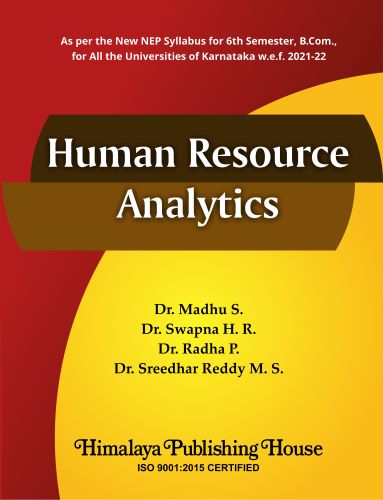



We have pleasure in placing before the teachers and the taught, our new book HUMAN RESOURCE ANALYTICS, written as per the New NEP Syllabus for Sixth Semester, B.Com., of all the State Universities. The attempt is to help the student fraternity gain sound foundational knowledge of HR Analytics irrespective of the discipline or special electives they may have chosen. The best way to benefit from this book will be to learn and exploring the sources of knowledge complied in this book as well as studying.
This book on “Human Resource Analytics”, is one of the hottest technology topics in the world, which is a strange mix of arts, sciences and technologies. Analytics is an HR umbrella term referring to the processes, technologies and techniques, which turn data into information and knowledge that drive HR decisions.
In the last few years there has seen a dramatic change in organisations across almost all sectors. No doubt as the organisation beings to take advantage of new technologies. That change is only going to acclerate over the years to come.
At the heart of rapidly changing organisations are people. Companies are noting without the right people. Even in this technology-driven age, those organisations that are able to attract (and keep) the right people are most likely to succeed now and in the future. As businesses navigate rapid change, this need to attract and nurture talent is arguably more important, not less. Now more than ever, people are the central driver of success.
It is therefore vital that Human Resource teams put in place the analytics and processes to find, recruit and retain the right people for their organisation. Which brings us to the need for Human Resource Analytics.
The books has 5 modules.
Module 1 – HR Decision-making and HR Analytics
Module 2 – HR Business Process and HR Analytics
Module 3 – Forecasting and Measuring HR value propositions with HR analytics
Module 4 – HR analytics and Data
Module 5 – HR Analytics and Predictive Modelling
Contents –
MODULE 1 HR DECISION-MAKING AND HR ANALYTICS
Introduction – HR decision making – importance and significance of HR analytics – benefits of HR analytics – Steps to implement HR analytics – HR analytics and changing role of HR managers – aligning human resources to business through HR analytics – HR analytics framework and models – LAMP Framework.
MODULE 2 HR BUSINESS PROCESS AND HR ANALYTICS
Statistics and statistical modelling for HR research and HR decision-making – HR research tools and techniques – data analysis for human resources – parametric and non- parametric tests- HRIS for HR decision-making – HR metrics – recruitment metrics – metrics for training and development function – HR scorecard – HR dashboard
MODULE 3 FORECASTING AND MEASURING HR VALUE PROPOSITIONS WITH HR ANALYTICS
Value proposition and HR decisions – Sustainability in HR decisions – HR optimization through analytics – Predictive HR analytics
MODULE 4 HR ANALYTICS AND DATA
HR data and data quality – data collection – big data for human resources – transforming HR data into HR information – HR reporting – HR report visualization – performing root cause analysis – datafication of human resources, Excel exercises: Preparing to Build Your Balanced Scorecard, Developing Executive and Operational Dashboards, Pivotal Talent Pools with High Rates of Voluntary Turnover: Voluntary Turnover, Involuntary Turnover, For-Cause Dismissals, and Layoffs
MODULE 5 HR ANALYTICS AND PREDICTIVE MODELLING
Different phases of HR analytics and predictive modelling – data and information for HR predictive analysis – software solutions – predictive analytics tools and techniques – understanding future human resources.