



The Government of India enacted a series of labour legislation, particularly after independence of our country, to protect the working class from exploitation and to bring about improvement in their working and living conditions.
With the evolution and progress of industrial society, however, labour laws have become very dynamic and complex. Over a period of years, multiplicity of labour laws have emerged because of each piece of legislation was enacted as and when the need for the regulation of some segment or an aspect of the labour market arose.
The inclusion of new labour enactments in the statute book, periodical amendments in the existing labour laws, and voluminous growth of case law have added new dimensions to industrial jurisprudence.
Over a period of years, it had become increasingly difficult on the part of the employers to comply effectively with various statutory measures, for the employees to claim statutory benefits, and for the government to enforce the statutory provisions, because of the complexity and rapid progress of labour legislation.
The major issue that arose in the area of labour law reforms is how to ensure minimum decent conditions of work and livelihood for workers in the unorganised or informal sector in the economy. Further, the issue of compliance with labour laws has become a big challenge due to proliferation of labour laws and their duplications and contradictions.
A need was felt, therefore, to formulate a national labour code to simplify, rationalise, harmonise and codify numerous labour laws.
As a boost to labour reforms, the existing 29 labour laws that got consolidated and streamlined into four labour codes are: (a) the Code on Wages, 2019; (b) the Industrial Relations Code, 2020; (c) the Code on Social Security, 2020; and (d) the Occupational Safety, Health and Working Conditions Code, 2020.
The Government of India implemented all the fours labour codes, passed by Parliament in 2019-20, from 21st Nov. 2025.
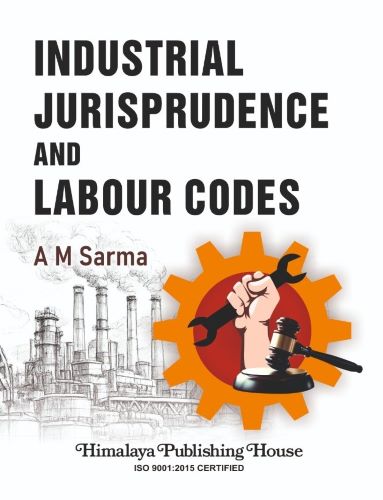
The book is divided into two parts. The first part deals with certain aspects of labour jurisprudence and the second part covers all the four bare labour codes, their salient features, review questions, and check your progress covering multiple choice questions (MCQs), and true false statements.
Contents –
PART I: INDUSTRIAL JURISPRUDENCE
1. Jurisprudence An Overview
2. Industrial Jurisprudence Principles
3. Jurisprudence Indian Context
4. Jurisprudence Indian Scenario
5. Jurisprudence Constitutional Aspects
PART II: LABOUR CODES
6. Prelude to Labour Codes
– Key Focus Areas
– Outstanding Issues
– Summary
– Review Questions
7. The Code On Wages, 2019
– Text of the Code: Arrangement of Sections
– Salient Features
– Summary
– Review Questions
– Check Your Progress
8. The Industrial Relations Code, 2020
– Text of the Code: Arrangement of Sections
– Salient Features
– Summary
– Review Questions
– Check Your Progress
9. The Code on Social Security, 2020
– Text of the Code: Arrangement of Sections
– Salient Features
– Summary
– Review Questions
– Check Your Progress
10. The Occupational Safety, Health and Working Conditions Code, 2020
– Text of the Code: Arrangement of Sections
– Salient Features
– Summary
– Review Questions
– Check Your Progress
PART III: APPENDICES
APPENDIX A
The Constitution of India
APPENDIX B
Disciplinary Proceedings in Industry
APPENDIX C
Contract Labour System
APPENDIX D
Sexual Harassment at Workplace
BIBLIOGRAPHY