



The twenty-first-century workplace requires professionals who bring together technical competence, ethical judgement, emotional intelligence, adaptability, and a commitment to lifelong learning. Although modern Human Resource Management (HRM) has evolved to meet these expectations, many of its foundational ideas closely reflect the principles of the ancient Indian Gurukul system.
The Guru-Shishya tradition emphasised holistic learning, mentorship, discipline, experiential education, and character building. These values remain highly relevant in today’s corporate environment, where organisations increasingly seek to develop capable, ethical, and well-rounded professionals.
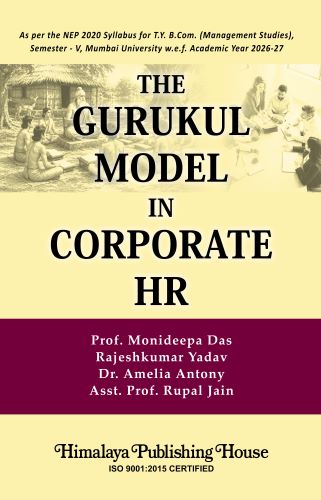
This book, Gurukul Model in Corporate Human Resource Management, has been developed in accordance with the T.Y.B.Com. (Management Studies) curriculum of the University of Mumbai. It seeks to bridge the wisdom of Indian Knowledge Systems (IKS) with contemporary Human Resource Management practices by presenting traditional concepts in a practical and application-oriented manner.
The book explores the relevance of the Gurukul philosophy in modern organisations through topics such as learning and development, mentoring, holistic onboarding, continuous and experiential learning, Corporate Dharma, ethical governance, employee well-being, dignity of labour, community building, organisational culture, and employee retention. It demonstrates how timeless Indian values can contribute to creating ethical, inclusive, people-centric, and sustainable workplaces.
To make learning engaging and meaningful, each chapter includes detailed explanations, contemporary examples, illustrations, case studies, classroom activities, discussion questions, multiple-choice questions, and university examination-oriented short and long-answer questions. The content is presented in a simple and systematic manner to help students understand concepts, develop analytical skills, and apply theoretical knowledge to real organisational situations.
Contents –
1. Learning, Development and the Guru-Shishya Framework
1.1 Foundation – The Gurukul Concept
1.1.1 The Gurukul System: Meaning and Philosophy
1.1.2 Key Features of the Gurukul Concept
1.1.3 Psychosocial Relationship between Guru and Shishya
1.1.4 Role of Self-Discipline in the Gurukul System
1.2 Historical Evolution of the Guru-Shishya Framework
1.2.1 The Master-Apprentice Bond
1.2.2 The Gurukul as a Vocational Training Hub in Pre-Colonial India
1.2.3 The Clash between Gurukul Learning and Industrialisation
1.2.4 Importance of the Gurukul Model in Corporate HR
1.3 Holistic Onboarding Strategies
1.3.1 Using Gurukul Principles in Employee Onboarding
1.3.2 From Transactional Management to Transformational Coaching
1.4 Continuous and Experiential Learning
1.4.1 Replicating Gurukul Learning in Modern L&D
1.4.2 Key Modern L&D Methods Inspired by the Gurukul
1.4.3 The Mentee’s Responsibility – Shishya-Vritti
2. Corporate Dharma and Organisational Culture
2.1 Corporate Dharma: Ethics and Governance
2.1.1 Understanding the Concept of Dharma
2.1.2 Colonial Economic Policies and the Emergence of New Labour Classes
2.1.3 Integrating ‘Labour as Virtue’ into Modern Governance
2.2 Holistic Employee Well-Being
2.2.1 The Gurukul Model and its Lessons
2.2.2 The Emergence of the Urban Working Class and Rural-to-Urban Migration
2.2.3 Adapting Holistic Well-being to Modern Work Life
2.3 Dignity of Labour in Practice
2.3.1 Historical Foundations: Social Reformers and the Equality of Labour
2.3.2 18th Century Reformism and its Organisational Implications
2.3.3 Creating Hierarchy-Neutral Environments
2.3.4 Breaking Down Blue-Collar vs. White-Collar Silos
2.4 Community Building and Retention
2.4.1 Historical Case Study: The Decline of Indian Weavers in the 19th Century
2.4.2 The Rise of Mumbai’s Textile Mills
2.4.3 The AshramModel: Fostering Belonging and Loyalty
2.4.4 Using the Ashram Model to Reduce Attrition