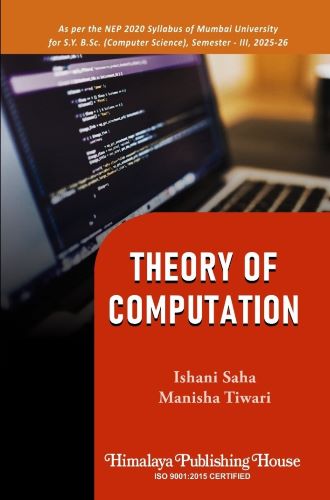



Theory of Computation is one of the fundamental subjects in Computer Science that deals with the mathematical principles and models of computation. It helps in understanding how computers process information, solve problems, and recognise different types of languages. The subject provides a theoretical foundation for designing algorithms, programming languages, compilers, and various computational systems. Understanding the concepts of computation is essential for every computer science student as it forms the basis of many advanced topics in the field.
This course is designed to help students learn the fundamental and advanced concepts of computation. It introduces important topics such as finite automata, regular expressions, context-free grammars, pushdown automata, Turing machines, decidability, and computational complexity. The course focuses on both theoretical understanding and analytical problem-solving skills through various examples and exercises. Students learn how different computational models are used to represent and solve real-world computing problems.
The main aim of this course is to develop logical thinking, mathematical reasoning, and problem-solving abilities among students. By studying different models of computation and language recognition techniques, students gain a deeper understanding of how computational systems work and what limitations they possess. The course enables learners to analyse problems systematically and evaluate the efficiency and feasibility of computational solutions.
Theory of Computation plays a vital role in the study of computer science and is widely used in areas such as compiler design, artificial intelligence, machine learning, software engineering, and formal verification. The concepts covered in this course provide a strong foundation for advanced subjects and research in computing. A thorough understanding of computational theory helps students appreciate both the power and limitations of computers in solving complex problems.
Contents –
Module I – Introduction to Theory of Computation
1. Introduction to Theory of Computation
1.1 Basics of Computation
1.2 Importance of Theory of Computation in Computer Science
1.3 Mathematical Foundations
2. Automata Theory
2.1 Defining Automaton
2.2 Finite Automaton
2.3 Transitions and Their Properties
2.4 Acceptability by Finite Automaton
2.5 Deterministic Finite State Machine/Deterministic Automata (DFA)
2.6 Non-Deterministic Finite State Machines/Non-Deterministic Finite Automata (NDFA/NFA)
2.7 DFA and NFA Equivalence
2.8 Moore Mealy Machines
2.9 Minimizing Automaton
3. Formal Languages
3.1 Defining Grammar
3.2 Derivations
3.3 Languages Generated by Grammar
3.4 Chomsky Classification of Grammar and Languages
3.5 Recursively Enumerable Sets
3.6 Operation on Languages
4. Regular Languages
4.1 Regular Grammar
4.2 Regular Expressions
4.3 Finite Automata and Regular Expressions
4.4 Pumping Lemma and its Applications
4.5 Regular Sets and Regular Grammar
4.6 Context Free Grammar
4.7 Ambiguity of Grammar
4.8 CFG Simplification
4.9 Normal Forms
4.10 Pumping Lemma for CFG
Module II – Advanced Models of Computation
1. Automata Design
1.1 Introduction to Pushdown Automata
1.2 Representation of Pushdown Automaton
1.3 Acceptance by PDA
1.4 Examples of Deterministic Pushdown Automata
1.5 PDA and CFG
1.6 Example of a Context-Free Grammar
2. Linear Bounded Automata
2.1 LBA and CSL
2.2 Key Features of LBA
3. Turing Machines
3.1 Representation of Turing Machine
3.2 Mechanical Diagram of Turing Machine
3.3 Examples of Turing Machine
4. Computability and Complexity