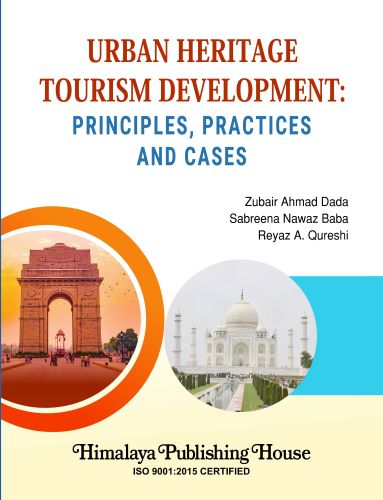


This book offers a comprehensive examination of Urban Heritage Tourism Development in India, with particular attention to Jammu and Kashmir. It engages with foundational academic concepts in heritage tourism, such as commodification, authenticity, ownership, heritage interpretation, and conservation, and applies them directly to Indian heritage sites, institutions, and regulatory frameworks. Alongside established topics such as heritage resource management, zoning, visitor management, and marketing strategy, the volume addresses contemporary concerns, including climate vulnerability, community participation, resident ambivalence towards tourism development, and the integration of digital heritage technologies.
The idea for this book emerged from more than a decade of teaching heritage-related courses at both undergraduate and postgraduate levels, combined with the author’s experience of evaluating tourism curricula across Indian universities. Through sustained engagement with students and researchers, it became evident that a contemporary textbook on urban heritage tourism grounded in the Indian context was largely absent from the available literature. The existing body of work in the field has been developed primarily for Western academic settings, and students in India — particularly those with limited exposure to international heritage destinations — often found it difficult to relate to examples drawn from institutional, administrative, and socio-cultural environments that differ substantially from those they would encounter in Indian heritage practice. This book addresses that gap by grounding its theoretical discussions in Indian case material and situating international scholarly perspectives within the operational realities of India’s heritage governance system.
The volume is organised around five interconnected practice domains — planning, product development, management, marketing, and conservation — that together constitute the operational architecture of urban heritage tourism development. These domains provide the conceptual structure linking the book’s eight chapters into a coherent analytical framework, with each practice domain examined through detailed Indian case studies. The book gives sustained attention to the urban heritage of Jammu and Kashmir, where the full range of heritage tourism development challenges presents itself in an unusually concentrated form: an extraordinary heritage resource base under acute conservation threat; a dramatic and largely unmanaged post-2019 tourism surge; institutional fragmentation across multiple management authorities; and living craft traditions of global significance whose economic viability is in decline.
The book has been written with a strong pedagogical orientation, following the principles of textbook design advocated by the UNESCO Planning Mission, which emphasise clarity, precision, accessibility, and instructional effectiveness. Each chapter includes clearly defined learning outcomes, key concept boxes, scholar spotlights, current affairs inserts from 2025-2026, case studies accompanied by explicit lesson statements, chapter summaries, review questions, and curated suggestions for further reading. While the book is intended primarily for postgraduate students of tourism, heritage studies, and cultural studies in Indian universities, it is also designed to serve as a reference for academics, urban planners, heritage professionals, and policymakers engaged in the conservation and sustainable development of heritage tourism destinations across the country.
Contents –
PART I – FOUNDATIONS OF HERITAGE TOURISM
Chapter 1: Urban Heritage: Concepts, Definitions, and Significance
Learning Outcomes
1.1 Chapter Overview
1.2 Introduction
1.3 Defining Urban Heritage: An Evolving Concept
1.3.1 Who Owns Heritage?
1.3.2 International Organisational Definitions
1.3.3 Scholarly Definitions: Key Theoretical Perspectives
1.3.4 Indian Institutional Perspectives
1.4 The Significance of Urban Heritage
1.5 Classification of Urban Heritage
1.5.1 Forms of Urban Heritage: Tangible and Intangible
1.5.2 Types of Urban Heritage: Built, Cultural, and Natural
1.5.3 Contemporary Urban Heritage Typologies
1.6 Urban Heritage Tourism Framework
1.6.1 Historical Development
1.6.2 Fundamental Relationship Between Urban Heritage and Tourism
1.6.3 Nature of Urban Heritage Tourism
1.6.4 Underlying Principles of Heritage Tourism (McKercher)
1.6.5 Use of Urban Heritage Assets
1.7 The Urban Heritage Tourist
1.7.1 Heritage as a Travel Motivator
1.7.2 Tourists Encountering Heritage: The Behaviour of Heritage Tourists (McKercher)
1.7.3 Typology of Heritage Tourists
1.7.4 Motivations and Experiences of Heritage Tourists
1.8 Case Studies
1.1: Heritage as a Politically Contested Urban Concept, The Kashi Vishwanath Corridor, Varanasi, Uttar Pradesh, India
1.2: Living Heritage, Contested Modernisation, and the Social Construction of Urban Significance, Chandni Chowk, Delhi (Old Delhi / Shahjahanabad), India
1.3: Heritage and Displaced Memory: Sacred Sites of the Kashmiri Pandit Community, Kashmir Valley, Jammu and Kashmir, India
Chapter Summary
Review Questions
Further Reading
Chapter 2: Urban Heritage Tourism Resources
Learning Outcomes
2.1 Chapter Overview
2.2 Rock-Cut Architecture
2.2.1 Historical Development
2.2.2 Architectural Character
2.2.3 Key Sites
2.3 Buddhist Architecture
2.3.1 Principal Building Types
2.3.2 Key Sites
2.3.3 The Gandhara and Mathura Schools
2.4 Hindu Temple Architecture
2.4.1 The Three Principal Styles
2.4.2 Key Sites
2.5 Indo-Islamic Architecture
2.5.1 Phases of Development
2.5.2 Key Sites
2.6 Modern Architecture as Urban Heritage
2.6.1 Colonial-Era Architecture
2.6.2 Post-Independence Architecture
2.7 Famous Forts and Palaces
2.8 Urban Heritage Resources in Jammu
2.8.1 Fort and Palace Heritage
2.8.2 Religious Heritage of the Urban Core
2.8.3 The Sufi Tradition in Urban Jammu
2.8.4 Museum Heritage: The Dogra Art Museum
2.9 Kashmir Urban Heritage Resources
2.9.1 The Old City: Shahr-e-Khaas
2.9.2 Colonial Urban Heritage
2.9.3 Islamic Religious Heritage
2.9.4 Hindu, Sikh, and Syncretic Heritage
2.9.5 Archaeological and Historic Heritage
2.9.6 Mughal Gardens
2.10 UNESCOWorld Heritage Site Resources in India
2.10.1 Historical Development of India’s World Heritage Inscriptions
2.10.2 Inventory by Category and Geographical Distribution
2.10.3 The UNESCO World Heritage Brand as a Tourism Resource
2.10.4 Analytical Profiles: Selected World Heritage Sites
2.10.5 Management Challenges at World Heritage Sites in India
2.10.6 Tentative List Properties and the J&K Opportunity
2.11 Case Studies
2.1: The Living Chola Heritage City as an Underdeveloped Tourism Resource, Thanjavur, Tamil Nadu, India
2.2: Complementary Heritage Resource Bases, Srinagar and Jammu, Jammu and Kashmir, India
2.3: Sacred Landscape as a Multi-Layered Tourism Resource, Hampi, Vijayanagara, Ballari District, Karnataka, India
Chapter Summary
Review Questions
Further Reading
PART II – HERITAGE PLANNING, PRODUCT AND MANAGEMENT
Chapter 3: Urban Heritage Tourism Planning Practices
Learning Outcomes
3.1 Chapter Overview
3.2 What is Urban Heritage Tourism Planning?
3.2.1 The Scope of Heritage Tourism Planning
3.3 Policy and Regulatory Frameworks
3.3.1 National-Level Frameworks
3.3.2 State-Level Frameworks
3.3.3 Urban Local Body Frameworks
3.4 Land Use Planning and Heritage Zoning
3.4.1 Types of Heritage Zones
3.4.2 Heritage Zoning in Indian Cities: Practice and Gaps
3.5 Infrastructure Planning for Heritage Tourism Destinations
3.5.1 Transportation Infrastructure
3.5.2 Visitor Infrastructure and Interpretation
3.5.3 Accommodation and Heritage Adaptive Reuse
3.6 Stakeholder Engagement and Community Participation
3.6.1 Stakeholder Mapping and Modes of Participation
3.6.2 Community-Based Heritage Tourism
3.7 Heritage Impact Assessment
3.7.1 Conceptual Foundations
3.7.2 The HIA Process
3.7.3 HIA in the Indian Context
3.8 Heritage Tourism Planning: Case Studies
3.1: Hriday in Ajmer, Heritage Zoning and Planning in Living Sacred Cities, Ajmer, Rajasthan and Varanasi, Uttar Pradesh, India
3.2: Heritage Precinct Planning and Stakeholder Conflict, Charminar Pedestrianisation, Hyderabad, Telangana, India
3.3: Srinagar Old City, Heritage Planning at the Crossroads of Conflict and Recovery, Srinagar, Jammu and Kashmir, India
Chapter Summary
Review Questions
Further Reading
Chapter 4: Urban Heritage Tourism Product Development Practices
Learning Outcomes
4.1 Chapter Overview
4.2 From Heritage Resource to Heritage Product: Theoretical Foundations
4.2.1 The Heritage Production Model
4.2.2 Commodification: Enabler or Destroyer?
4.2.3 The Product Lifecycle
4.3 The Typology of Urban Heritage Tourism Products
4.3.1 Site-Based Heritage Products
4.3.2 Route-Based Heritage Products
4.3.3 Event-Based Heritage Products
4.3.4 Craft and Living Heritage Products
4.3.5 Gastronomy and Culinary Heritage Products
4.4 Heritage Interpretation as Product Development
4.4.1 Authorised Heritage Discourse and Its Critique
4.4.2 Modes of Interpretation Delivery
4.5 Authenticity in Heritage Tourism Product Development
4.6 Digital Innovation in Heritage Tourism Product Development
4.6.1 Augmented and Virtual Reality
4.6.2 Heritage Apps and Digital Storytelling
4.6.3 Social Media as Heritage Product Platform
4.7 Heritage Product Development in Practice: Case Studies
4.1: The Living Fort and the Product Development Dilemma of Inhabited Heritage, Jaisalmer Fort, Jaisalmer, Rajasthan, India
4.2: Community Co-Production and the Ethics of Living Heritage Tourism, Dharavi Heritage Walk, Mumbai, Maharashtra, India
4.3: The Authenticity Crisis and the Studio-Visit Model, Kashmir Craft Heritage, Jammu and Kashmir, India
Chapter Summary
Review Questions
Further Reading
Chapter 5: Urban Heritage Tourism Management Practices
Learning Outcomes
5.1 Chapter Overview
5.2 What is Heritage Tourism Management?
5.2.1 The Management Hierarchy: Site, Precinct, and Destination
5.3 Visitor Management: Systems, Instruments, and Techniques
5.3.1 Demand Management Instruments
5.3.2 Spatial Management Instruments
5.3.3 Behavioural Management Instruments
5.4 Destination Management Organisations and Governance
5.4.1 DMO Functions and Structures
5.4.2 DMO Development in India
5.5 Heritage Site Operations: Workforce, Service Quality, and Standards
5.5.1 Guide Management and Training
5.5.2 Service Quality Frameworks
5.5.3 Accreditation and Quality Standards
5.6 Revenue Management, Pricing, and Benefit Distribution
5.6.1 Entry Pricing Strategies
5.6.2 Conservation Levies and Visitor Contribution Schemes
5.7 Monitoring, Evaluation, and Performance Management
5.7.1 A Framework for Heritage Tourism Monitoring
5.7.2 Evaluation Frameworks and UNESCO Periodic Reporting
5.8 Heritage Tourism Management in Practice: Case Studies
5.1: Visitor Management at India’s Most Pressured Heritage Site, The Taj Mahal, Agra, Uttar Pradesh, India
5.2: Managing the Precinct Between Pilgrimage and Heritage Tourism,
Jagannath Temple, Puri, Odisha, India
5.3: Management of a Heritage Landmark in Structural Crisis, Mubarak Mandi Palace Complex, Jammu, Jammu and Kashmir, India
Chapter Summary
Review Questions
Further Reading
PART III – HERITAGE MARKETING, CONSERVATION, AND GOVERNANCE
Chapter 6: Urban Heritage Tourism Marketing Practices
Learning Outcomes
6.1 Chapter Overview
6.2 Heritage Destination Branding: Concepts and Theoretical Foundations
6.2.1 Heritage Brand Architecture
6.3 Authentic Marketing of Heritage Tourism: Chhabra’s Framework
6.3.1 The Authenticity Flow Model
6.3.2 Three Foundational Principles
6.4 Market Segmentation and the Heritage Tourist
6.4.1 Motivational Typologies of Heritage Tourists
6.4.2 Behavioural and Demographic Segmentation
6.5 Heritage Destination Positioning and Competitive Identity
6.5.1 Distinctive Heritage Positioning of J&K
6.5.2 Competitive Positioning Strategies
6.6 Digital Marketing and Social Media in Heritage Tourism
6.6.1 Search Engine and Content Marketing
6.6.2 Social Media and User-Generated Content
6.6.3 Influencer Marketing
6.7 Marketing Channels and the Travel Trade
6.8 Ethical Dimensions of Heritage Tourism Marketing
6.9 Heritage Tourism Marketing in Practice: Case Studies
6.1: The Construction and Limits of a Heritage Tourism Brand, Rajasthan, India
6.2: Heritage Branding and the Francophone Tourism Proposition, Puducherry (Pondicherry), India
6.3: Rebranding Post-Conflict Heritage Tourism, Jammu and Kashmir, India Chapter Summary
Review Questions
Further Reading
Chapter 7: Urban Heritage Tourism Conservation Practices
Learning Outcomes
7.1 Chapter Overview
7.2 The Foundations of Heritage Conservation Theory
7.2.1 The Riegl Framework: Conservation as Value Attribution
7.2.2 The International Conservation Charters
7.3 The Conservation Intervention Spectrum
7.3.1 The Minimum Intervention Principle
7.3.2 Adaptive Reuse in Urban Heritage Tourism
7.3.3 Revitalisation and the Historic Urban Landscape
7.4 Integrity, Authenticity, and the Conservation-Tourism Interface
7.4.1 Conservation Integrity versus Tourism Pressure
7.4.2 Material Authenticity in the Indian Context
7.5 Conservation Challenges in Urban Heritage Tourism Contexts
7.5.1 Tourism Use Pressure and Physical Deterioration
7.5.2 Development Encroachment and Setting Erosion
7.5.3 Climate Change and Heritage Conservation
7.6 Conservation Practice in India: Frameworks, Institutions, and Limitations
7.7 Conservation Practice: Indian Case Studies
7.1: The Aga Khan Trust Conservation Model, Delhi, India
7.2: Vernacular Heritage Conservation Beyond the Monument Paradigm, The Stepwells (Vavs) of Gujarat, Gujarat, India
7.3: Conservation of a Threatened Building Tradition, The Taq Timber Architecture of Srinagar, Srinagar, Jammu and Kashmir, India
Chapter Summary
Review Questions
Further Reading
PART IV – CONTEMPORARY DIMENSIONS AND FUTURE DIRECTIONS
Chapter 8: Urban Heritage Tourism Sustainable Development Practices
Learning Outcomes
8.1 Chapter Overview
8.2 Introduction
8.3 Sustainable Development and Urban Heritage Tourism
8.3.1 The Three Pillars of Sustainability
8.3.2 Sustainable Heritage Tourism: Key Principles
8.4 The UN Sustainable Development Goals and Heritage Tourism
8.4.1 Heritage Tourism’s Contribution to the SDGs
8.4.2 SDGs in Practice: Indian Heritage Tourism Policy
8.5 Contemporary Sustainability Trends in Heritage Tourism
8.5.1 Circular Economy and Sustainable Resource Use
8.5.2 Green Technologies and Smart Urban Planning
8.5.3 Social Equity and Inclusive Development
8.5.4 Cultural Preservation and Authenticity
8.6 Global Governance Frameworks for Heritage Sustainability
8.6.1 International Organisations and Charters
8.6.2 International Policies and Approaches
8.6.3 Legal Frameworks and Conventions
8.6.4 Funding and Financial Mechanisms
8.7 Climate Change and Urban Heritage Tourism
8.7.1 Understanding Climate Threats to Heritage
8.7.2 Climate Vulnerability of Indian Heritage Destinations
8.7.3 Adaptation Strategies for Heritage Tourism Destinations
8.7.4 Low-Carbon Heritage Tourism: An Emerging Competitive Advantage
8.8 Post-COVID Heritage Tourism Transformation
8.8.1 The Impact of COVID-19 on Global Heritage Tourism
8.8.2 Recovery Trends and the New Heritage Tourist
8.8.3 Lessons from the Pandemic for Heritage Tourism Resilience
8.9 Resilience Frameworks for Urban Heritage Tourism
8.9.1 Defining Resilience in Heritage Tourism
8.9.2 Building Destination Resilience: Key Dimensions
8.9.3 Community Resilience and Heritage Tourism
8.10 Inclusive and Accessible Heritage Tourism
8.10.1 The Case for Inclusive Heritage Tourism
8.10.2 Physical and Cognitive Accessibility at Heritage Sites
8.11 Sustainable and Resilient Heritage Tourism in Practice: Case Studies
8.1: Responsible Tourism Initiative, Kerala, India
8.2: Climate Vulnerability and the Conservation of Coastal Heritage, Sun Temple, Konark, Odisha, India
8.2: Climate Vulnerability and the Conservation of Coastal Heritage, Sun Temple, Konark, Odisha, India
8.3: Climate Resilience and the Heritage Waterscape, Dal Lake, Srinagar, Jammu and Kashmir, India
Chapter Summary
Review Questions
Further Reading
Chapter 9: Artificial Intelligence and Digital Innovation in Urban Heritage Tourism
Learning Outcomes
9.1 Chapter Overview
9.2 Introduction
9.3 Digital Transformation of Urban Heritage Tourism
9.3.1 What is Digital Heritage?
9.3.2 From Digitisation to Digital Engagement
9.4 Artificial Intelligence in Urban Heritage Tourism
9.4.1 AI for Heritage Documentation and Conservation
9.4.2 AI-Powered Visitor Management Systems
9.4.3 Intelligent Interpretation and Personalised Heritage Experiences
9.4.4 Ethical Dimensions of AI in Heritage Tourism
9.5 Augmented Reality and Virtual Reality in Heritage Tourism
9.5.1 Augmented Reality Applications at Heritage Sites
9.5.2 Virtual Reality and Virtual Heritage Tourism
9.5.3 The Authenticity Dilemma of Immersive Digital Heritage
9.6 GIS, Remote Sensing, and 3D Modelling in Heritage Management
9.6.1 Geographic Information Systems in Heritage Management
9.6.2 Remote Sensing and Drone Documentation
9.6.3 3D Modelling and Digital Twins
9.7 Social Media, Digital Nomadism, and Urban Heritage Tourism
9.7.1 Social Media and Heritage Site Visitation
9.7.2 Digital Nomadism and Heritage Cities
9.8 Smart Heritage Tourism: Technology Integration in Indian Cities
9.8.1 Smart Cities Mission and Urban Heritage
9.8.2 QR Codes, Smart Interpretation, and the Visitor Journey
9.9 Digital Heritage Innovation in Practice: Case Studies
9.1: ASI Virtual Tours and the E-Heritage Initiative, Indian Digital Heritage Infrastructure, National (Archaeological Survey of India), India
9.2: The Walled City Digital Management System, Jaipur, Rajasthan, India
9.3: Digital Documentation and Immersive Heritage Tourism in J&K, Virtual Kashmir, Srinagar, Jammu and Kashmir, India
Chapter Summary
Review Questions
Further Reading
Chapter 10: Policy Recommendations and Future Directions in Urban Heritage Tourism
Learning Outcomes
10.1 Chapter Overview
10.2 Introduction
10.3 Policy Recommendations for Urban Heritage Tourism Development
10.3.1 Governance and Institutional Reform
10.3.2 Planning and Conservation Policy
10.3.3 Tourism Product Development and Marketing Policy
10.3.4 Community Participation and Social Equity Policy
10.4 Implications for the Future of Urban Heritage Tourism
10.4.1 Digital Disruption and the Transformation of the Heritage Experience
10.4.2 Demographic Change and the Evolution of Heritage Tourism Markets
10.4.3 Climate Vulnerability and Heritage Conservation Imperatives
10.4.4 Geopolitics, Post-Conflict Heritage Tourism, and the J&K Opportunity
10.5 SWOT Analysis: Urban Heritage Tourism in India
10.6 SWOT Analysis: Urban Heritage Tourism in Jammu and Kashmir
10.7 Emerging Research Directions
10.8 Future Directions in Practice: Case Studies
10.1: Integrated Governance as a Heritage Tourism Development Framework, The Nizamuddin Urban Renewal Project, Delhi, Nizamuddin West, New Delhi, India
10.2: Community-Led Heritage Conservation in a High-Altitude Heritage Destination, Leh Old Town Initiative, Leh, Ladakh, India
10.3: Post-Conflict Heritage Tourism Governance and the Road Ahead, Jammu and Kashmir, India
Chapter Summary
Review Questions
Further Reading