
The field of management has witnessed a remarkable transformation in recent decades, evolving from traditional administrative practices to a dynamic discipline that integrates technology, human behaviour, and global perspectives. The Bachelor of Business Administration (BBA) Programme, effective from the academic year 2025–26 onwards, has been carefully designed to prepare students for these modern challenges by providing them with both foundational knowledge and contemporary insights.
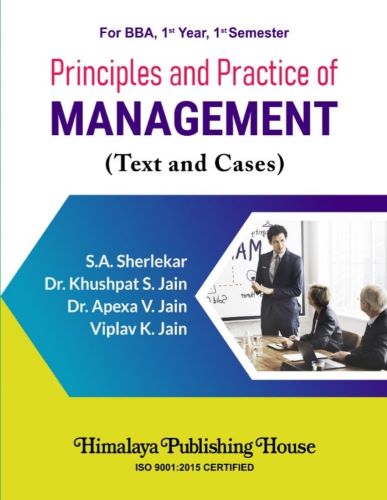
This book, Principles and Practices of Management, has been developed as a core resource for BBA Semester I students. It aims to introduce learners to the essential concepts, theories, and practices of management while also addressing emerging trends that are reshaping organisations worldwide.
The text begins with an overview of the nature, scope, and functions of management, emphasising its dual role as both an art and a science. It further traces the evolution of management thought, providing learners with a clear understanding of classical, human relations, behavioural, systems, and contingency approaches. The sections on planning and decision-making help students grasp how strategies are formulated and choices are made in real-world contexts.
Subsequent units explore the principles of organising, different organisational structures, and the vital concepts of authority, responsibility, delegation, and decentralisation. The chapters on staffing, directing, and controlling highlight the practical aspects of recruitment, selection, communication, supervision, and control mechanisms that ensure organisational efficiency.
A distinctive feature of this book is the inclusion of contemporary topics such as digital transformation, data-driven decision-making, remote and hybrid work models, ethics in management, and sustainability. These areas have become critical for managers in the 21st century, ensuring that students are not only grounded in traditional theories but also wellprepared to face modern challenges in business.
The book is structured in a simple, student-friendly manner, with clear explanations, examples from Indian and global organisations, and thought-provoking questions to encourage critical thinking. It aligns with the course objectives and outcomes prescribed for the BBA programme, enabling students to connect theoretical concepts with practical applications.
Contents –
Chapter 1. NATURE OF MANAGEMENT
1.1 Introduction
1.2 Concept of Management
1.3 Nature of Management
1.4 Significance of Management
1.5 Scope of Management
1.6 Management as an Art
1.7 Management as a Science
1.8 Management as an Art and a Science
1.9 Managers vs. Administrators
1.10 Managerial Roles
1.11 Managerial Skills
1.12 Functions of Management
Question Bank
Chapter 2. MANAGEMENT THOUGHTS AND FUNDAMENTALS OF PLANNING
2.1 Evolution of Management Thoughts
2.2 Classical Approach
2.3 Contribution of F.W. Taylor
2.4 Contribution of Henri Fayol
2.5 Taylorism vs. Fayolism.
2.6 Contribution of MaxWeber
2.7 Human Relations Approach
2.8 Contribution of Elton Mayo
2.9 Behavioural Approach
2.10 Contribution of Douglas McGregor
2.11 Systems Approach to Management
2.12 Contingency Approach to Management
Question Bank
Chapter 3. PLANNING AND DECISION-MAKING
3.1 Concept of Planning
3.2 Nature of Planning
3.3 Scope of Planning
3.4 Importance of Planning
3.5 Objectives of Planning
3.6 Planning Process
3.7 Components of a Plan
3.8 Types of Planning
3.9 Concept of Forecasting
3.10 Role of Forecasting in Planning
3.11 Concept of MBO
3.12 MBO Process
3.13 Advantages of MBO
3.14 Limitations of MBO
3.15 Concept of Decision-making
3.16 Decision-making Process
3.17 Techniques of Decision-making
3.18 Types of Decisions
3.19 Concept of Strategic Planning
3.20 Applications of Strategic Planning in Organisation
Question Bank
Chapter 4. ORGANISING
4.1 Concept of Organisation
4.2 Nature and Characteristics of Organisation
4.3 Principles of Organising
4.4 Organisation Structure
4.5 Formal Organisation
4.6 Informal Organisation
4.7 Formal Organisation vs. Informal Organisation
4.8 Concept of Line and Staff Organisation
4.9 Features of Line and Staff Organisation
4.10 Line and Staff Conflicts
4.11 Remedies for Line and Staff Conflicts
4.12 Line Organisation vs. Staff Organisation
4.13 Concept of Matrix Organisation
4.14 Features of Matrix Organisation
4.15 Advantages of Matrix Organisation
4.16 Disadvantages of Matrix Organisation
4.17 Concept of Departmentation
4.18 Bases of Departmentation
4.19 Significance of Departmentation
4.20 Concept of Authority and Responsibility
4.21 Concept of Span of Control
4.22 Determining Span of Control
4.23 Factors Affecting Span of Control
4.24 Concept of Decentralisation
4.25 Advantages of Decentralisation
4.26 Factors Determining the Degree of Decentralisation
4.27 Concept of Delegation of Authority
4.28 Importance of Delegation of Authority
4.29 Barriers to Effective Delegation
4.30 Principles of Effective Delegation
4.31 Delegation of Authority vs. Decentralisation
Question Bank
Chapter 5. STAFFING, DIRECTING AND CONTROLLING
5.1 Concept of Staffing
5.2 Scope of Staffing
5.3 Concept of Recruitment
5.4 Sources of Recruitment
5.5 Concept of Selection
5.6 Selection Process
5.7 Concept of Induction and Orientation
5.8 Scope of Induction and Orientation
5.9 Concept of Directing
5.10 Elements of Directing
5.11 Importance of Directing
5.12 Concept of Co-ordination
5.13 Coordination as an Essence of Management
5.14 Concept of Communication
5.15 Process of Communication
5.16 Channels of Communication
5.17 Formal Communication vs. Informal Communication
5.18 Barriers to Communication
5.19 Measures to Make Communication Effective
5.20 Concept of Controlling
5.21 Types of Controls
5.22 Control Process
5.23 Principles of a Good Control System
5.24 Control Techniques
5.25 Challenges in Controlling
5.26 Relationship between Planning and Control
Question Bank
CASE STUDIES