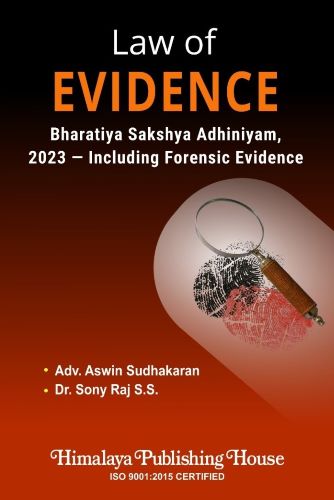


The Bharatiya Sakshya Adhiniyam, 2023 marks a significant milestone in India’s legal framework, replacing the Indian Evidence Act of 1872. This new legislation modernises the rules of evidence, aligning them with contemporary judicial needs and technological advancements. With the rapid evolution of digital transactions, electronic records, and forensic methodologies, the legal system requires a more robust and adaptive approach to evidence law. This book delves into the key provisions of the Bharatiya Sakshya Adhiniyam, 2023, explaining its impact on legal proceedings and evidentiary standards in India.
A crucial aspect of this transformation is the growing reliance on forensic science in legal investigations. The integration of forensic techniques such as DNA analysis, fingerprint examination, cyber forensics, and digital evidence authentication has become indispensable in ensuring the accuracy and reliability of evidence. This book explores the role of forensic science within the framework of the new evidence law, highlighting how scientific advancements contribute to fair and effective justice delivery. By examining landmark cases and legal interpretations, it provides a comprehensive understanding of how forensic evidence is evaluated under the new statute.
Contents –
1 General Introduction and Relevancy of Facts Sections 1 to 50 and Relevant Definition under Information Technology (Amendment) Act 2008 and Bharatiya Sakshya Adhiniyam, 2023
1.1 Introduction and Applicability of Bharatiya Sakshya Adhiniyam, 2023
1.2 Important Terminologies under Bharatiya Sakshya Adhiniyam, 2023
1.3 Doctrine of Res Gestae
1.4 Motive, Preparation and Conduct (Section 6)
1.5 Conspiracy when Relevant
1.6 When Facts not Otherwise Relevant become Relevant
1.7 State of Mind and Body (Section 12)
1.8 Admissions and Confessions
1.9 Statements by Persons Who Cannot be Called as Witness (Sections 26 and 27)
1.10 Judgements of Courts When Relevant
1.11 Relevancy of Opinion of Third Party
1.12 Character, When Relevant (Sections 46–50)
1.13 Definitions under the Information Technology (Amendment) Act, 2008 – Section 2
2 Proofs and Burden of Proof (Sections 51 – 123)
2.1 Facts which Need not be Proved
2.2 Oral and Documentary Evidence
2.3 Proof of Electronic Evidence
2.4 Public and Private Documents
2.5 Law Relating to Presumptions (Sections 78 to 93)
2.6 Exclusion of Oral Evidence by Documentary Evidence (Sections 94 to 103)
2.7 Rules Relating to Burden of Proof (Sections 104 to 120)
2.8 Doctrine of Estoppel (Sections 121 to 123)
3 Witnesses (Sections 124 – 169)
3.1 Who May Testify (Section 124)
3.2 Procedure for Examination of Witnesses (Chapter X, Sections 140 to 169)
3.3 Questions to be Put up to the Witnesses
3.4 Credibility of Witnesses
3.5 Judge’s Power to Put Questions or Order Production (Section 168)
3.6 Improper Admission or Rejection of Evidence
4 Forensic Evidence – Use and Applicability of Forensic Evidence in the Courts
4.1 Introduction and Branches of Forensic Science
4.2 Forensic Evidence and Types of Forensic Evidence in Civil and Criminal Cases
4.3 Application of Forensic Evidence in Civil and Criminal Cases
4.4 Relevance and use of Forensic Evidence under Bharatiya Sakshya Adhiniyam, 2023
4.5 Expert Witness and Admissibility of Expert’s Opinion in the Courts