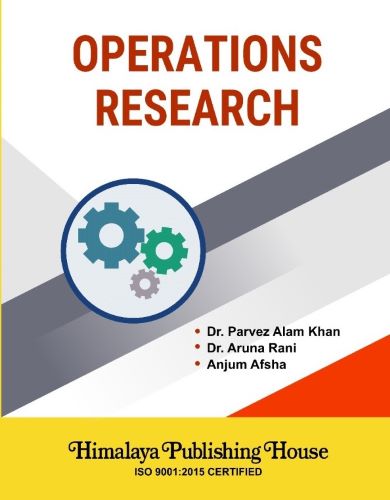


We have great pleasure in presenting First edition “Operations Research” written for students of PG courses. The related matters are written in a simple and easily understandable.
This volume is an attempt to provide the students with thorough understanding of Operations Research. We have presented the subject matter in a systematic manner with liberal use of charts and diagrams where ever necessary so as to make it interesting and sustain students’ interest.
Contents –
Module – 1 Introduction to Operation Research
Introduction
History of Operations Research
Stages of Development of Operations Research
OR Tools and Techniques
Applications of Operations Research
Limitations of Operations Research
Linear Programming
Assumption of Linear Programming
Advantages of Linear Programming
Limitations of Linear Programming
General Mathematical Model
Linear Programming Problem Formulation
Graphical Method Solution
Multiple Optimal Solutions
Unbounded Solution
Infeasible Solution
Simplex Method
Duality
Review Questions
Fill in the Blanks
Multiple Choice Questions (MCQs)
Short Answer Questions
Long Answer Questions
Practical Problems
Module – 2 Transportation and Assignment Problems
Introduction
Transportation Problems
Formulation of Transportation Problem
Types of Transportation Problems
Initial basic Feasible Solution using North-West
Corner Rule (NWCR)
Least Cost Method (LCM)
Vogel’s Approximation Method (VAM)
Optimality in Transportation Problem by Modified
Distribution (MODI) Method
Assignment Problems
Formulation
Solutions to Assignment Problems by Hungarian Method
Special Cases in Assignment Problems
Unbalanced
Maximization Assignment Problems
Review Questions
Fill in the Blanks
Multiple Choice Questions (MCQs)
Short Answer Questions
Long Answer Questions
Practical Problems
Module – 3 Network Analysis 107 – 150
Introduction to Networks
Rules for Drawing Network Diagram
CPM Computations
Finding Critical Path
PERT Computations
Computation of Earliest and Latest Allowable Times
Probability of Meeting the Scheduled Dates
Difference between PERT and CPM
Concept of Project Crashing
Decision Tree Analysis
Review Questions
Fill in the Blanks
Multiple Choice Questions (MCQs)
Short Answer Questions
Long Answer Questions
Practical Problems
Module – 4 Sequencing and Replacement Models
Introduction
Sequencing
Principal Assumptions
Job Sequencing
‘n’ jobs on 2 Machines
‘n’ Jobs on 3 Machines
‘n’ Jobs on ‘m’ Machines
Sequencing of 2 Jobs on ‘m’ Machines
Replacement Analysis
Replacement of Items that Deteriorate with Time
when Money Value is not Counted and Counted
Replacement of items that fail Completely
Group Replacement
Theory of Games
Formulation of Game Models
Two Person Zero Sum Games & their Solution
2 x N and M x 2 Games
Pure Strategy Games with Saddle Point
Mixed Strategies (Graphical and Algebraic Methods)
Limitations of Game Theory
Review Questions
Fill in the Blanks
Multiple Choice Questions (MCQs)
Short Answer Questions
Long Answer Questions
Practical Problems
Module – 5 Simulation
Introduction
Simulation
Definition of Simulation
Types of Simulation Models
Phases of Simulation
Applications of Simulation
Advantages of Simulation
Disadvantages of Simulation
Queuing Models
Characteristics of Queuing Models
Models for Arrival
Service Times
Single Poisson Arrival with Exponential Service Rate
Applications of Queuing Models
Review Questions
Fill in the Blanks
Multiple Choice Questions (MCQs)
Short Answer Questions
Long Answer Questions
Practical Problems